
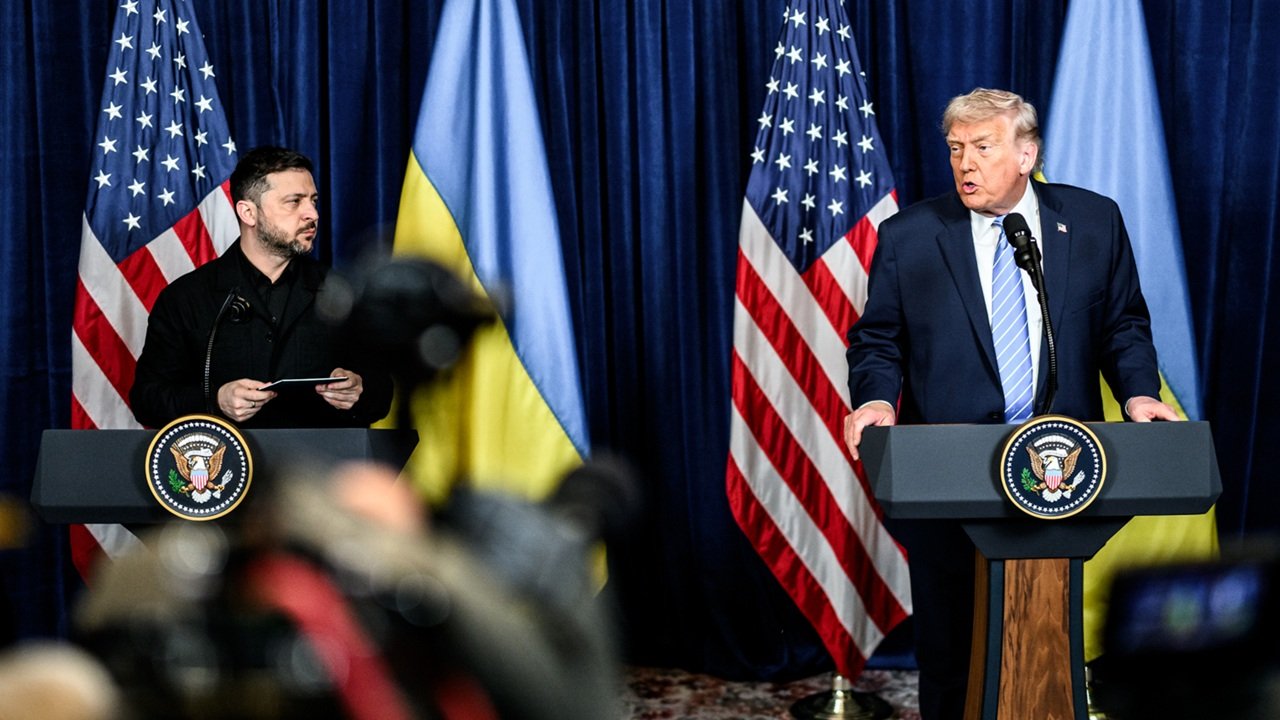
While facing a brutal war against Russia for more than four years, Ukraine is helping the United States, Israel and Western-allied Arab countries in the conflict with Iran, which last weekend completed three weeks.
Kiev has shared its expertise in intercepting Russian drones to help forces from allied countries neutralize the feared Iranian Shahed.
Last week, Rustem Umerov, chairman of the National Security and Defense Council of Ukraine, said on his Telegram channel that military experts from Kiev are working in the United Arab Emirates, Saudi Arabia, Qatar, Kuwait and Jordan.
According to him, Ukraine has deployed interception units in the region to help protect civilian and strategic infrastructure and is expanding this network.
In a post on X, Ukrainian President Volodymyr Zelensky added that, in addition to helping to build a defense system, Kiev is providing expert assessments in the area.
The president stated that, in addition to the Arab countries already served, Ukraine has also received requests from the US for “specialized support” in two areas of the Middle East and is analyzing requests from European partners who have forces based in the region.
“Ukraine is committed to the rapid and reliable stabilization of the situation in Iran, which is of global importance for oil and gas markets and therefore for price formation, particularly in Europe and Ukraine. We also take a principled position on the unacceptability of any success of the terrorist campaign of the Iranian regime – a long-time accomplice of Russia,” Zelensky wrote in X.
In an interview with the BBC, the Ukrainian president gave more details about his government’s concerns, highlighting that for Russian dictator Vladimir Putin, “a long war in Iran is an advantage”, because, in addition to raising energy prices (oil and gas are Russia’s main export products, and the US has partially suspended sanctions on Russia in this area), the conflict could “deplete” American arms reserves – compromising sales and transfers to allies such as Ukraine.
“The United States produces 60 to 65 missiles per month. Imagine, 65 missiles per month is equivalent to about 700 to 800 missiles produced annually. And on the first day of the war in the Middle East alone, 803 missiles were used,” said Zelensky, who projected that there will “definitely” be a shortage of Patriot missiles in the near future.
In an interview with the report, retired colonel and military analyst Paulo Roberto da Silva Gomes Filho, columnist for People’s Gazetteagreed with Zelensky’s assessment that Russia, as a major exporter of oil and natural gas, benefits from the conflict in Iran, given that, if the war prolongs, its gains will be greater “to finance its war economy”.
“Secondly, the longer the war drags on, the more it will require the use of anti-aircraft missiles and drones, which will no longer be available for sale to Ukraine. Furthermore, the attention of global public opinion, focused on Iran, reduces the pressure on governments, especially European ones, to support Ukraine,” said Gomes Filho.
Ukraine wants to show that it is not just an “emergency case”, says analyst
According to Frederico Dias, professor of international relations at Ibmec Brasília, by helping with agendas that interest the USA outside the immediate theater of the war in Ukraine, “Kiev reinforces the perception that it is a long-term strategic partner, and not just an emergency case.”
“In its wartime diplomacy, by offering operational know-how, Kiev increases its value as a partner: it is not just a ‘recipient of assistance’ but a producer of relevant military knowledge in an emerging field — drone war”, stated Dias.
For Eduardo Galvão, professor of public policy at Ibmec Brasília, by inserting himself into Washington’s priority agenda, Zelensky also “tries to guarantee continuity in the flow of military support and influence negotiation conditions [intermediada pelos EUA] with Russia”, conversations currently taking place.
This is a strategy that guarantees points for Ukraine at a time when American President Donald Trump is complaining about the lack of help from NATO allies in the Middle East, but this tactic has its limits, warned the analyst.
“So far, there are no signs that this will be enough to substantially change the American stance in the negotiations, which continue to be guided by broader calculations of cost, time and interest,” stated Galvão.
