
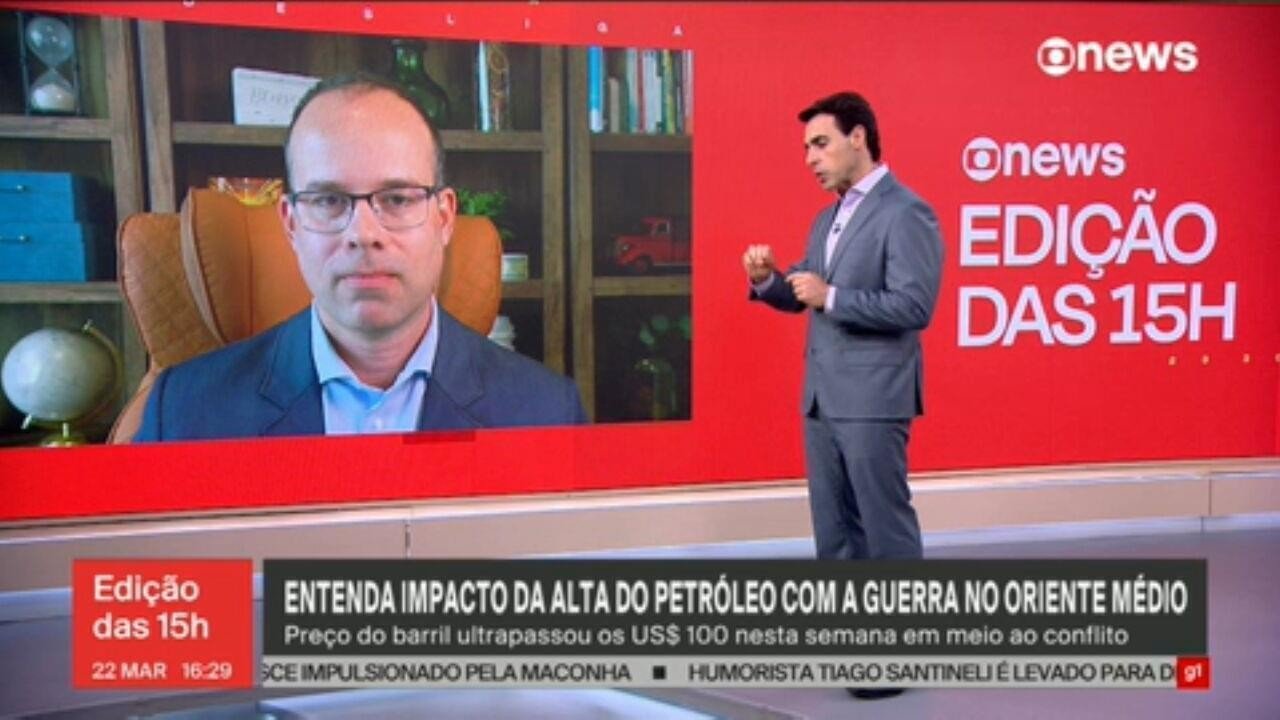
Understand the impact of the rise in oil prices with the war in the Middle East The sharp increase in oil prices, amid the war between the United States and Israel against Iran, raised the alarm of governments around the world about a possible global rise in inflation. Oil is the raw material for fuels — such as gasoline, diesel, aviation kerosene and cooking gas — and for various inputs, such as plastics, rubber, fertilizers and medicines. This generates a chain effect, putting pressure on production costs and logistics in industry and agribusiness. In addition to transport, agriculture also suffers from the cost of operating agricultural machinery and the increase in the cost of chemical fertilizers. The production of electrical energy also tends to be impacted, especially in thermoelectric plants — which generate energy from fuels and are usually activated during periods of drought, when hydroelectric plant reservoirs are lower. ➡️ In Brazil, President Lula announced the exemption from federal taxes and financial aid (the so-called subsidy) for diesel producers and importers, in an attempt to contain the impact of oil prices on consumers. See below how different countries reacted to the price increase: India According to the Reuters news agency, an Indian government official reported that the country should review its fuel exports if necessary. The objective would be to guarantee availability in global markets. According to the Ministry of Foreign Affairs, India evaluates fuel supply requests from its neighbors and will only approve exports if it has surplus volumes. Furthermore, the country also prohibited consumers of piped natural gas from keeping, obtaining or refilling domestic cylinders of liquefied petroleum gas. The government also invoked emergency powers to order refineries to maximize LPG production and reduce sales of the product to industry, in order to avoid shortages for the 333 million homes that use LPG for cooking. South Korea South Korea has relaxed limits on coal-fired power generation capacity and increased the use of nuclear power plants to up to 80%. In addition, the South Korean government is also considering the possibility of distributing additional energy vouchers to support the most vulnerable families. China China banned exports of refined fuels to anticipate a possible fuel shortage in the domestic market, according to Reuters news agency. The country also began releasing fertilizer supplies from national commercial reserves ahead of spring planting. Australia Australia has moved to release gasoline and diesel from its domestic reserves to alleviate shortages affecting rural supply chains as well as mining and agriculture. Japan Japan asked Australia, its largest supplier of liquefied natural gas, to increase production to avoid a shortage of the product in the country. European Union European Union leaders have unveiled a series of temporary measures to mitigate the impact of rising energy prices. In addition to possible electricity tax cuts, the region has also proposed lower grid fees and state support as possible short-term solutions. Bangladesh Bangladesh said it is seeking billions in external financing to secure imports of fuel and liquefied natural gas needed by the country. Serbia Serbia announced that it will reduce excise taxes on crude oil by a total of 60%. The country’s government also extended the export ban on crude oil and petroleum products to protect its market from shortages and sudden price increases. Italy Italian Prime Minister Giorgia Meloni has stated that Italy is considering reducing excise taxes to smooth fuel prices and is ready to increase taxes on companies responsible for profiting unduly from the energy crisis. Cambodia Cambodia is importing more fuel from suppliers in Singapore and Malaysia to make up for a lack of supplies from Vietnam and China. Malaysia Malaysia will increase spending on gasoline subsidies from 700 million ringgit (local currency, equivalent to US$178.5 million) to 2 billion ringgit (US$510 million). The objective is to maintain a fixed fuel price. Thailand Thailand has discussed with the Russian government the possibility of purchasing crude oil, the country’s deputy prime minister said, reiterating that the government would try to cap the price of diesel domestically at 33 baht ($1.02) per liter. Thailand’s Planning Agency also said the government will freeze prices of some products and provide support to farmers. Greece Greece will offer subsidies for fuel and fertilizers as well as discounts on ferry tickets totaling 300 million euros ($346 million) in April and May to protect consumers and farmers, Prime Minister Kyriakos Mitsotakis said. Slovenia Slovenia has temporarily limited fuel purchases to combat shortages at domestic gas stations, caused in part by cross-border fueling and excessive storage due to the war with Iran. Philippines The Philippines announced a plan to import Russian oil next week for the first time in five years, according to information from the Reuters news agency. The plan also calls for reducing electricity bills as LNG prices soar, encouraging coal-fired power generation and regulating electricity rates. Vietnam Vietnam will fully transition to ethanol-based gasoline ahead of schedule as part of its efforts to reduce the use of fossil fuels, according to a government document. Indonesia Indonesian President Prabowo Subianto has stated that he intends to increase the country’s coal production. Furthermore, he indicated that the government is considering implementing a tax on extraordinary profits in exports. Ethiopia Ethiopia has increased fuel subsidies. North Macedonia The government of North Macedonia has decided to reduce the Value Added Tax (VAT) on fuels to contain rising prices at gas stations. According to Prime Minister Hristijan Mickoski, the tax will be reduced from 18% to 10%. The measure came into force this Monday (23) and will last for two weeks. Sri Lanka Sri Lanka has said it will bring in additional fuel rationing measures to reduce queues and ensure extra oil supplies, a senior official told Reuters. Oil crisis: understand why Iran’s offensive at sea threatens the global market Reproduction/TV Globo *With information from the Reuters news agency.
Source link
War in Iran: how countries try to contain the impact of the energy crisis on families
41

previous post