
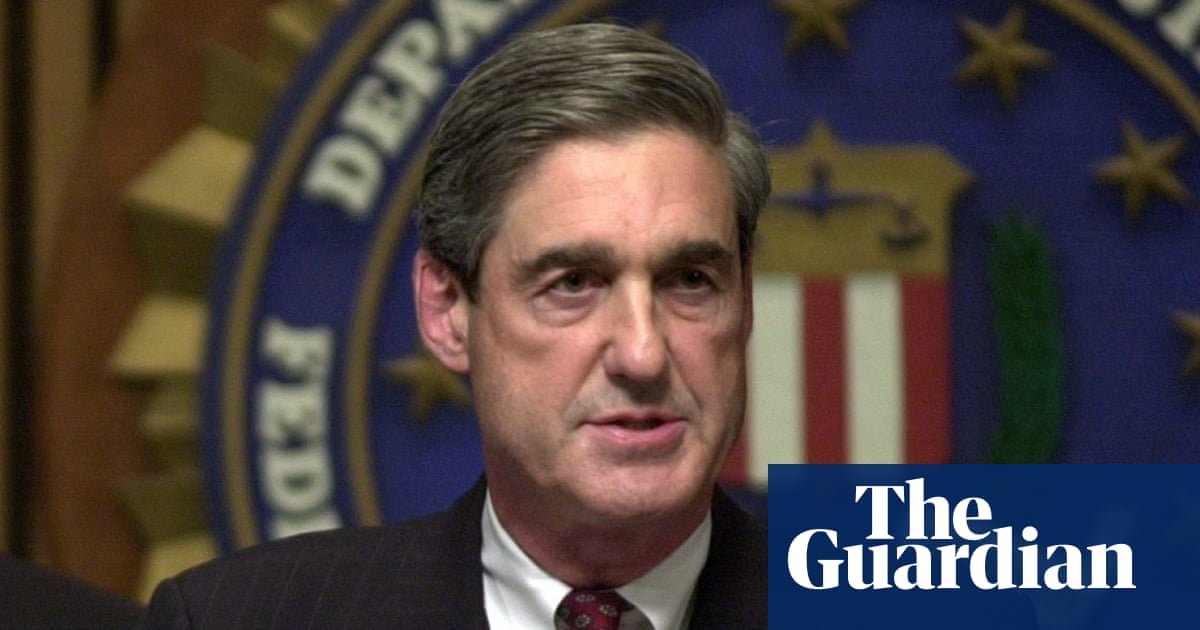
Robert Mueller, who has died aged 81, led an investigation, as US special counsel, into Russian interference in the 2016 White House election and alleged collusion with Donald Trump’s campaign team. Trump was enraged by the two-year-long investigation, which dominated much of his first term as president. He repeatedly dismissed it as a “witch-hunt”.
Mueller’s report, published in 2019, was inconclusive. He found links between Russians and those around Trump, and that his bid for the presidency had benefited from Russian leaks that undermined the Democratic campaign. But he failed to establish collusion on the part of the Trump campaign.
He cited 10 episodes in which Trump and his aides may have been obstructive to his investigation. This could have led to impeachment, but Mueller delivered what was basically a not-proven verdict. In the most controversial and damning passage of the report, he wrote: “While this report does not conclude that the President committed a crime, it also does not exonerate him.”
Mueller built a reputation for integrity as director of the Federal Bureau of Investigation from 2001 to 2013. He stood up to the then president George W Bush and vice-president Dick Cheney when, in the wake of the 9/11 attacks on New York and Washington, they condoned increased surveillance of US citizens as well as the use of torture against suspected terrorists.
Before taking over at the FBI, he had worked in senior roles in the prosecution of the Panama dictator Manuel Noriega and the mafia boss John Gotti.
He led the US side of the investigation into the bombing of the Pan Am flight that blew up over Lockerbie
in 1988.
The investigation into Russia and the Trump campaign was to prove the most politically explosive of his career. He had been retired from the FBI for four years, succeeded by James Comey. While investigating the alleged links with Russia, Comey was sacked by Trump. Mueller was appointed in 2017 by the attorney general’s office to conduct an investigation into the alleged collusion. For the next two years, his inquiry dominated Washington politics.
The report found Russia had intervened in a “sweeping and systemic fashion”. But it “did not establish that members of the Trump campaign conspired or coordinated with the Russian government in its election interference activities”.
The attorney general, William Barr, did not initially release the whole report but only selected highlights. His watered-down version allowed Trump to claim, erroneously, that he had been totally exonerated. Mueller was frustrated that Barr had left out critical aspects of the investigations and created public confusion about the findings.
The investigation did lead to indictments against Russian spies, Russian hackers and former Trump advisers. Among them were the former campaign manager Paul Manafort, who was jailed for fraud, and the former Trump national security adviser Michael Flynn, who pleaded guilty in 2017 to lying about a conversation with a Russian ambassador to the US. Both were pardoned by Trump in 2020.
Mueller, a Republican, had been appointed by Bush to head the FBI in 2001. When he reached the end of a 10-year statutory limit, Bush’s successor, Barack Obama, impressed by Mueller’s record, extended his tenure for a further two years.
He had only been at the FBI for seven days when al-Qaida flew planes into targets in New York and Washington. Bush and Cheney condoned the use of what the administration referred euphemistically to “enhanced interrogation techniques” such as waterboarding and other forms of torture against suspected terrorists. Mueller distanced the FBI from this. While the CIA tortured suspects, Mueller barred his agency from participating. He said he did not believe in coercion and ordered FBI agents to leave the room if they saw suspects being tortured.
In another panicked response to 9/11, the Bush administration agreed to an expansion of domestic surveillance in breach of the constitution. When warrantless wire-taps came up for renewal in 2004, Mueller threatened to resign and Bush and Cheney were forced to back down.
But when the National Security Agency whistleblower Edward Snowden
revealed in 2013 mass surveillance of US citizens, Mueller, giving evidence to a congressional hearing, defended the NSA on the grounds that such surveillance could have stopped the 9/11 attacks.
Over the course of his time as director, he oversaw a major internal shake-up and modernisation of the bureau in direct response to 9/11. He recruited agents with an array of language and computer skills. One of the biggest changes was increased cooperation and coordination with other agencies, especially in sharing information; one of the criticisms of US intelligence in the run-up to the events of 2001 had been the way the various agencies were compartmentalised, each holding on to information. His 12 years in the post made him the longest serving director since the first incumbent, J Edgar Hoover.
He was born in New York City to Robert Swan Mueller, an executive with the DuPont chemical company, and Alice (nee Truesdale). He went to school in Princeton, New Jersey, and then boarded at St Paul’s, in New Hampshire, before going to study at Princeton University, where he graduated with a BA in politics in 1966, and then at New York University, earning an MA in international relations.
He joined the US marines and was posted as a second lieutenant to Vietnam, where he was awarded a Bronze Star for valour after rescuing a wounded comrade under fire and a Purple Heart after being shot in the thigh. He left the marines in 1970 with the rank of captain.
Enrolling in law at the University of Virginia, and graduating in 1973, he worked as a litigator in a law firm for a few years and then went on to take a series of roles in US attorney offices in California and Washington DC, rising to become acting US deputy attorney general.
He was involved in prominent cases such as prosecuting Gotti, the head of the Gambino family, one of the biggest crime syndicates in the US. Gotti, known as the Teflon Don and the Dapper Don, was convicted in 1992 of murder and racketeering.
Other high-profile cases included the prosecution of Noriega, who had been an ally of the US against leftwing groups in Central America and was jailed for drug trafficking, racketeering and money laundering.
The Lockerbie case was one of the most complicated because it involved coordination not just with the CIA and the British intelligence services but also the Scottish police, as Lockerbie fell under its jurisdiction. A Libyan, Abdelbaset al-Megrahi, was charged in 1991 and the case was held in a Scottish court built especially for the trial at a former US air force base in the Netherlands. Megrahi was found guilty and jailed.
Mueller married Ann Standish in 1966. She survives him as do their two children, Melissa and Cynthia.
