
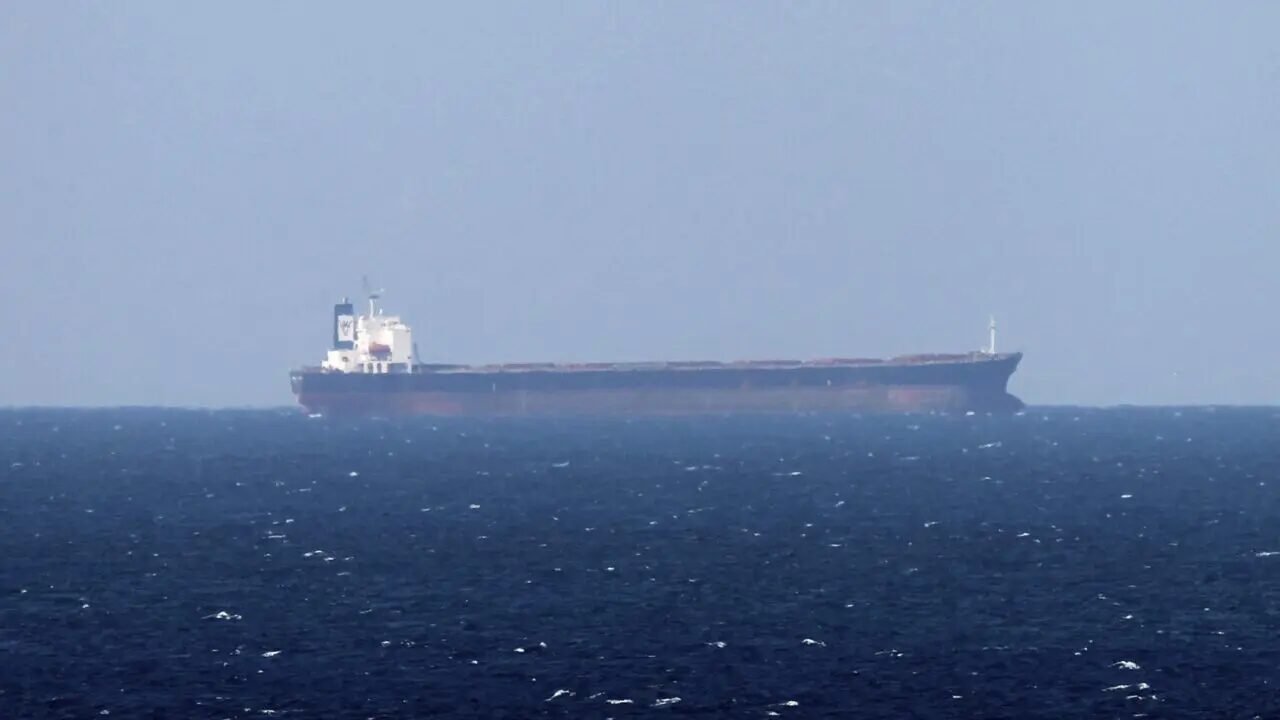
The United States announced this Saturday (21) that Iran’s ability to “threaten freedom of navigation” in the Strait of Hormuz was weakened after attacks carried out by the American Armed Forces this week against an underground arsenal off the coast of the Islamic republic. Since the start of the war three weeks ago, attempts by the Iranian Revolutionary Guard to prevent the passage of ships whose cargo could benefit the US and Israel have drastically reduced freighter traffic through the area, sending prices for a barrel of Brent oil soaring above US$105.
The Iranian facility hit by the US was used to store anti-ship cruise missiles and other materials, as explained in a video published on social media by Admiral Brad Cooper, from the American Central Command (Centcom).
The attack, which occurred earlier this week, used “several 5,000-pound bombs” (approximately 2,300 kg), according to Cooper, identified by authorities as the GBU-72 Advanced 5K Penetrator model, designed to destroy bunkers and fortified structures.
“The Iranian regime used this reinforced underground facility to discreetly store anti-ship cruise missiles, mobile launchers and other equipment that posed a serious risk to international navigation,” the military official said.
Cooper assured that, in addition to this underground silo, the American operation neutralized “intelligence support facilities and missile radar repeaters, used to monitor the movement of vessels. As a result, Iran’s ability to threaten freedom of navigation in and around the Strait of Hormuz was reduced,” he analyzed.
US calls for support in Strait of Hormuz
The Strait of Hormuz is the only maritime passage between the Persian Gulf and the Indian Ocean, through which 20% of global oil exports transit.
US President Donald Trump has urged NATO partners and Asian allies such as South Korea and Japan – which depend heavily on the region’s oil – to provide military support in the strait, but so far no country has committed to sending assets to the zone.
Cooper said that since the start of Operation “Epic Fury” against Iran on February 28, the US has struck more than 8,000 military targets, including 130 Iranian vessels. “This constitutes the largest elimination of a Navy during a three-week period since World War II,” he noted.
“Their navy is not sailing, their tactical fighters are not flying and they have lost the ability to launch missiles and drones at the high rate seen at the beginning of the conflict,” added the military officer, reiterating that the US has complete air superiority over Iran.
Israel attacks missile development facilities in Tehran
The Israeli Army carried out another wave of bombings against ballistic missile development facilities in Tehran in the early hours of Friday (20) and Saturday, according to a statement from the Israeli Armed Forces.
Among the “dozens” of targets hit is a Revolutionary Guard complex “used for the production and development of components”, a missile production unit, an Iranian Ministry of Defense complex in charge of producing fuel for the projectiles and another site for manufacturing parts.
“During the night, the Israeli Air Force, acting on accurate intelligence from the Israel Defense Forces (IDF), completed a large-scale air raid on Tehran,” the statement said.
The armed forces explained that the attacks are part of the “current phase of the operation”, which seeks to expand the damage to the “central and fundamental systems” of the ayatollahs’ regime.
This Saturday morning, Israeli Defense Minister Israel Katz stated that Israel and the United States intend to “considerably” increase the intensity of their attacks against the Islamic republic next week. The statement comes after Trump said on social media that he was considering reducing his military presence in the Middle East in light of progress in achieving his war objectives.
