
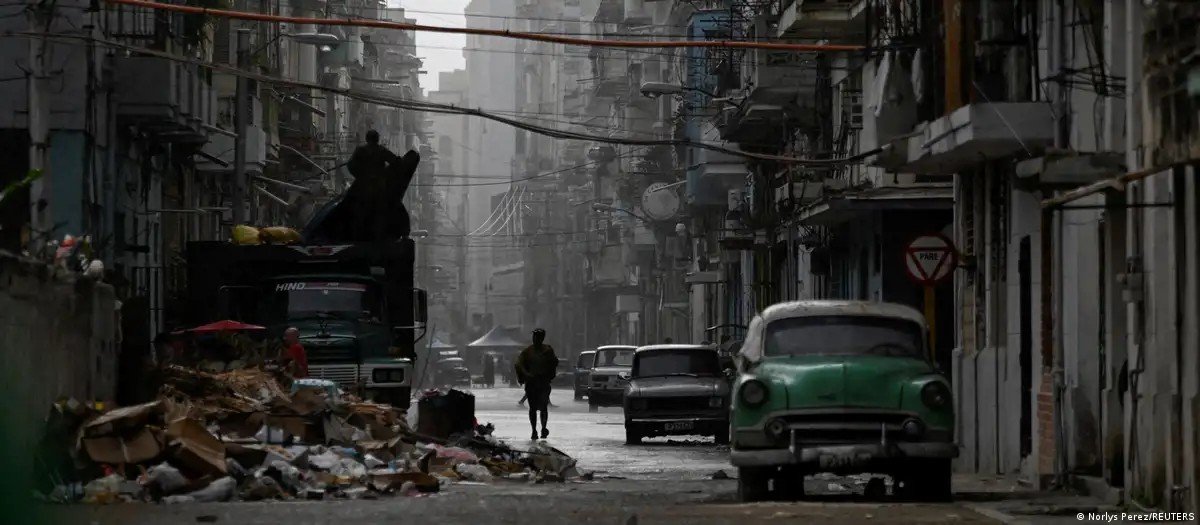
Cuba has suffered several blackouts in recent years Norlys Perez/REUTERS In the last two years, Cuba has suffered four blackouts in all regions of the country. Since February 2024, ten widespread blackouts have shaken the economy and the population’s spirits. As pressure from the oil blockade imposed by the United States increases, the Cuban government was forced to begin negotiations with Washington. 📱Download the g1 app to see news in real time and for free Donald Trump reiterated earlier this week his threats to take control of the island and said he could do “anything” he wanted with the Caribbean country – which increased speculation that the main Cuban leaders could face the same fate as former Venezuelan leader, Nicolás Maduro. Maduro’s arrest in January not only showed Cubans how far Trump was willing to go, but also left the regime without one of its main allies and oil suppliers. Thorny relations between the US and Cuba Located about 150 kilometers from the southern US state of Florida, Cuba has been a thorn in the side of Americans since the 1959 revolution led by Fidel Castro. The communist regime consistently imposed itself on the United States, which used to exert strong influence on the island and, during the Cold War, considered Cuba an entry point for other communist states, such as the Soviet Union and China. Many Cuban exiles in the US wait for the fall of the regime in Cuba so they can return to the country Carl Juste/Miami Herald/ZUMA/picture alliance Former US president, Barack Obama, even sought rapprochement and tried to revive relations with Havana, however, efforts were reversed by Trump during his first term (from 2017 to 2021). US Secretary of State Marco Rubio is one of the most prominent Americans of Cuban descent. The Cuban diaspora, in turn, constitutes an important voting bloc — especially in Florida, a key state in the elections. Klemens Fischer, a foreign policy expert at the University of Cologne, Germany, told German broadcaster ZDF that the current escalation of Trump’s rhetoric toward Cuba is likely motivated by domestic political issues. “It could be an attempt to extricate himself, given that things are not going as he would like in Iran,” he said. “He needs to show that he is a strong president. On the other hand, he also needs to avoid getting involved in another war.” Trump, however, had already intensified pressure on Cuba. In January, the US president asked the new Venezuelan leader, Delcy Rodríguez, to completely stop sending oil to the Caribbean island. The US has also blocked shipping routes to the island and threatened countries that supply oil to Cuba with sanctions. According to the Cuban government, the country has not received oil shipments for three months. At the same time, domestic production — falling for years — covered less than 30% of demand in 2024, worsening blackouts, as the main source of local energy is still oil-fired thermoelectric plants. Worst economic crisis in three decades Energy shortages are just one – albeit significant – aspect of the current economic crisis, Cuban economist Elias Amor, who lives in Spain, told DW. He said that, in addition to a brief period of recovery, the Cuban economy has shrunk by an average of 2.75% per year since the start of the Covid-19 pandemic in 2020, and in 2025 this contraction increased to 5%. “The Cuban economy is in its worst state since the ‘Special Period,'” he noted. The Special Period is the term given by the Cuban regime to the deep recession that hit the country after the collapse of the Soviet Union in the early 1990s, when real wages fell by 90% in four years. Fidel Castro’s government introduced temporary reforms, including the gradual opening of the tourism sector, which resulted in a partial recovery. But it was only when Hugo Chávez came to power in Venezuela and the country assumed the role of Cuba’s sponsor, replacing the Soviet Union, that the economy really began to recover substantially. The economist assesses that the gradual opening of the Cuban economy in recent decades helped to avoid a crisis similar to that of the early 1990s. Even so, he projects that the reforms implemented by Raúl Castro and his successor, Miguel Díaz-Canel, did not have a major impact. “Not even tourism will be able to stop this crisis, as the driving forces of the economy have completely stopped,” he said. Rubio: Cuban system needs to ‘drastically change’ Apparently, it was Cuba’s enormous internal and external pressure that forced the regime to the negotiating table. Last week, the Cuban president confirmed that the talks would take place, as Trump had announced in early March. Earlier this week, Deputy Prime Minister Oscar Pérez-Oliva, the Castro brothers’ great-nephew, stated that Cuba was open to allowing trade with American companies and allowing Cuban-Americans to invest in Cuban companies. Secretary of State Marco Rubio is one of the most prominent Cuban descendants in the US Jonathan Ernst/AFP Rubio, however, said the regime’s efforts were not “drastic enough”. He stated that the political and governmental system could not be fixed and added that the economy was not working, adding that “they need to change drastically”. Despite the serious economic situation, Maria José Espinosa, director of the Washington-based Center for Engagement and Activism in the Americas (Ceda), doubts that the Cuban regime is on the verge of collapse. “The state apparatus – the communist party, the security forces and the military-economic system – remains relatively cohesive,” he said. Only the Castros can bring real change. However, cracks are beginning to appear. For many, Miguel Díaz-Canel is seen as a member of the party who lost influence and became, in practice, replaceable. According to Ted Henken, professor at the City University of New York (Cuny), only the military – and the Castros – would really be capable of introducing fundamental changes in the country. “It is the Castro family that controls and directs negotiations with the United States,” the expert told DW. In addition to Deputy Prime Minister Pérez-Oliva, whose star is rising, Raúl Castro’s grandson Raúl Guillermo, known as El Cangrejo (“The Crab”), is also becoming increasingly important. “Everything points to the fact that they will represent the interests of the Castro family and, in one way or another, will end up leading the government,” Henken said. He also said he doubts that the new generation will be able to promote structural reforms that would take several years to be implemented.
Source link
Trump’s measures and blackouts force Cuba to negotiate with the United States
21

previous post