
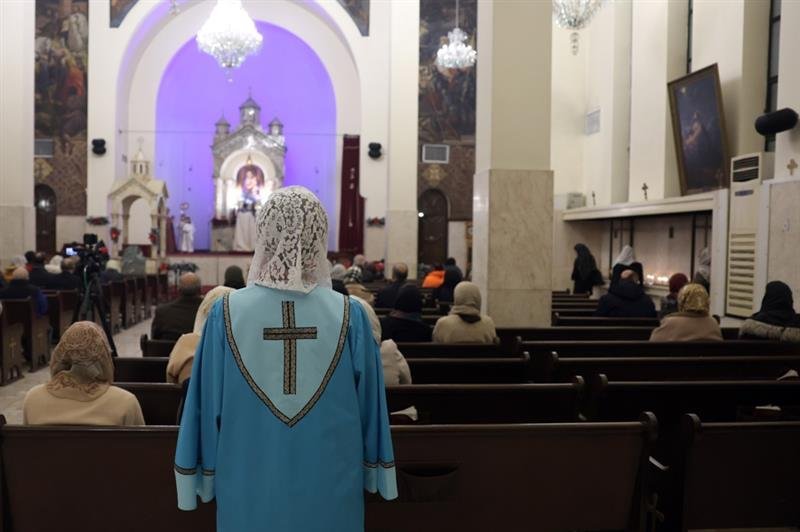
Iran is one of the many countries in the world where publicly declaring oneself a Christian is still a reason for torture, imprisonment and even death. Although Christianity is legally recognized as a minority religion, its practice is a constant target of surveillance by the Islamic regime and, among Muslims, conversion can be punished by murder.
Bahar Rad, a Christian of Iranian origin whose name was changed for security reasons, told People’s Gazette the reality he has experienced since he began his journey of faith and had to leave the country with his family due to persecution.
She says that her experience with Christianity began to develop as a teenager, when her father converted through a Christian program in Persian that was shown on satellite television. “From that moment on, our lives slowly started to change,” he said.
The Iranian, who is now one of the spokespeople for NGO Open Doorswhose objective is to support Christians in persecuted countries, highlighted that the first challenges in relation to faith did not come from the regime itself, but from Muslim family members, according to her “very devout”, who were strongly opposed to Christianity.
She details that they began calling her father, and eventually all the other family members, in an attempt to humiliate them and convince them that they had “betrayed” the culture and faith of their blood relatives. “There was mockery, pressure and many attempts to force us to return to Islam. These things were painful, but somehow we managed to bear them,” he said.
In the statement, Bahar Rad said that her father then connected to a house church – secret places used by Christians to gather for worship, which she rarely visited due to the risks to the family.
“At that time, my siblings and I were still very young, so my father felt it was too risky for us to attend regularly. I only went a few times, but I still remember those moments clearly: the soft whisper of worship songs, the beauty of praying together, and at the same time, the fear that something might happen if we were discovered,” he describes the experience.
After this first contact, the hardest impact came for her and her family: her father’s arrest for religious reasons. When she was still a teenager, she saw him taken to prison for 13 months after being reported by an informant about his missionary work.
He began traveling to different cities to teach the Bible and help found house churches in Iran. In one such instance, someone pretending to be interested in Christianity joined the meetings at the behest of the regime and secretly recorded him teaching about the faith. After that, authorities built a case against him and took him into custody.
Rad reports that this experience deeply affected her, her mother and brothers, who began to suffer constant pressure to abandon Christianity.
“He [o pai] He was transferred between different interrogation rooms and cells, faced intense psychological pressure and physical abuse. During that year, my mother, my brothers and I lived in constant fear. We didn’t know what would happen to him or us. Our relatives insisted that my mother think about our future, our education, our jobs and encouraged her to divorce my father for the sake of her children.”
According to her, on the day of her father’s release, authorities told him that if he continued his religious activities, the next punishment would be execution.
Threats and constant surveillance led the family to leave Iran
With his father’s release, Bahar Rad says that the family began to be constantly monitored. “Sometimes when we went to a park or shopping mall, we would get a call shortly after we got home from an unknown number saying exactly where we had been. It was clear we were being monitored.”
This routine pressure forced them into isolation and abandoning contacts with domestic churches to the point that they decided to flee to a neighboring country thirteen years ago. Since then, they have lived as refugees.
According to her, the main challenges of exile are missing the city where she was born, family, friends, culture and starting life again in an unknown place as a refugee, which proves to be an obstacle due to limited rights, lack of access to stable work, education and medical care, in addition to the constant fear of being sent back to Iran.
The interviewee also denounced that leaving the country alone does not end the persecution. The regime often uses its resources and external contacts to monitor Iranian Christians abroad.
Iranian Christian believes regime change can bring religious freedom to the country
For Rad and many other Christians still living in Iran, political change could pave the way for religious freedom.
“For more than four decades, many Christians in Iran have lived without recognition or protection under the law,” he says. “As a Christian and an Iranian, I have hope for a future where the country experiences true freedom, justice and dignity for all its people, including religious minorities and especially converts to Christianity who have faced decades of oppression.”
According to Rad, despite the war, economic difficulties, internet cuts and the trauma that people are experiencing, many Iranians remain hopeful for a better future. “An encouraging sign is that many people still want to stay in the country rather than leave, which shows that hope for change is still alive.”
Iran occupies 10th position on the World Persecution List (LMP) of the NGO Open Doors, which brings together the main countries where professing faith is still a reason for severe punishment. In the survey’s classification, the level of persecution is considered extreme and Christians can suffer state surveillance, threats, arrests and even death.
