
“Pigs get fat, hogs get slaughtered. And they’re getting hoggy.” When Mark Cuban, then owner of the NBA’s Dallas Mavericks, fired that line at the NFL in 2014, he was partly goading and partly gloating.
It felt directionally true. The NFL looked bloated, arrogant and vulnerable. Decades-long skeletons were tumbling out of the closet. Crisis followed crisis: concussions, Colin Kaepernick, sinister owners, cheating scandals and an almost Nixonian attempt to institute law and order. Youth participation declined. Football felt, if not dying, then at least dated, creaking under the weight of its own mythology.
The NBA, meanwhile, was ascendant. It was a highlights-driven league designed for the TikTok age. And while the NFL was rooted in rah-rah Americana, the NBA had a growing global footprint. It had a new breed of owners, who were younger, tech-savvier and internationally inclined. The league was a natural export, with a lower barrier to entry and star players from Greece and Cameroon, and soon from Serbia and Slovenia.
Twelve years on, that advantage – if it ever really existed – has evaporated. The NBA has an identity crisis, trapped in a system that rewards losing and lurching from gimmick to gimmick. The NFL, by contrast, has tightened its grip on everything, commercially, politically, culturally.
Live sports are the last vestige of the monoculture. In the attention economy, scarcity and event programming are the currency. Sports dominate. And no product commands attention like the NFL. It has colonized the calendar. It owns Sundays, Mondays and Thursdays. Not content with owning Thanksgiving, it came for Christmasand reportedly now wants a game on Thanksgiving Eve. Last year, 83 of the 100 most-viewed telecasts in the US were NFL games. Regular-season matchups outdrew Game 7 of the World Series. Even the secondary programming crushes the competition. Bad Bunny’s Super Bowl half-time show has more than 125m views on YouTube. Highlights from last year’s NBA Finals have barely scratched 1m. The NFL has transitioned rights packages to Netflix and Amazon Prime, turning away from traditional broadcasters to chase a younger, global audience. In sports leagues, at least, the old money has trounced the tech bros.
If this is what “hog” behaviour looks like – relentless growth, global ambition, squeezing every available drop of value out of the product – then the NFL isn’t getting slaughtered. It’s lapped the field domestically. And now its sights are set on competing internationally with the Premier League.
“We are serious about being a global sport,” Commissioner Roger Goodell said last year. In 2026, he’s putting his money and games where his mouth is.
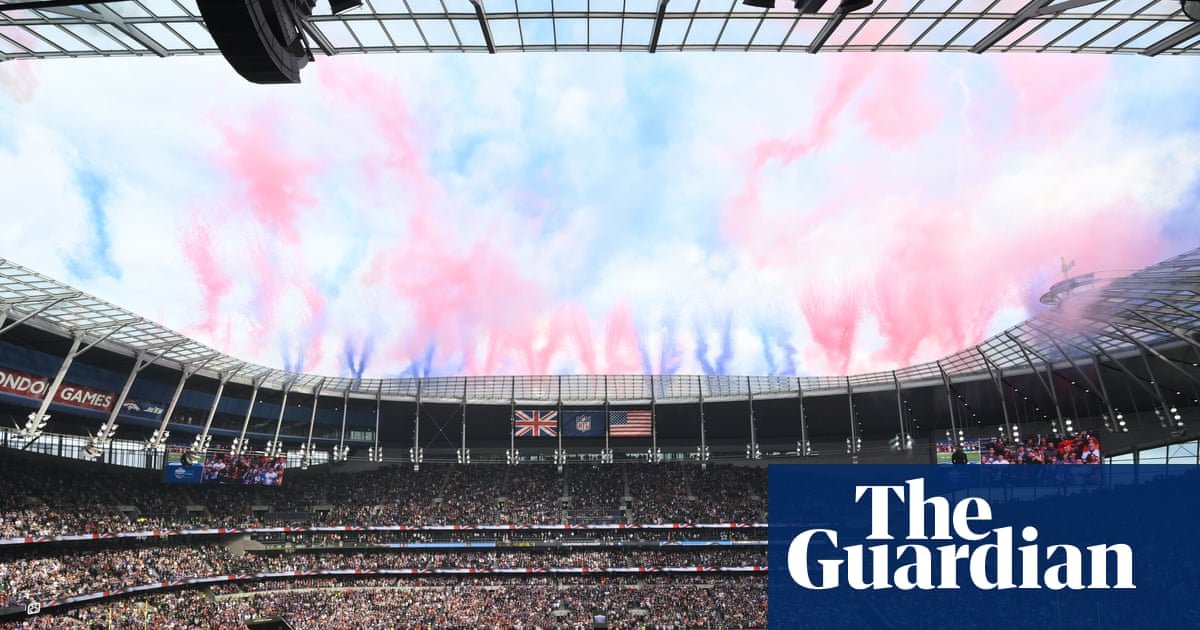
International expansion has been a cornerstone of Goodell’s commissionership. What began as a once-a-year novelty in London nearly 20 years ago has evolved into a foundational part of the schedule. Last year’s slate, the broadest yet, took games to Brazil, Spain and Ireland alongside the established games in the UK and Germany. Viewership for the International Series rose by 32%.
This year, the NFL is upping the ante in the global content race. Nine international games are scheduled, stretching from Melbourne to Paris: the 49ers play the Rams at the Melbourne Cricket Ground to open the season and will later go to Mexico City; the Cowboys head to Rio de Janeiro; the Falcons go to Madrid; the Lions to Munich; the Saints to Paris; the Commanders and two Jaguars games fill out a three-game London slate. It is the most expansive international slate the league has attempted.
Goodell has long pushed for an 18-game regular season with an extra bye week. More games create more windows, and more windows create more territory to plant the NFL flag in different time zones. When the schedule expands, the league will probably adopt Robert Kraft’s proposal to have every team play at least one game in an international market each year. It shouldn’t go unnoticed that Netflix receiving $2.8bn to withdraw its bid for Warner Bros happens to be the estimated price for a 16-game international rights package.
“You can think of expansion as the number of teams, or you can think of expansion as us playing in international markets and reaching in different areas,” Goodell told Westwood One recently. It is a revealing distinction. Expansion, in his framing, isn’t about housing a permanent franchise any more but consistent reach.
It’s a savvy ploy. There are echoes here of the Premier League’s ill-fated push for a 39th game, an extra gameweek with every team playing overseas. That idea collapsed under cultural resistance as much as logistical strain. The NFL doesn’t face that friction. Exporting games is now embedded in the culture, and by allocating one additional game per team, local fans will return to a full slate of home games. As expansion goes, it’s at least a coherent plan.
The NFL’s current collective bargaining agreement caps international games at 10. To reach Goodell’s target, the league needs the NFL Players’ Association to agree. Given recent turmoil in the union, the chances of a CBA extension before 2031 have diminished. Landing those extra international games is likely six years away.
There is also the persistent question of player welfare. Players complain about the travel and lopsided schedules. “Every player hates it,” Pat McAfee has said. Coaches grumble even more. Consider the Chiefs’ schedule in 2025: Brazil to open the season, a Monday night game before a short week to play Buffalo, then Thanksgiving, then Christmas Day. “You fly 12 hours to Brazil, and then on gameday you have to drive three hours just to get to the site,” Chiefs guard Trey Smith said recently. International assignments do not fall equally. They tilt the competitive balance, and the players know it.
No amount of moaning, however, will slow the NFL down, certainly not with a union caught up in its own inter-personal squabbling. If playing in Abu Dhabi increases the overall pie, the union will probably sign off.
The expansion isn’t stopping there. The 2028 Olympics, set to include flag football for the first time, will offer another on-ramp to the sport. The league continues to flirt with the idea of a Super Bowl in London, and Goodell has teased a European-based franchise or division. “I don’t take international expansion off the table,” Goodell said at this year’s Super Bowl. “I think that’s very possible someday.”
In the short term, a stand-alone franchise remains out of reach. Goodell has long said that a division would be needed for international expansion to work. It would also mean negotiating with the union, navigating international tax law and hoping players are willing to relocate.
And what if the franchise team stinks? Or free agents opt out of playing in Berlin, Mexico City, Riyadh or Seoul full-time? Why anchor in one place when you can be everywhere? Better to have a global footprint every week, taking the weekly carnival as far and wide as possible, than pin your hopes on the London Jaguars. With a traveling roadshow, every market gets a piece of the spectacle without one needing to carry the full burden.
But the idea of a future overseas franchise still lingers. The most consequential development there will be technology. During last year’s International Series, team executives consistently brought up the prospect of supersonic travel. The league office has been closely monitoring Boom Supersonicthe American aerospace startup attempting to build the first commercial supersonic aircraft since the Concorde retired in 2003. Boom has broken the sound barrier with a prototype and secured pre-orders for 130 commercial planes, with passenger flights targeted for 2030. Cut transatlantic flight times roughly in half, and the most stubborn obstacle to a permanent overseas franchise will disappear. At a minimum, it will offset the union’s concerns about travel times for the future international schedule. The solution isn’t here yet, but it’s coming.
There is an irony in all of this. In the America First era, the most powerful sports property in the country is aggressively going global. A league that wraps itself in the flag is taking Niners-Rams, one of the most consequential games of the season, to an Australian cricket ground … on a Thursday night … pushing the league’s season opener to a Wednesday. The NFL is expanding its calendar and geography simultaneously, while selling the idea back home that there is nothing better than waking up with football.
Last year, Cuban sold his controlling stake in the Mavericks. The NBA he championed is stuck in a ratings and personality quagmire. The NFL he warned about getting hoggy is scheduling games in Melbourne and Paris and plotting supersonic expansion. The hogs, it turns out, are fine.
