
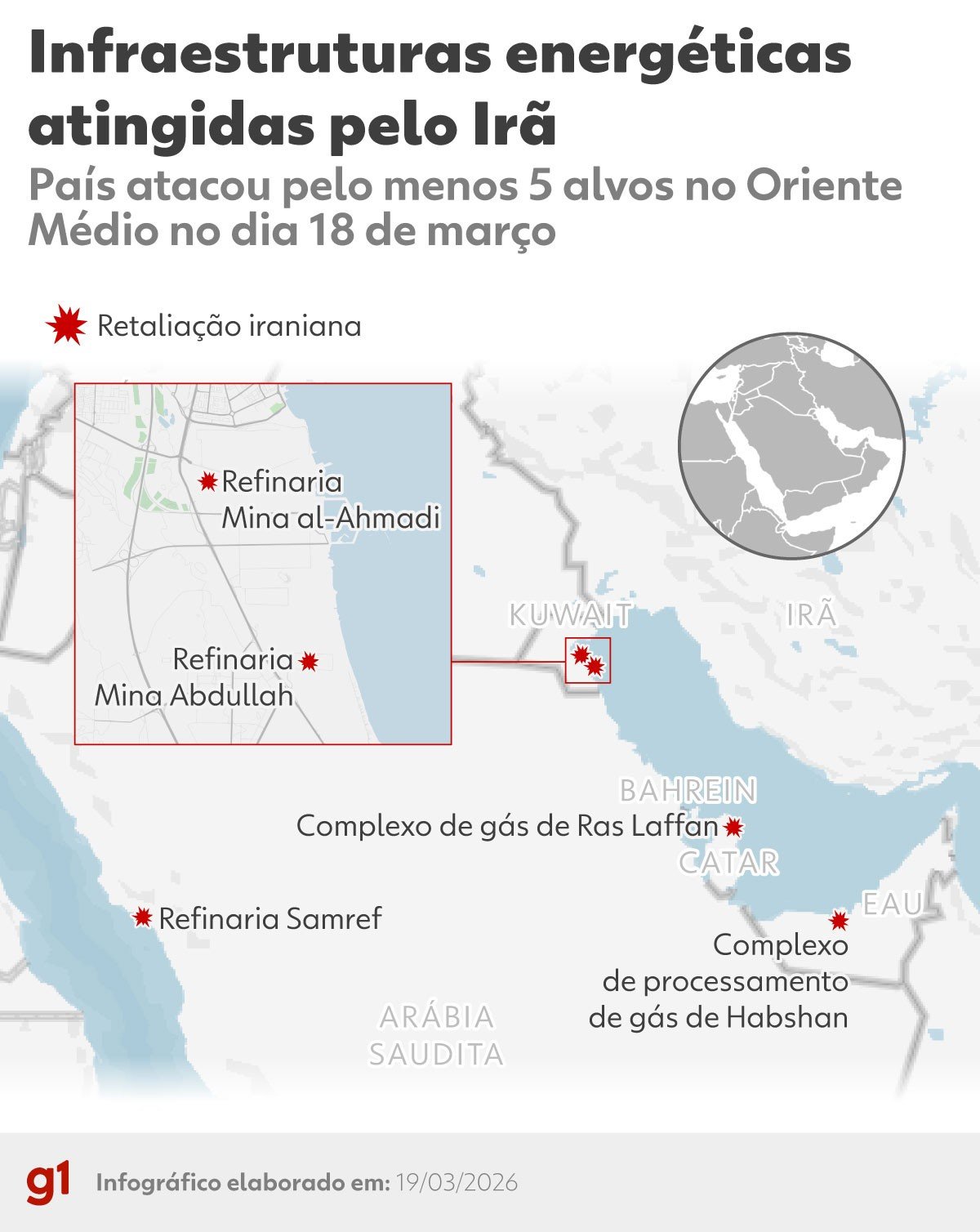
Israel bombs natural gas field in the Persian Gulf Iran embarked on a new offensive in the war in the Middle East and attacked a series of energy production or supply facilities in the Persian Gulf on the night of Wednesday (18) and the early hours of this Thursday (19). The strategy now, said Tehran, is to undermine the energy infrastructure of Gulf countries that have connections with the United States and Israel. ✅ Follow the g1 international news channel on WhatsApp LIVE: follow all the news about the war in Iran in real time The Iranian offensive is in retaliation for the attack that Israel carried out on Wednesday (18) on the largest gas production field in the world, South Pars. Iran shares the reserve in the Persian Gulf with Qatar. A video recorded the moment of the attack. See below. The escalation sent oil and gas prices soaring. Brent — the market benchmark — reached its highest level in more than a week and surpassed US$115 per barrel. The war completes three weeks on Saturday (21), with no prospect of ending. This Thursday, the Pentagon even announced that it will ask the North American Congress for approval for a contribution of US$200 billion to continue the conflict. See below the energy facilities attacked by Iran in the Gulf: Kuwait: two national oil refineries were attacked by drones and caught fire, the country’s Ministry of Information reported; Saudi Arabia: A drone crashed at the Saudi Samref refinery in the industrial zone of the Red Sea port of Yanbu, the Defense Ministry said. Earlier, the ministry announced that it had intercepted a ballistic missile launched at the port; Qatar: Ras Laffan, the world’s largest industrial complex and liquefied natural gas (LNG) export port, caught fire after an Iranian attack, the Interior Ministry said; United Arab Emirates: An Abu Dhabi natural gas processing center was closed after debris from intercepted missiles fell. The country blamed Iran for the attacks. Iran’s energy targets on March 18 Igor Ramon/Arte g1 Trump’s reaction US President Donald Trump said this Thursday (19) that he asked Israeli Prime Minister Benjamin Netanyahu not to attack the South Pars field in Iran. The statement contradicts Israeli government officials. According to sources heard by the Reuters news agency, the bombing was coordinated with the USA. On Wednesday night (18), Trump had already stated in a post on his social network that Israel acted on its own. In the publication, the US president also threatened to destroy Iranian gas fields if Tehran continues attacks against Qatar. “If it continues to attack Qatar, the United States of America, with or without the assistance or consent of Israel, will massively explode the entire South Pars Gas Field with a level of force and power that Iran has never seen or witnessed before,” Trump said. In a statement this Thursday, Netanyahu said that Israel acted alone in the attack on South Pars and confirmed that Trump requested that the country not carry out new attacks on energy infrastructure. Israeli attack causes fire at South Pars gas field in Iran Reaction in the Middle East Foreign ministers from 12 Arab and Islamic countries condemned Iran’s attacks on targets within their territories at a meeting held in Riyadh, in the capital of Saudi Arabia, this Thursday. In the joint statement released after the meeting, the countries demand an immediate halt to the Iranian offensive and also ask Tehran to stop “supporting, financing and arming affiliated militias in Arab countries.” ➡️ Context: For years, Iran has been supporting extremist groups in the region that are part of the self-styled Axis of Resistance. The “axis” coordinated by the Iranian regime is predominantly made up of Shiite militias and has among its main pillars Hezbollah, Houthis, Hamas (the only Sunni) and supporting factions in Iraq and Syria. Strait of Hormuz Amid the oil boom, European countries and Japan said this Thursday (19) that they are “ready” to join the “efforts” to free passage through the Strait of Hormuz. In a joint statement, governments from the United Kingdom, France, Germany, Italy, the Netherlands and Japan also stated that they will take measures to stabilize the energy market, affected by Iran’s attacks on infrastructure in the Persian Gulf. The statement, however, does not specify how the countries would help in the Strait of Hormuz, a maritime route in the Middle East through which ships carrying around 20% of all oil consumed in the world travel. Strait of Hormuz Art/g1
Source link
War in Iran enters new phase with attacks on energy facilities; see bombed sites and Trump’s reaction
25
