
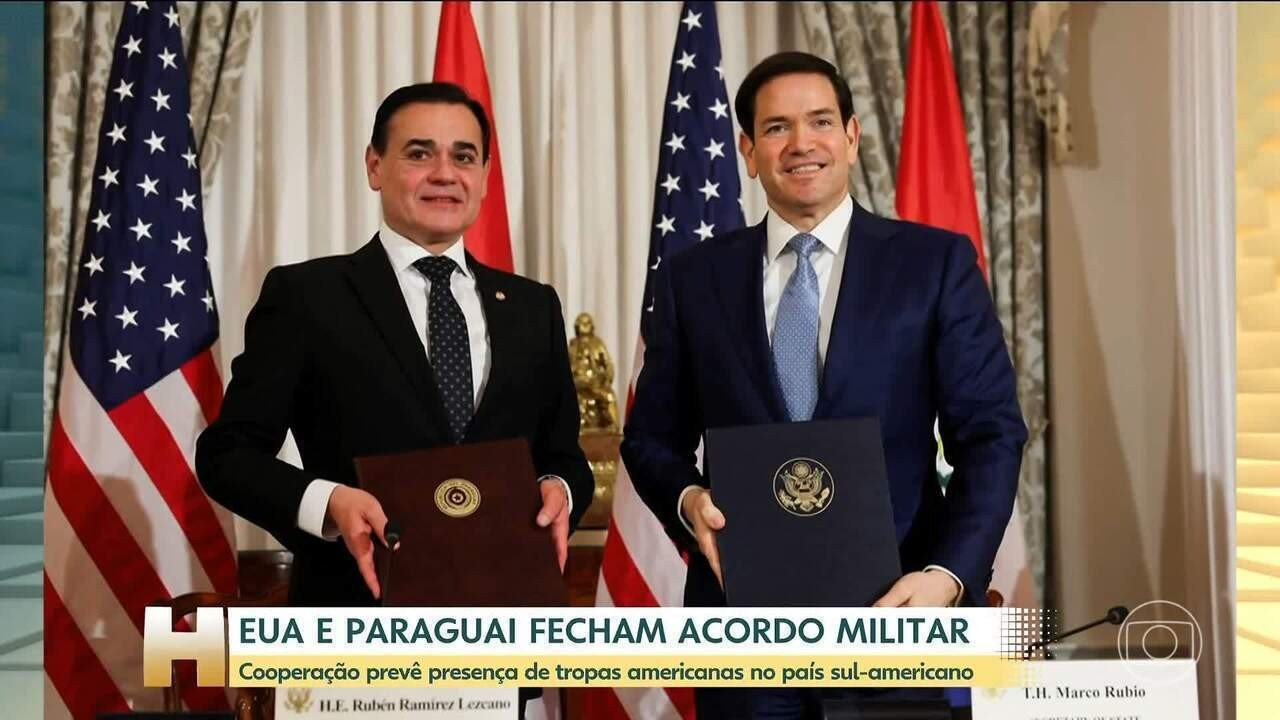
United States and Paraguay sign military agreement For some, this is a “strategic obligation” to combat organized crime. For others, it is American “direct interference” in Paraguay. ✅ Follow the g1 international news channel on WhatsApp Paraguayan President Santiago Peña sanctioned the Status of Forces Agreement (SOFA) a few days ago, signed with the United States. The agreement authorizes and regulates the temporary presence of civilian and military personnel from the Pentagon and American companies in Paraguay, to carry out activities related to the entry of vehicles, training and military exercises. The initiative was defined in December between the American Secretary of State, Marco Rubio, and the Paraguayan Foreign Minister, Rubén Ramírez Lezcano. Paraguay’s Congress ratified the decision last week. “This is an international agreement that establishes the legal framework to facilitate cooperation and joint training in terms of security and defense,” the Paraguayan government said in a brief statement. The American State Department confirmed to the BBC that the agreement reached with Paraguay constitutes the “gold standard” in this type of agreement. Government deputy Juan Manuel Añazco, from the Colorado Party, defended the initiative. He states that this is his country’s “strategic obligation”. “It’s about establishing clear, transparent and legal rules for existing international cooperation which, today, does not have an appropriate regulatory framework”, defended the deputy to the Paraguayan newspaper ABC Color. But the agreement with Washington divided the Paraguayan Congress and sparked debates. Critics claim that the initiative grants excessive privileges to the United States, establishing an unequal security relationship between the two countries. Opposition deputy Adrián Vaesken, from the Liberal Party, argues that “to celebrate this agreement is to be truly unpatriotic”. The leader of the Guasu Front, Sixto Pereira, defined the agreement as “direct interference”. The agreement was approved three days after Peña participated in the Shield of the Americas summit, a hemispheric security initiative promoted by United States President Donald Trump. She approved the creation of an Anti-Cartel Coalition of the Americas. But what does the agreement signed between Paraguay and the United States include? And why does it generate so much controversy? ‘Unprecedented’ rapprochement The agreement grants ‘privileges, exemptions and immunities’ to US military personnel in Paraguay Getty Images via BBC The signing of this agreement adds to the long history of close ties between Paraguay and the United States. Therefore, the experts consulted argue that, more than a simple change of direction, it is a deepening of relations between the two countries. “Since the beginning of Trump’s second term, Paraguay has experienced unprecedented levels of bilateral collaboration with the United States,” explains Gregory Ross, from Washington-based consultancy McLarty Associates. SOFA agreements are agreements that define the legal framework for Department of Defense employees, members of the Armed Forces and United States companies linked to military activities when operating in a foreign country. In addition to Paraguay, the United States maintains this type of agreement with Ecuador, El Salvador, Panama, Trinidad and Tobago, Honduras, Belize and Guatemala. The United States has many other security agreements in the region, including some similar status protections. But this short list of countries includes those that reach the “gold standard” level. “Washington has long exerted significant influence on Paraguay’s domestic and foreign policy, but this close cooperation has become particularly visible in the last year under the Peña and Trump administrations,” explains Ross. Ross says the benefits for Washington are based on increased cooperation with a strategically located partner at a time when “external actors, from China to international criminal organizations, have been expanding their presence in the region.” Until the signing of the agreement, the presence of American military personnel in Paraguay was restricted to training programs, anti-narcotics operations and the exchange of intelligence on international crime threats, according to the experts consulted. For international security professor Juan Battaleme, former secretary of International Affairs at the Argentine Ministry of Defense, this type of agreement allows the United States to protect its own internal security. “The American defense strategy is very clear,” he explains. “It seeks to regain control over what they understand as an area of interest to the Americas, in terms of defense and security, which ranges from the Arctic to the Antarctic.” The professor states that international threats, such as drug trafficking, have become one of the main sources of instability for Latin American countries and end up complicating relations between the continent and the rest of the world. What makes the agreement possible The US Secretary of State, Marco Rubio, and the Minister of Foreign Affairs of Paraguay, Rubén Ramírez Lezcano, present the agreement signed between the US and Paraguay REUTERS/Kevin Mohatt The agreement establishes that employees of the Department of Defense and members of the United States Armed Forces will have “privileges, exemptions and immunities” while carrying out activities linked to the agreement. This means that they will be able to enter and leave Paraguay with an American identity document, such as their driver’s license, wear a uniform and carry weapons. And they will not pay taxes in Paraguayan territory either. The agreement also allows American military personnel and employees to enter the country with technological equipment and supplies, without facing exhaustive inspections by Paraguayan control authorities. Among the most discussed points in Congress is the fact that Paraguay authorizes the United States to exercise criminal jurisdiction over its personnel while they are in Paraguayan territory. This means that crimes committed by American military personnel in Paraguay must be tried in the United States, not in the South American country, which was contested by the opposition. But, for intelligence and security specialist José Amarilla, “in the state of Paraguayan justice, it is much more likely that the transgression will be penalized in the United States than in Paraguay.” “For this reason, more than a certain transfer of sovereignty, it is almost an advantage that cases can be judged by more reliable systems”, argues the Paraguayan analyst. Furthermore, with the signing of this agreement, Paraguay allows the United States to operate its own telecommunications systems. And the use of the radio spectrum will come at no cost to Americans. The document also establishes that “aircraft, ships and land vehicles operated by the United States Department of Defense will be able to enter, leave and move freely within Paraguayan territory.” Analysts agree that, in legal terms, it is simply a bilateral treaty that establishes the legal framework for the presence of civilian and military personnel from one country in the territory of another. But, “in strategic terms, it is a decision taken by Paraguay in the face of several security problems where there are very clear deficits, such as the fight against international organized crime”, highlights Amarilla. The Santiago Peña controversy shortly after voting in Paraguay, on April 30, 2023 Daniel Duarte/AFP The approval of the agreement in Congress generated a heated debate, which divided the country’s legislators and public opinion. Criticism focused on articles granting diplomatic immunity and external criminal jurisdiction to Americans. Critics claim that these points threaten the country’s sovereignty. “We are going to vote on whether we are in favor of citizenship or the surrender of sovereignty”, expressed opposition senator Esperanza Martínez. She told the Paraguayan newspaper Última Hora that this agreement could pave the way for the approval of other laws related, for example, to mineral exploration. Amarilla does not agree with Martínez. But, for him, the agreement could bring complications for Paraguayans who are victims of crimes possibly committed by American personnel, who may file lawsuits. “If there is a Paraguayan victim, they will need to go to justice in the United States, going back and forth, or from Paraguay”, remotely, he explains. “In either case, it’s basically impossible for low-income families.” Battaleme states that the United States seeks, with this agreement, to prevent its military personnel from having access to “lower quality justice.” “Some think that this is a letter of impunity, but, technically, these are the legal guarantees that the United States has to be able to operate in a foreign country”, argues the expert. For some analysts, the agreement should be understood in the field of relations between the two countries. But others believe that it can be interpreted at a regional level, considering Paraguay’s geopolitical position. “Brazil and Argentina are its main allies in the region, but there are also opposing strategic interests in terms of trade, intelligence, resource exploration and other important topics”, highlights Amarilla. “Furthermore, Argentina and Brazil are much more attractive partners for other world powers, such as China or Russia. This leaves Paraguay with only one option, which is the United States.” The agreement received broad support from parliament, but was rejected by sectors of civil society. “The security of a people cannot be built by importing troops, nor by shielding foreign agents with diplomatic immunity,” the organization Servicio Paz y Justicia declared in a statement received by the AP news agency. Present throughout Latin America, it is dedicated to defending and promoting human rights. The entity highlighted that the alliance “does not represent an advance in terms of security, but the formalization of a geopolitics of impunity, which harms the pillars of our national dignity.” VIDEOS: most watched on g1
Source link
The controversial agreement that allows the presence of American military personnel in Paraguay
17

previous post