
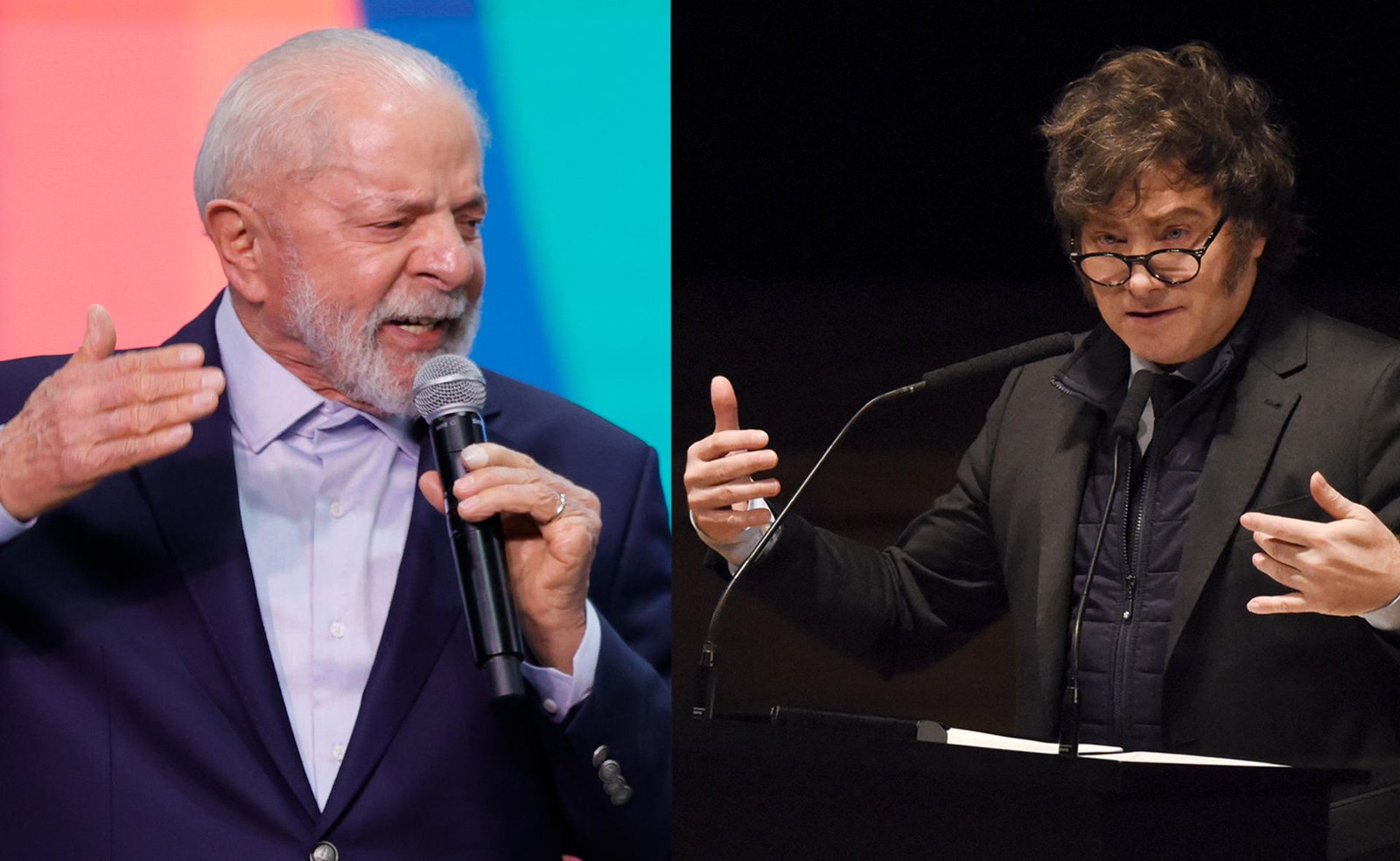
President Javier Milei scored two recent victories in his structural reform agenda in Argentina. One of them, labor, seeks to make labor relations more flexible and adapt to the new demands of the digital era, while the other foresees changes to the Juvenile Penal Regime, including the reduction of the age of criminal responsibility from 16 to 14 years old.
Both measures highlight the contrast between the political model defended by the libertarian and the Brazilian government, led by Luiz Inácio Lula da Silva (PT).
One of the hallmarks of the Milei government is the “shock therapy” in the economy to try to recover the country from a deep crisis opened by previous administrations. Among the actions taken since 2023 are drastic cuts in public spending, facilitation of privatizations and an increasing reduction in State interference in society. Another distinction in relation to the Brazilian administration, which recorded record spending last year.
Professor of International Business and International Relations at the Pontifical Catholic University of Paraná (PUC-PR) João Alfredo Lopes Nyegray highlights that the main differences between Milei and Lula’s political agendas are related to the role of the State in the economy and the organization of society.
Although the two nations with the largest economies in Latin America face similar challenges, such as low growth, social inequality and strong fiscal pressure, the proposed responses are structurally opposite in practice.
“In the Argentine case, Milei’s strategy is based on a classic liberal diagnosis: the central problem of the economy is the excess of the State. For this diagnosis, decades of state intervention, protectionism, subsidies and institutional rigidity have produced an economic system that is uncompetitive, highly inflationary and dependent on public financing”, points out the professor.
In this sense, reforms proposed by the government such as labor reforms fulfill the function of helping with economic recovery by reducing the regulatory cost of productive activity, making the labor market more flexible and reducing legal risk for companies.
Brazilian model follows almost the opposite logic
Lula’s political vision follows an almost inverse logic of maintaining the State’s presence as a central agent of economic development and social protection.
In this model, explains Nyegray, public policies such as expanding social programs, increasing public investment, strengthening state banks and fiscal stimuli are seen as instruments to boost the economy and reduce inequalities.
In relation to the Argentine labor reform, the new legislation approved by Congress allowed for the flexibility of working hours (there is now the possibility of shifts of up to 12 hours), the reduction of union participation in negotiations between employer and employee and an incentive for companies that have become victims of economic stagnation in the country in the last decade through cheaper employer contributions and layoffs.
In contrast to this measure, the Lula government made it one of its priorities in this election year to move forward with the approval of the end of the 6X1 scale, to reduce the weekly working hours from 44 to 36 hours.
Regarding the issue of the age of criminal responsibility, the two countries are also following antagonistic paths. While the Milei government celebrated the reduction of the age of criminal responsibility from 16 to 14 years in Argentina, last month, the Lula government base managed to block the approval of a section of the Public Security PEC currently being processed in Congress, which proposes reducing the age of criminal responsibility from 18 to 16 years.
Countries’ economic and security expectations contrast
One of the main points that demonstrate the different paths between the two countries is the economic comparison.
While Argentina shows signs of recovery, despite annual inflation remaining at high levels – it closed at 33.1% according to updated data from the National Institute of Statistics and Census –, Brazil once again faced an inflationary acceleration, remaining at 0.7% monthly and 3.81% in the last 12 months, above market expectations.
President Javier Milei told businesspeople in New York, during an official trip focused on seeking resources for Argentina, that his government foresees inflation below 1% between June and August 2026.
Since 2023, the Argentine has been promoting his “chainsaw” policy, which has become a global symbol of the movement to reduce the State and bureaucracy in Argentina. Among the main measures taken to reduce the public sector are the elimination of thousands of positions and the emptying of ministries in the government – another point that Lula contrasts with Milei, as he defended the creation of more ministries in his administration.
In relation to policies aimed at national and regional security, the two governments also maintain a considerable distance. Since arriving at Casa Rosada, the Argentine libertarian has toughened the State project against crime and drug trafficking, while Brazil has faced major obstacles in the fight against criminal organizations.
A recent episode that highlights this contrast between the two leaders was the meeting promoted by the USA to launch the “Shield of the Americas” summit, an initiative aimed at strengthening security cooperation and combating drug trafficking in the Western Hemisphere, in which Milei was present and Lula did not participate.
The absence of the PT member and other left-wing leaders in the region signals a lack of alignment with Trump’s security policies, an issue that could become an obstacle in diplomatic relations between countries on the continent.
Washington has also indicated in recent days that it is considering classifying the Brazilian factions Primeiro Comando da Capital (PCC) and Comando Vermelho (CV) as foreign terrorist organizations, an announcement that was received by the Lula government with concern. In turn, Argentina had already taken the decision last year, when there was a risk of Brazilian criminals fleeing to the country following the mega police operation in Rio de Janeiro against organized crime.
