
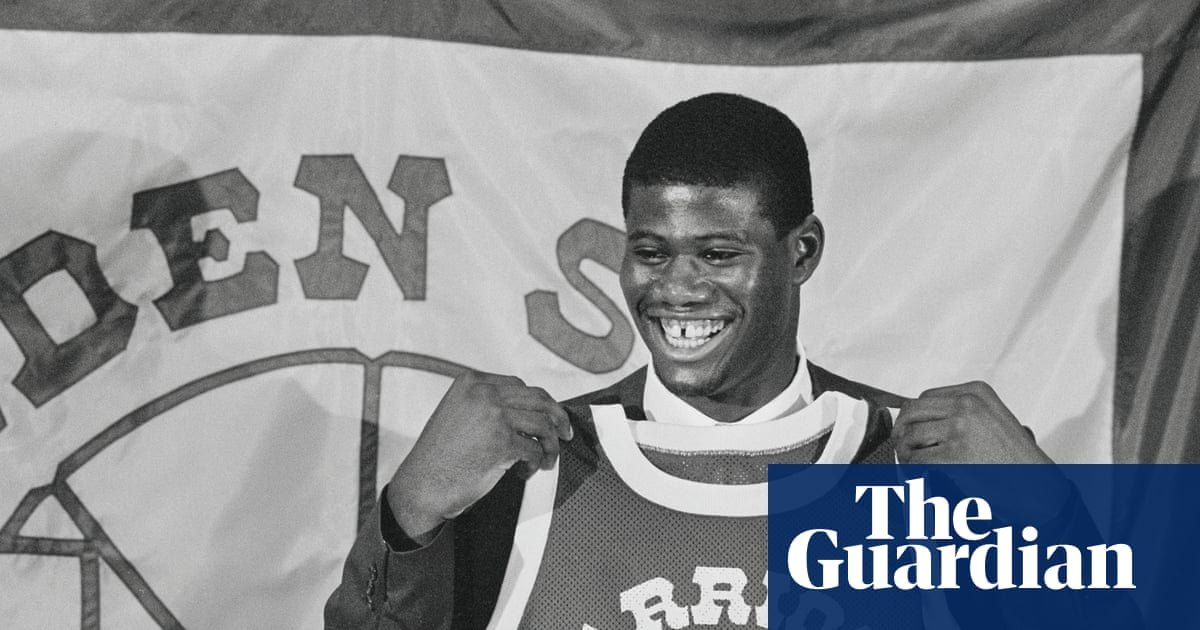
When the Golden State Warriors drafted Chris Washburn with the No 3 pick in 1986, it should have been a dream come true. Instead, it might have been the worst thing that could have happened for the 6ft 11in NC State prospect.
“I put on a smile because they were paying me to be out there,” Washburn, a former three-time high school All-American, tells rhe Guardian. “But I felt alone.”
Oakland was just about as far as you could get from Washburn’s hometown of Hickory, North Carolina. There was hope the team could help. He was on a roster with the likes of Sleepy Floyd and Chris Mullin. In the preseason, the rookie Washburn scored prolifically. He had a starting role on the team. Everything was going well – until it wasn’t.
“But drugs took a toll,” Washburn says. “My mind wasn’t on basketball. A lot of times, I was on the bench watching the clock tick down because as soon as the fourth quarter was over, I could leave to go get high.”
The NBA’s so-called “cocaine era” has been well-documented. But while much attention has been paid on athletes who lost their money and standing in the league, not enough is paid to the reasons why. Sure, drugs were everywhere, from Hollywood movie sets to New York City discos. But there were real reasons people turned to them.
“No one paid attention,” says Washburn, who, though being so highly touted, only played parts of two NBA seasons. “Now, if a team sees a player fading, they’ll step in. But back then, no one did. Cocaine, crack was new. They didn’t know what to look for.”
Washburn says he ultimately faults himself for how his brief career unfolded. “All I had to do was stop,” he says. “But I felt more alive when I was doing crack.” Still, there was a real sense of loneliness and depression he felt as a young player.
“When I came into the league,” says Washburn, who averaged 17.6 points and 6.7 boards as a sophomore at NC State, despite several off-court controversies, “the NBA was trying to clean up the image from the 70s. They said there were two things you can’t do: cocaine and heroin. That’s all they had to say.”
Despite the clear, stern warning, many players felt the pain of self-inflicted wounds, from multi-time All-Stars like Micheal Ray Richardson, who was the first player banned for life by the NBA for drugs, to youngsters like Washburn, who, despite using often, said he had trouble functioning on them. “I couldn’t handle the drugs,” the 59-year-old says of his playing days.
The big man’s body broke down, his game suffered. He missed practices, lost focus. He was out of the league – banned for drugs after just two seasons. Washburn only played in 72 regular-season games, along with six playoff games.
“I was a young guy, very impressionable,” Washburn says. “A lot of people my size, we grew physically real fast, but mentally, some of us like myself took a little time. I made a lot of mistakes.”
The first time Washburn tried cocaine, he says, he did it in college with Len Bias, of all people. Famously, Bias died in 1986 at 22 years old, just two days after being drafted one slot ahead of Washburn by the Boston Celtics. Many say Bias was the rival Michael Jordan never had. Washburn says the senior Bias was who he wanted to be – a star with the world at his fingertips.
“I’m thinking this is what we’re supposed to be doing at that level,” Washburn says, thinking back on trying drugs with Bias in a dorm room.
But even when Bias died from a drug overdose after Boston made him the No 2 pick, Washburn wasn’t spurred to quit. The two standouts weren’t best friends, so Washburn said it was just another unfortunate headline. Soon, that’s what he was, too.
After the NBA, Washburn bounced around. “I only got high on days that ended in ‘y’,” he says now with a hard-earned laugh. “I got high when I was down. I got high when I was happy,” he says.
For a few years, he lived in the street. He ate out of trashcans. He stole everything from perfume to lunch meat. He went to prison. He married, but at some point his wife up and left their Houston home for a less hectic life in Dallas. Washburn stayed in Houston to get high. He had no possessions. He slept wherever he could find a park bench.
“I could have gone to the John Lucas treatment center [in Houston],” Washburn says. “But I didn’t want treatment.”
He says his issues didn’t come from a broken childhood home or from abuses he suffered early on in life. Washburn grew up in a two-parent household, one that prided itself on discipline. In that way, the former NBA top pick was actually rebelling.
“I was able to get out and do stuff I only saw on TV or head people talking about,” Washburn says. “It was an adrenaline rush, yeah. But also a learning process.”
Today, the former No 3 pick speaks to young people about the perils of addiction. He also says he’s tried to reach out to leagues like the NBA to talk to troubled stars like Ja Morant, but he hasn’t been afforded the opportunity.
“I got caught with guns, too,” Washburn says. “I want to talk to him. To say it’s OK to make mistakes but just don’t make the same mistakes over again.”
Washburn is one of those people who has seen it all. He calls it understanding “both sides of the fence”. Lots of people have experienced poverty and many have known wealth. Few have seen both – but Washburn has.
“I always thought the party would never end,” he says. “But you can have money in your 20s and then be flat broke and homeless in your 50s.”
A player’s outcome depends so often on the quality of their relationships. In Oakland, Washburn’s life was devoid of family or close friends. He didn’t click with his team or coach, the famously irate George Karl. Then in a matter of months, it was all over.
“Today,” Washburn says, “I have a smaller circle, but it’s one I can trust – that’s all I was actually looking for back then.”
Now, Washburn is married and living in his hometown of Hickory. He recently co-wrote a candid new memoir, Out Of Boundswhich highlights his story. Thankfully, the book has a happy ending – the former high school standout is alive and well.
“Even with basketball,” he says, “everything has an expiration date with me. Someone asked me if basketball had worked out, would I have played 15 or 20 years like LeBron? And I said no. After I’ve given enough to a sport, I walk away and do something different.”
For the former top prospect, his a-ha moment came when his father died. His mother was alone and Washburn had to take care of her. With her own medical issues, he had to take on the power of attorney and handle her finances.
“Although I’d stolen from her and my dad in the past,” Washburn says, “at this point it was all on me. If I was a person who still wanted to get high, we would have been homeless. That’s why I say the Man Upstairs makes no mistakes. He got me to a point to clean everything up.”
Prior, Washburn had been to rehab 14 times and it never stuck (he would list his dealers as family and they’d visit him with a score). But once he had to take care of his mother, he says, he stopped.
“I got tired of being broke,” Washburn says. By then, he also had four sons, including a future NBA player. “I wanted to be more than Chris Washburn the junkie. So, I had to make some changes.”
With his new book, Washburn says he wrote the memoir to help others like him.
“I knew there were other Chris Washburns out there,” he says. “Not just on the court but off the court. Now I’m seeing my message start to get out there. You can only hold certain things down for so long – if it’s meant to get out there, it will.”
