
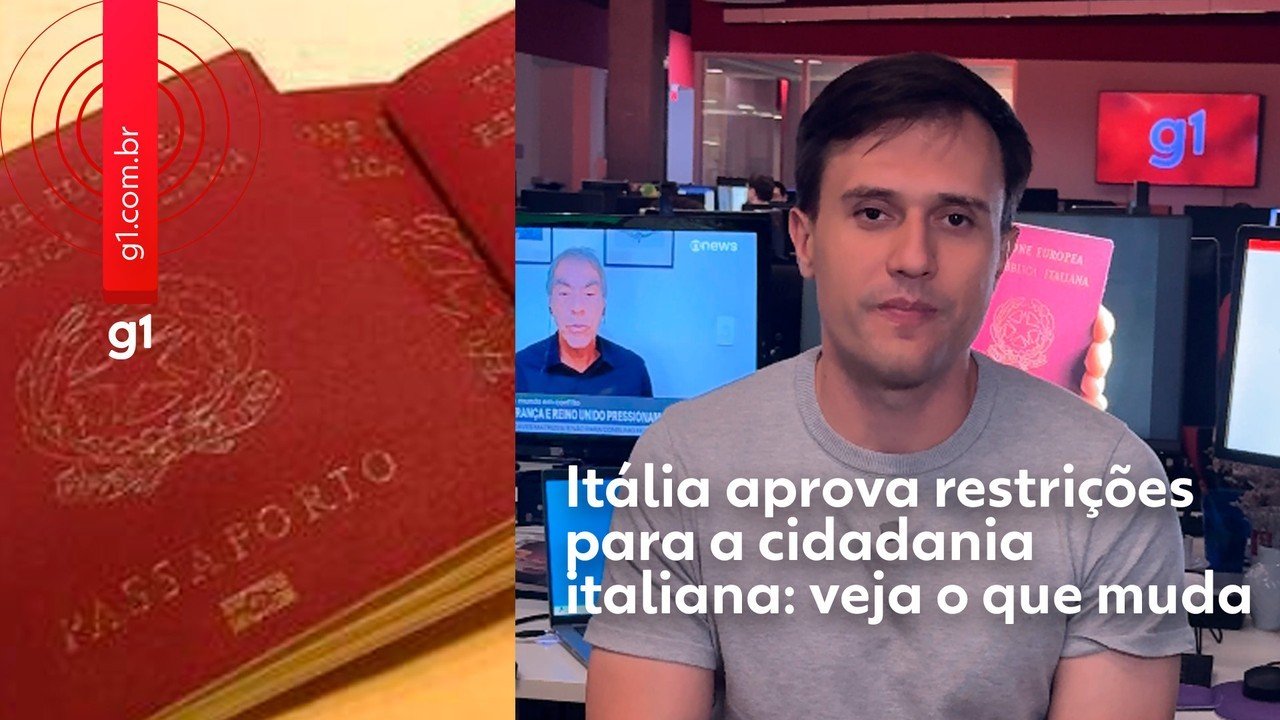
Italian passport Bruno Todeschini/RBS Agency Last year, when the Italian Parliament approved a Provisional Measure by the Italian government restricting the granting of Italian citizenship, lawyers specializing in immigration and nationality said that the new law would be easily overturned in court, as it was unconstitutional. On Thursday (12), however, the Constitutional Court of Italy, one of the highest instances of Italian Justice, rejected an appeal that alleged the law was unconstitutional and, as a result, maintained the restrictions on granting citizenship (read more below). ✅ Follow the g1 international news channel on WhatsApp 👉 The decision caught lawyers who contest the constitutionality of the new law by surprise, according to Brazilian jurist David Manzini. “It was totally unexpected,” said Manzini, who is part of the group of lawyers calling for the law to be overturned. The jurist stated that the decision was surprising both due to the short period of time in which it was taken — a definitive ruling was not expected before the next few weeks, as the hearing to hear the parties took place on Wednesday (11) — and due to the merit itself. “There are many unconstitutional issues in the new law: the misuse of a provisional measure to change the Constitution, the application of retroactive effects and the breach of legitimate trust, the precept that establishes that citizens have the right to organize their lives around long-established norms,” he said. Jurists, according to Manzini, will now wait for the full sentence to better understand the judges’ arguments and prepare new appeals — the ruling had not yet been published until the publication of this report. What changes now Meanwhile, for descendants of Italians who hoped to obtain nationality — as is the case for many Brazilians –, the processes remain canceled, for those who do not meet the new requirements. The current norm now restricts the right only to children and grandchildren of Italians, and only in two cases: if the father, mother, grandfather or grandmother was an Italian citizen, being born in Italy or being considered Italian at the time of death; if the father, mother, grandfather or grandmother with Italian citizenship was born outside the country, but lived in Italy for at least two consecutive years before the birth of the child or grandchild. Anyone who does not fit into one of these categories but was in the queue will have their request cancelled, unless another legal challenge is accepted in Italy. “The only way we can achieve anything now is by legally challenging the law,” said Manzini. ➡️ New resources will still be analyzed by the Italian Court. One of them will be judged next month, and the other in June. But, in addition to them, jurists are preparing new challenges, which could lead to a long legal battle. The decision In the decision of Thursday (12), the judges of the Constitutional Court judged a request for unconstitutionality presented last year to a court in the city of Turin. The appeal questioned the legitimacy of the new law and asked that it not be retroactive for people born before the sanction. According to the Italian news agency Ansa, the judges judged the questioning to be “unfounded” and “inadmissible”. “The Constitutional Court declared partially unfounded and partially inadmissible the questions of constitutionality raised by the Court of Turin,” says a statement released on Thursday. The restrictions generated frustration among people of Italian descent, especially in countries like Brazil and Argentina. In the case of Brazilians, thousands of great-grandchildren and great-great-grandchildren of Italians who seek citizenship may lose this right. 👉 Before the new decree, which came into force in 2025, Italy’s legislation recognized the right to citizenship based on the legal principle of “jus sanguinis” — or “right of blood”, which guarantees the nationality of a country to the child of a citizen of that country, regardless of where they were. In the case of Italy, this right could be transmitted without limit of generations, as long as the link with an Italian ancestor who was alive after the creation of the Kingdom of Italy, on March 17, 1861, was proven. In other words, anyone who had Italian great-grandparents or great-great-grandparents, for example, had the automatic right to citizenship. Government wants to control new entries Italy approves restrictions for Italian citizenship: see what changes At the beginning of last year, the government of Italian Prime Minister, Giorgia Meloni, approved an emergency decree with the current restrictions. The argument of Meloni’s management was to limit the entry of foreigners into Italy. Due to its emergency nature, the decree came into force, but was later voted on in the Italian Parliament, which would have to support it for the measure to become a de facto law. During two days of debates, many deputies spoke out against the new law, arguing that it violated the principle of the Italian Constitution that all citizens have the same rights and disrespected thousands of Italians who left the country in search of work in the past. However, the majority that Meloni’s government has in Parliament guaranteed the approval of the measure. The challenge The appeal denied on Thursday by the Constitutional Court was the first challenge to the new law in the Italian courts. In it, eight Venezuelan citizens filed a challenge in the Turin Court. The group questioned the retroactive nature of the measure — that is, the fact that it was valid for those born before it was sanctioned by the prime minister. The group’s lawyer, Giovanni Bonato, said at the time that “a specific category of our fellow citizens was suddenly and unexpectedly deprived of their citizenship”, according to the Ansa agency. 👉 The rejection of the appeal does not mean, however, that it is no longer possible to challenge the current law. Groups of lawyers have already prepared other joint appeals, which should be analyzed by the Court in the coming months.
Source link
Italian citizenship: the court’s decision to maintain restrictions frustrates lawyers; understand the impact on Brazilians
14
