
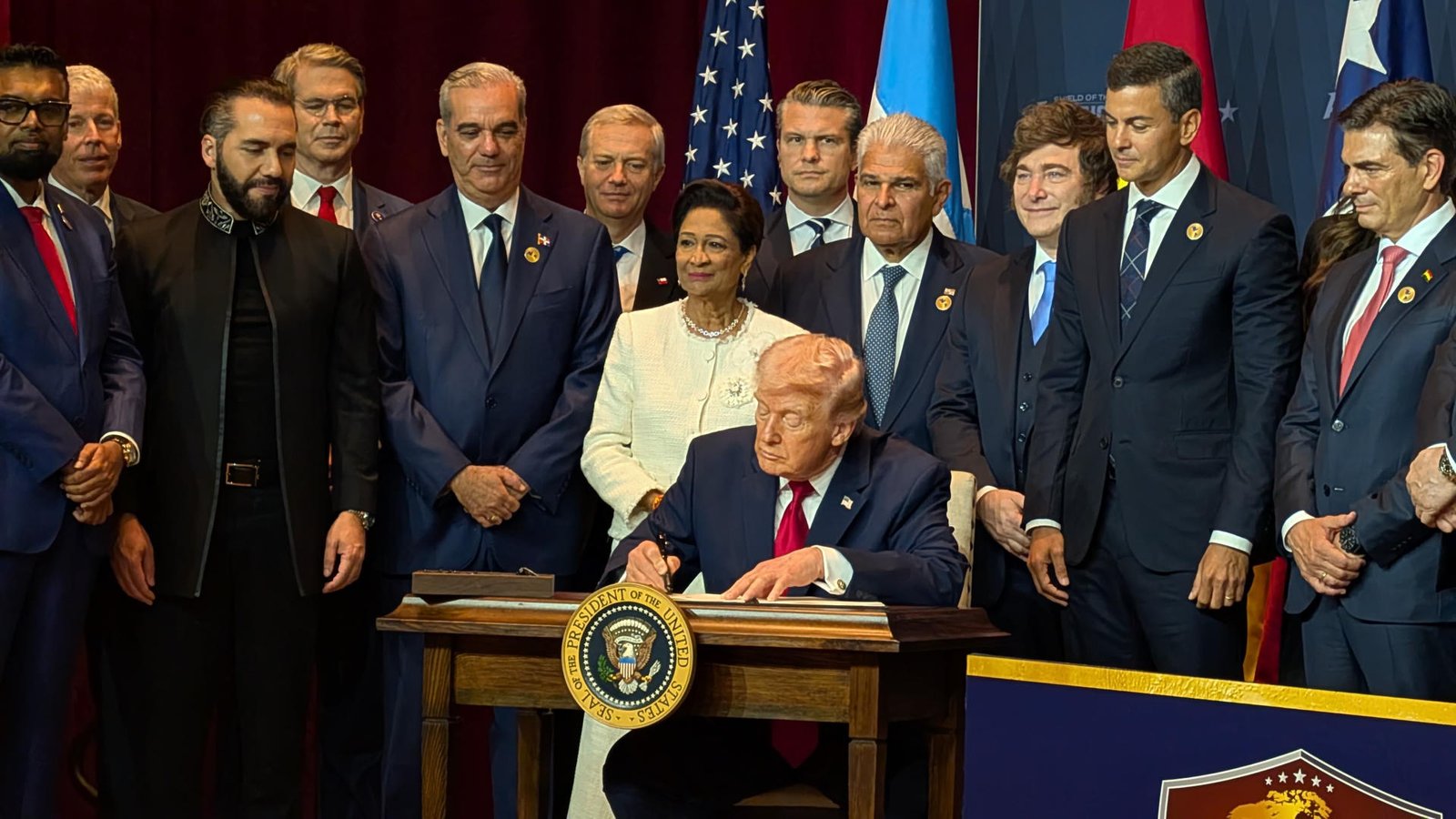
The President of the United States, Donald Trump, launched this weekend the call “Shield of the Americas”, an initiative that envisages the formation of a regional military coalition to confront criminal factions operating on the American continent. The proposal is also seen by analysts as a US strategy to reaffirm its regional hegemony and counter the growing influence of China and Russia in Latin America.
In a meeting with Latin American leaders in Florida, Trump signed the “Doral Declaration”document that formalizes the coalition, and stated that the “only way to defeat” drug trafficking cartels and terrorist networks in the region is “using the power of armies”.
The initiative so far brings together 17 Latin American countries, including Argentina, Ecuador, El Salvador and Paraguay. Brazil was left outas well as Mexico and Colombia. This Wednesday (11), Trump said that he “thought” that these countries had been invited, but that “maybe” they had not agreed to join the coalition.
The absences indicate, in addition to the lack of alignment with Trump’s security policies for the region, that these countries want to preserve their governments’ autonomy in combating internal organized crime.
In the Brazilian case, there is friction between the Trump and Lula administrations over the designation of the Primeiro Comando da Capital (PCC) and Comando Vermelho (CV) factions as terrorist groups. The US is considering implementing this classification and the White House has already stated that the two criminal organizations are “relevant threats to regional security”.
The PT government, however, is against it and last year acted to prevent the approval of a bill in the Brazilian Congress that designated PCC and CV as terrorists. Brazilian diplomats estimate that this classification could open space for tougher measures by the US, including military attacks, in the fight against drug trafficking in Latin America.
The professor of International Law and director of Ibmec Brasília, Ricardo Caichiolo, warns that the intensification of coordinated operations between members of the “Shield of the Americas” could generate indirect effects for Brazil, Mexico and Colombia, such as the displacement of criminal routes to territories that do not participate in the initiative.
How the “Shield of the Americas” will work
In addition to combating drug trafficking, Trump’s coalition also outlines objectives to combat illegal immigration and human trafficking, expanding military and security cooperation on the region’s borders and maritime routes.
Trump’s “Shield of the Americas” predicts military coordination, high-level intelligence sharing, joint training and operational support between armed forces of participating countries.
During the summit in Florida over the weekend, Trump stated that the coalition’s core commitment is use “lethal military force to destroy cartels and their terrorist networks.” The president compared the “Shield” to the international coalition formed in the past by the US and allies to combat the Islamic State (IS) terrorist group in the Middle East.
The United States must expand training and exchange information with countries participating in the coalition, as well as increase its logistical presence in the Caribbean and the eastern Pacificareas considered strategic on international drug trafficking routes.
For Caichiolo, the creation of the coalition represents a structural change in cooperation between the United States and Latin American countries. It marks a “transition from tactical cooperation to an integrated regional security model”.
“The United States understands that the fluid and transnational nature of organized crime requires that national capabilities be merged into a collective response architecture, overcoming the fragmentation that currently exists,” he said.
Caichiolo assesses that the initiative opens space for an “interoperability framework”, whose objective would not only be local training, but “the standardization of intelligence and logistics protocols” between participating countries.
Military partnerships in Latin America
Argentina, Ecuador and Paraguay are already adopting measures in line with the strategy defended by Washington in the fight against organized crime. In recent months, they have classified criminal organizations operating in their territories as terrorist groups and expanded security cooperation with the United States.
In the case of Ecuador, the government classified as terrorist all the cartels that control drug trafficking in the country and spread violence – including the drug cartels. The Wolves e The Choneros.
Paraguay, in turn, last year classified the PCC and Comando Vermelho, both of which originate in Brazil, as terrorist groups, as they represent a risk to national security.
Argentina, led by President Javier Milei, also classified the PCC and CV as terrorists last year, as well as creating a security plan to control drug trafficking at the border. The Milei government stated that Argentina’s adherence to Trump’s “Shield of the Americas” represents a new strategic alignment with Washington.
“This historic coalition of nations will work together to promote strategies that curb foreign interference in our hemisphere, combat organized crime and drug trafficking and respond to the problem of illegal immigration,” the Casa Rosada said in a statement.
According to Caichiolo, the coalition must institutionalize mechanisms for immediate action among members in scenarios considered “critical” in Latin America.
USA already operates in Ecuador and may begin to circulate in Paraguay
On March 3, the United States participated in a joint operation in Ecuador alongside the Ecuadorian armed forces against members of the group “Frontier Commandos”dissent from the Revolutionary Armed Forces of Colombia (FARC) involved in drug trafficking in the border region.
During operation, a camp assigned to the faction in the Amazon region was hit in precision bombing, with intelligence support, aircraft and direct coordination between the military of both countries.
The action highlighted the level of operational integration between the two countries, which should intensify after the launch of the “Shield”.
In Paraguay, the country’s Congress approved this week the military cooperation agreement known as SOFA (Status of Forces Agreement), which regulates the presence of United States military personnel in Paraguayan territory.
The text grants prerogatives similar to those of diplomatic missions to military personnel and civilian employees of the US Department of War who are on mission in the country, defines rules of criminal jurisdiction – establishing that, in cases linked to the exercise of their functions, these professionals are under the responsibility of the American Justice – and authorizes the movement of American troops, equipment and military aircraft upon notification to local authorities.
The agreement, which must be sanctioned by President Santiago Peña, also makes it possible to carry out training, joint exercises and other actions previously agreed between the two governments.
“Shield” against China
In addition to combating drug trafficking and illegal immigration, Trump’s “Shield” is part of a broader strategy to reposition the US in America – in line with the National Security Strategy released last year, which advocates a more active role in the region “as a condition for its security and prosperity” and the containment of the influence of adversary powers, especially Russia and China.
In recent years, China has increased investments in port infrastructure, telecommunications and energy in several Latin American countries, while Russia has deepened military cooperation with regimes in Venezuela, Cuba and Nicaragua.
By carrying out the operation to overthrow dictator Nicolás Maduro in January, the US has already managed to reduce part of this influence in Venezuela, which is now under the scrutiny of the White House and following directives from Washington.
Caichiolo assesses that the Shield of the Americas “seeks to be a pillar of reaffirmation of US regional hegemony in a context of multipolarity”. According to the analyst, Washington is currently seeking to regain its status as “preferred security partner” for Latin American countries, using the fight against organized crime as an instrument of strategic reorganization in the hemisphere.
“Geopolitically, the coalition will be able to consolidate American technological and military standards in the region, creating entry barriers for the influence of China and Russia,” he stated. According to the professor, this could restrict the penetration of these powers into sensitive infrastructure in the American zone of influence, such as 5G networks and monitoring systems associated with these powers.
In an analysis published days before the summit by think tank Center for Strategic and International Studies (CSIS)the director of the institution’s Americas Program, Ryan Berg, noted that the meeting could serve to “expand the strategy of containing China in the Western Hemisphere”, including in digital infrastructure, strategic ports and sensitive production chains.
According to Berg, China maintains a strong presence in Latin American telecommunications networks, with companies such as Huawei operating in several countries in the region. The analysis points out that Beijing has built “unrestricted access to the strategic surroundings of the United States” in recent decades, consolidating its presence in ports, energy and space infrastructure.
For the analyst, the “Shield of the Americas” can function as the nucleus of a broader network of economic, energy and security agreements, capable of reducing the influence of foreign powers in Latin America and establishing regulatory and technological standards in the region aligned with Washington. According to him, the countries invited to the summit tend to form the basis of this strategic repositioning movement on the continent.
US operations in the Caribbean and the Pacific preceded the “Shield”
Since September last year, the United States has carried out operations against drug trafficking in the Caribbean and the eastern Pacific. The actions are part of the operation called by the White House as “Spear of the South”, conducted primarily by the US Navy and Coast Guard.
The operation served to suffocate maritime trafficking routes, as well as prevent crime in Venezuela and attempts to break the blockade against Cuba. The initiative preceded the capture of dictator Nicolás Maduro, in January this year.
According to data released by US authorities, so far 44 vessels linked to international drug trafficking have been the target of attacks or interceptions as part of the operation. The initiative has already resulted in at least 150 criminals being killed, according to an official report from the American government.
Days before the official launch of the “Shield of the Americas”, US Secretary of War Pete Hegseth stated that Washington is prepared to launch a unilateral offensive against criminal organizations in Latin America, although the preference is to act “together with neighbors and allies”.
According to Caichiolo, the possibility of unilateral US actions against crime in Latin America, even after the launch of the coalition, cannot be ruled out.
“US security doctrine allows actions when it believes there is an imminent threat. It is possible, therefore, for there to be American military operations without a formal request from the State involved, depending on the perception of the US government”, he stated.
