
The cohesion and coordination capacity of the BRICS diplomatic bloc (Brazil, Russia, India, China, South Africa, Egypt, Ethiopia, Indonesia, Iran, Saudi Arabia and the United Arab Emirates) has been in crisis since members of the group went to war against each other in the context of the American attack on Iran. Tehran has been bombing the United Arab Emirates and Saudi Arabia, which are evaluating retaliation, but the bloc has not taken a position on the attacks.
The crisis raises questions in Brazil about the diplomatic strategy of President Luiz Inácio Lula da Silva (PT), who has been betting on strengthening the Brics bloc as a way of expanding Brazil’s international relevance and projecting leadership in the so-called “Global South”.
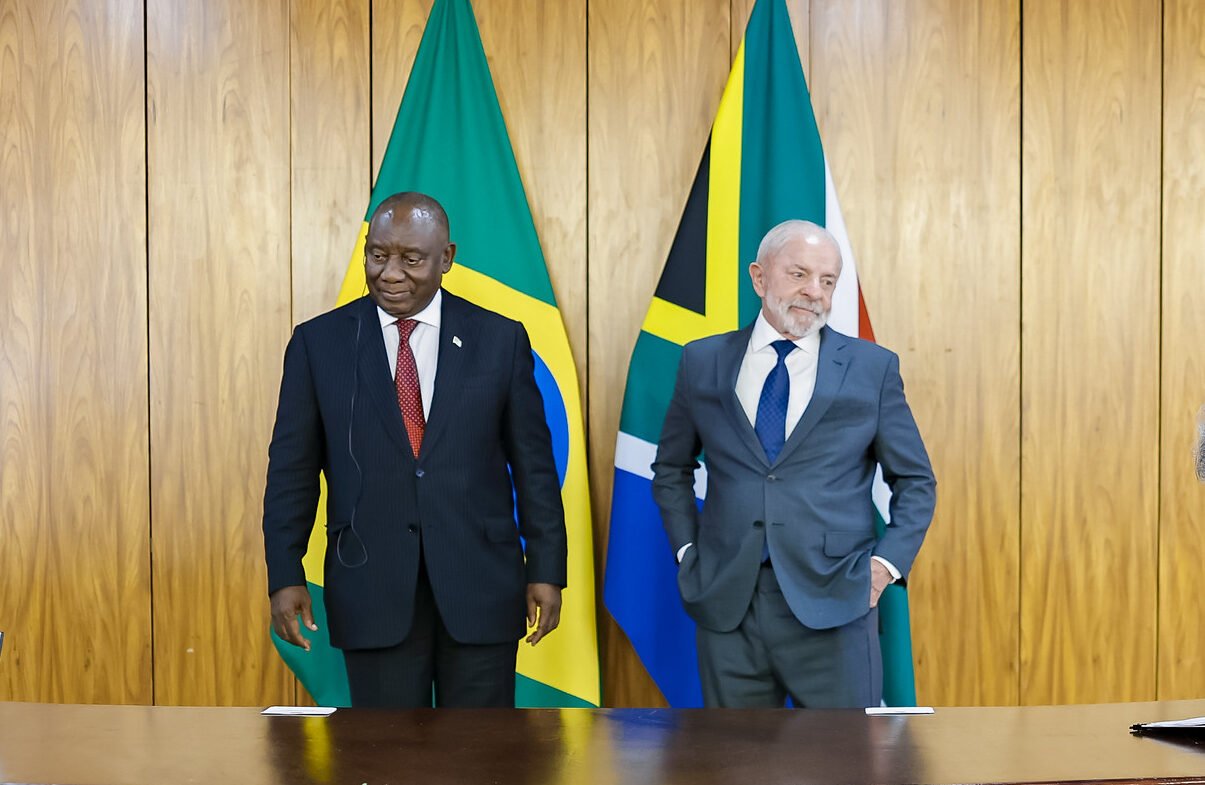
Lula received in Brasília, on Monday (9), a visit from another Brics leader, the president of South Africa, Cyril Ramaphosa. During the meeting, both made individual statements about the situation in the Middle East, showing concern and calling for peace. But neither president singled out the group as a discussion forum for peace in Iran.
Since 2023, due to the influence of China and Russia, the bloc had been adopting anti-American positions. In June last year, the Brics took an institutional stance against the attacks by Israel and the United States on Iran’s nuclear structures, in the 12-Day War. But during the current military campaign in Iran, the bloc has chosen to remain silent.
Meanwhile, the United Arab Emirates and Saudi Arabia had oil refineries, airports and ports bombed and are now evaluating the possibility of not only defending themselves against attacks, but also retaliating militarily on Iranian territory.
For analysts, the bloc’s lack of action in relation to the conflict in the Middle East highlights a structural weakness: the Brics lacks institutional and strategic instruments to act as a geopolitical actor. The understanding is that the group brings together countries with divergent strategic interests, a low degree of institutionalization and little capacity for political coordination.
For international strategist Cezar Roedel, PhD in Philosophy from PUCRS/UniBonn, the absence of a joint position is not surprising. According to him, since its creation, the group has never functioned as a political alliance in the strict sense. “The BRICS was never a cohesive bloc. It was just the union of some countries that had certain similar characteristics, but which today are very different from each other”, he stated.
Iran and the United Arab Emirates joined the bloc after the expansion announced in 2023 and formalized their entry in 2024, along with Egypt and Ethiopia. Saudi Arabia was invited to be part of the group at the same opportunity, but is not yet a full member of Brics, although she participates in some meetings. The expansion movement sought to expand the group’s political influence and reinforce the idea of an alternative pole to the international order led by the West.
SEE ALSO:
-
Flávio and Lula’s antagonistic positions on Iran are already heating up the electoral debate
-
Lula admits Brazil’s vulnerability: “someday someone invades us”
Analysts see a lack of cohesion and unequal weights among Brics members
In the assessment of international strategist Cezar Roedel, internal differences intensified after the expansion of the group, which began to include countries with strategic interests and significant regional rivalries. “If there is a joint position, it will be something very weak, basically symbolic”, points out Roedel.
Another factor that limits the political activity of the bloc, according to political scientist and professor at the Federal University of Piauí (UFPI) Elton Gomes, is the great asymmetry of power between its members, with countries at very different levels of global influence. “The Brics are relevant mainly because of China, for its economic and technological weight, and Russia, for its military power. The other countries play an intermediate or lesser role in the distribution of global power”, stated Gomes.
In his assessment, countries like Brazil, India and South Africa have limited influence within the global geopolitical arrangement and do not have the capacity to counterbalance the great powers. “None of these smaller Brics actors have enough weight to influence the decisions of the major players, inside or outside the bloc. Much less to counterbalance the United States and NATO countries. [aliança militar ocidental]”, said political scientist Elton Gomes.
Roedel also states that, at the moment, the bloc’s strongest countries are more concerned with their own strategic interests — especially the security of energy routes in the Persian Gulf. “The biggest concern for the Russians, Indians and Chinese is the oil that passes through the Strait of Hormuz. There is no great incentive to mobilize a strong political reaction within the BRICS.”
Lula bets on weakened bloc
The Lula government’s commitment to strengthening BRICS as an axis of Brazil’s international projection, according to analysts, may face difficulties given these structural limitations. Roedel assesses that the country runs the risk of investing diplomatic capital in a project with low real capacity for geopolitical influence. “Brazil insists on this speech, but, in practice, each BRICS member follows its own path”, he stated.
Roedel states that the group is going through a moment of strategic disorganization. According to him, there are deep divergences on central issues, such as the proposal to create an alternative currency to the dollar.
“BRICS entered into an almost bankruptcy process [processo de esvaziamento]. The Indian Prime Minister, who currently presides over the bloc on a rotating basis, does not even want to seriously discuss replacing the dollar. Meanwhile, Russia is pushing for alternative payment systems and China has toned down that speech,” he said.
In an article recently titled under the title “The end of Brics”Roedel further argues that the group has transformed into a space dominated by political rhetoric. According to him, “BRICS has become a bloc that talks a lot and delivers little”.
Internal rivalries also expose the bloc’s fragility and highlight its symbolic role
The political composition of the group also makes it difficult to build common positions. A significant part of the members are formed by authoritarian regimes, which, according to political scientist Elton Gomes, tends to reduce the degree of trust between governments. “Autocratic regimes tend to deeply distrust each other. Dictators rarely trust dictators,” he said.
The strategic differences between the members themselves are more evident in the simultaneous presence of Iran and Saudi Arabia in the expanded group.
The two countries compete for regional influence in the Middle East and belong to rival political and religious camps within the Islamic world. While Saudi Arabia maintains strategic relations with the West, Iran approaches the axis formed by Russia and China.
“These are countries with very different geopolitical agendas, with low economic complementarity and inserted in opposing security camps. This greatly reduces the incentives for real cooperation”, he assessed.
Given these limitations, the political scientist assesses that the Brics functions much more as a space for political signaling than as a strategic alliance capable of acting in a coordinated manner. “In practice, Brics serves much more to produce political capital and international projection. A Brazilian diplomat once summed it up ironically: Brics is very good for ‘photo opportunities‘ (from English, photo opportunity)”, he stated.
According to him, the group ends up serving as a platform to expand the international influence of countries like China, which seeks to reinforce its position in the geopolitical dispute with the United States.
“For those who want to compete for global hegemony, it is important to appear surrounded by allies. But, in the case of Brics, it is a very fragile alliance”, he concluded.
Lula and Ramaphosa do not mention Brics as a mediation instrument
At this week’s meeting, even in the face of the war in Iran, Brics was not mentioned by Brazilian and South African leaders as a possible forum for diplomatic coordination to deal with the conflict, which reinforces doubts about the group’s political capacity. In individual statements, Lula and Ramaphosa expressed concern and called for peace without mentioning the group of which their countries are founders.
Ramaphosa stated that his visit to Brazil comes at a time of worsening international tensions and appealed for a peaceful solution. “We call on all parties involved in this conflict for an immediate ceasefire, so that conflicts can be resolved through negotiation,” he said.
In the same vein, Lula stated that only diplomacy can produce a lasting solution to the crisis. “Dialogue and diplomacy constitute the only viable path to building a lasting solution,” declared the Brazilian president.
Mention of the conflict in the Middle East also appeared in the joint statement released after the bilateral meeting. In the document, Brazil and South Africa expressed concern about the attacks against Iran and subsequent hostilities in the region.
“[Os presidentes] condemned and expressed grave concern about the February 28 attacks against Iran and the hostilities and retaliatory actions in the Middle East, which represent a serious threat to international peace and security, with potential far-reaching humanitarian and economic impacts”, says the text.
The document also records an appeal for the cessation of hostilities. “The Presidents expressed solidarity with the countries subject to retaliatory attacks. They called for the cessation of military actions, urged all parties to respect international law and exercise maximum restraint, and reaffirmed that dialogue and diplomatic negotiation constitute the only viable path to overcoming differences.”
Brics appears in the statement only in the economic and financial context. In one of the excerpts, the two presidents reaffirm their interest in expanding trade between the group’s countries and reducing dependence on the dollar in transactions.
During the visit, Ramaphosa also mentioned the negative impact of trade tariffs imposed by President Donald Trump without naming him and defended greater economic integration between emerging countries.
The speech reinforces a frequent interpretation among analysts that the Brics has been used mainly as a platform for economic and political contestation of the influence of the United States — especially in the international financial system — and not as a structured mechanism for diplomatic mediation or resolution of international conflicts.
