
Rarely has a first touch carried so much consequence.
As the Philippines’ second goal sailed untouched into the back of the net, sealing their victory, the clock started ticking for their opponents: the Iranian women’s team were now out of the Asia Cup tournament.
They were going home.
To a land ravaged by war, to the hands of a regime that had branded them “wartime traitors” for failing to sing their national anthem in their opening match of the tournament.
But already, machinations were under way.
For days, members of the Iranian team had been trying to find a way to stay.
‘Woman life freedom’
The Iranian women’s team arrived at the women’s Asian Cup unfancied against more match-hardened opposition. But their very presence was a victory for their country, a place where women’s rights are violently and viciously curtailed, where “woman life freedom”, a Kurdish-rooted feminist slogan, had become a rallying cry for an entire oppressed nation.
Their first match, against South Korea, took place less than 48 after US and Israeli airstrikes devastated their homeland.
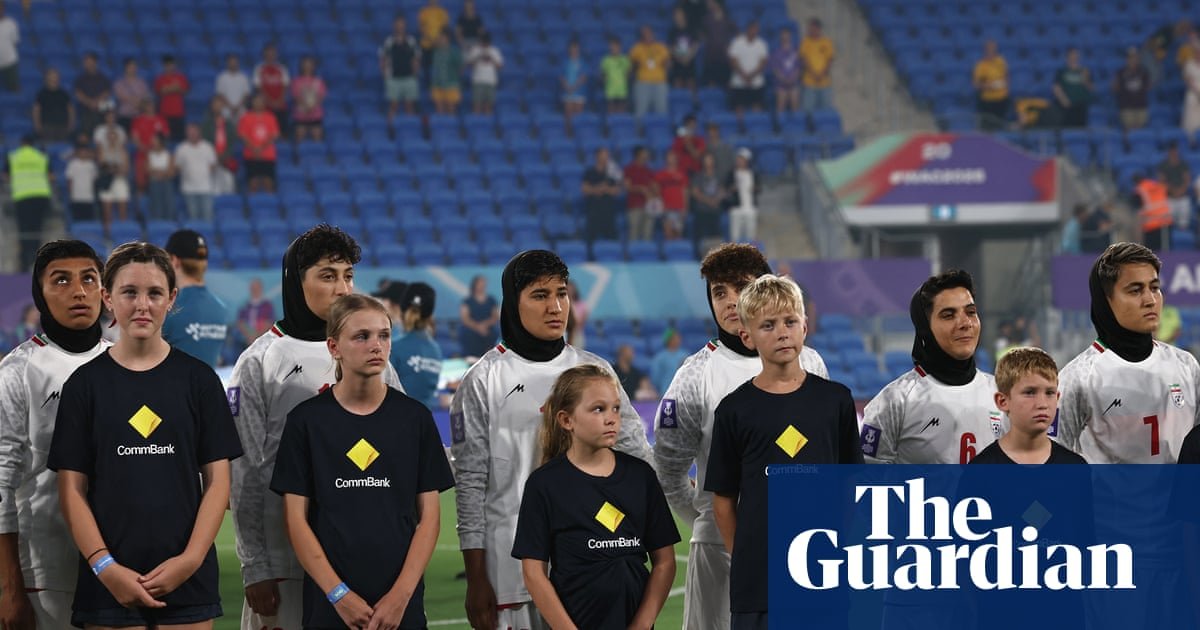
The players stood resolutely silent while their nation’s anthem was played.
On state-run television, the response was furious invective, and the message was clear: “I must emphasise that traitors during wartime should be dealt with more severely,” host Mohammad Reza Shahbazi said.
“The stain of dishonour and treason must remain on their foreheads, and they must face a definitive and severe confrontation.”
The pressure brought to bear on the team – tightly sequestered in the team hotel, their movements and communications monitored by team security presumed to be members of Iran’s Revolutionary Guard Corps – became apparent at their next match.
When the Iranian national anthem was played before the team played Australia’s Matildas, every member of the team saluted and sang.
Already, some were planning they would not return to Iran.
Iran’s final group match was against the Philippines on Sunday. A loss would see them out of the tournament.
Amid ceaseless rain on the Gold Coast, so it came to pass. Despite repeated extraordinary and desperate saves by goalkeeper Raha Yazdani, Iran lost 2-0, their tournament ended.
As their bus left the stadium, protesters surrounded it, chanting “save our girls”. Some players were seen to be making the international hand gesture for help – holding one hand up, tucking the thumb into the palm, and folding the fingers down over it.
Over Sunday and Monday, home affairs minister Tony Burke travelled to Queensland to speak with team members about their situation, and their potential desire to stay in Australia.
In the lobby of the Royal Pines Resort, friends and advocates sought a fleeting chance encounter – as little as eye contact across the room – with members of the tightly sequestered, surveilled team.
On Sunday, Iranian diaspora leaders wrote to home affairs minister Tony Burke, concerned time was running out to reach the players.
‘Forces of coercion and control’
The advocates held “serious concerns that Islamic Republic officials accompanying the team are closely monitoring the players and are intimidating them”.
“We respectfully urge the Australian authorities to speak with the players individually and privately … away from Islamic Republic officials or security personnel, to ensure they are aware of their rights.”
A source familiar with the operation said that there was little chaos or confrontation when officials sought access to the players Monday. The source said that federal police – in inviting individual players to speak privately so that could be informed of their rights – were able to remove the minders’ “forces of coercion and control” that were keeping the players isolated.
The Australian government offered temporary humanitarian visas to members of the team who did not feel they could safely return to Iran. The visas are subclass 449 which offer temporary protection, with a pathway to permanency: they are the visas that have previously been offered to Ukrainians and Afghans fleeing conflict in their countries.
Five players from the squad – captain Zahra Ghanbari, and teammates Fatemeh Pasandideh, Zahra Sarbali, Atefeh Ramezanizadeh, and Mona Hamoudi – made the decision not to return to Iran.
Those players were then taken by Australian federal police officers “to a secure location” away from the team hotel: slipping their oppressive surveillance, and driven from the hotel by police.
They have been security-vetted by intelligence agency Asio. The players remain under the protection of the AFP, and have given permission for their names and images to be published.
The ministerial paperwork was finalised about 9:30pm Monday, long before the bombastic declaration of US president Donald Trump. The visas were formally granted at about 1:30am on Tuesday. The players had a right to stay in Australia.
Fifteen minutes earlier – late morning Washington DC time – Trump had taken to Truth Social to berate Australian prime minister Anthony Albanese for failing to protect the team.
“Australia is making a terrible humanitarian mistake by allowing the Iran National Woman’s Soccer team to be forced back to Iran, where they will most likely be killed. Don’t do it, Mr. Prime Minister, give ASYLUM.”
Trump promised the US would resettle the players if Australia wouldn’t. He then reposted a post from Australian activist Drew Pavlou alleging team members faced a “flight home tomorrow to almost certain persecution”.
Albanese was then woken by a phone call from the president just before 2am in Canberra, a discussion, despite the hour and the urgency, the prime minister characterised as “positive”.
“He [Trump] was concerned about the Iranian women in the soccer team and their welfare and their safety if they returned home,” Albanese said.
“I was able to convey to him the action that we’d undertaken over the previous 48 hours and that five of the team had asked for assistance and had received it and were safely located.
“Assistance remains available for the other members of the team, but it of course is a decision for them. If they make a decision to ask for support, they will receive it.”
Trump returned to megaphone diplomacy on Truth Social just before 3am Australia-time, his tone markedly changed.
“I just spoke to Prime Minister Anthony Albanese, of Australia, concerning the Iranian National Women’s Soccer Team. He’s on it! Five have already been taken care of, and the rest are on their way. Some, however, feel they must go back because they are worried about the safety of their families, including threats to those family members if they don’t return. In any event, the Prime Minister is doing a very good job… with this rather delicate situation. God bless Australia!”
A few hours later, Australia woke to the news that five members of the Iranian team would not be leaving the country.
“They are welcome to stay in Australia,” Burke told an early morning press conference in Brisbane. “They are safe here, and they should feel at home here.
“I say to the other members of the team: the same opportunity is there. Australia has taken the Iranian women’s soccer team into our hearts.
“These women are tremendously popular in Australia, but we realise they are in a terribly difficult situation with the decisions that they’re making. But the opportunity will continue to be there to speak to Australian officials if they wish to.”
While so far, only five members of the team have chosen not to return to Iran, more defections may follow.
Sources close to the group have told the Guardian they expect more players – and possibly some staff – to make the decision to stay in Australia. But the team is still under surveillance by regime-linked minders surrounding the team.
‘Speculation and wild misinformation’
On Tuesday afternoon, the team bus left their hotel, bound for the Gold Coast airport for a flight to Sydney, from where they would leave the country. At least one player was seen to be being forcibly led on to the team bus – held by the hand and pulled by a team-mate.
Anxious friends and advocates speculated on where they might fly to, and how players could be safely reached – and asked freely their wishes – before they boarded a flight.
Iran state media quoted Farideh Shojaei, vice-president for women’s affairs at the Iranian Football Federation, who said the team had left the hotel accompanied by police.
“We have contacted the embassy, the football federation, the foreign ministry and anywhere possible to see what will happen,” she said. “We have even spoken with the families of these five players.”
Shojaei said while the squad had originally planned to return to Iran via Dubai, in the wake of Iranian missile strikes on UAE territory, its government had refused to allow Iran’s players to transit through its territory. Shojaei said she now expected the team to return through Malaysia and Turkey.
In Australia, as the team’s expected departure drew closer, speculation grew rampant, fuelled by wild misinformation, over the fate of the team.
Australian academic Kylie Moore-Gilbert, detained by Iran’s Revolutionary Guards in Evin Prison for 804 days between 2018 and 2020, urged Australia to make a last-minute intervention.
“This is a rare opportunity to hold the regime to account for the way that it treats women and girls. If there is any evidence of coercion by the accompanying delegation, I think Australia should seize upon it and investigate and do our best to protect these women,” she told the Guardian.
Late on Tuesday, the remaining team members landed at Sydney airport. They were escorted from the back of their plane on to a bus, surrounded by airport staff and federal police. It was not known where they were taken.
Dozens of supporters who had gathered at the gate inside the terminal to greet the players were forced instead to shine torches through the airport window.
Someone from inside the team’s bus appeared to shine a torch light back. Those gathered to support the team argued with police that the light meant the person wanted help.
One supporter, Farak, carried a recording she said was of one player’s mother, urging her to stay in Australia, to not return home. Farak intended to play it via a speaker to the player as she exited the plane.
“I’m pretty sure if she hears this she will want to stay,” Farak, who gave only her first name, told the Guardian.
Farak said she was devastated the player did not get the chance to hear the recording.
“It’s so sad. What if something happens to this girl?”
with Jordyn Beazley
