
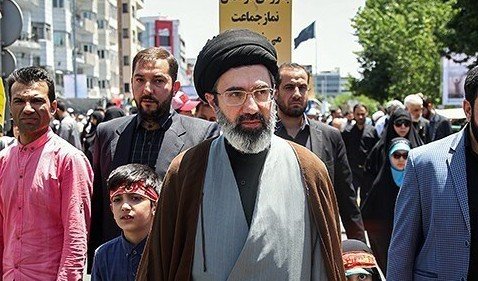
The death of Iran’s supreme leader, Ali Khamenei, in the first days of war with the US and Israel raised questions about political succession in the country. His son, Mojtaba Khamenei, emerged as one of the main bets to keep the regime standing.
The candidate for the most important position in Iran is 56 years old and has never held an important position. Despite this, he is identified as an active name behind the scenes in national politics for coordinating his father’s cabinet and for maintaining ties with the Revolutionary Guard, considered the “guardian” of the ayatollahs’ ideological influence.
A newspaper article The Economist mentions that, despite being a political unknown, he has close relations with Hossein Taib, a powerful intelligence chief in Iran’s Revolutionary Guards, which may have influenced his rise.
One of the groups he maintains some influence over is the Basij militia, the volunteer force responsible, among other things, for repressing protests in Iran. In American diplomatic cables released by WikiLeaks in 2008 he was described as “the power behind the robes” and “a capable and energetic leader and manager”.
The new supreme leader was born in 1969 in the holy city of Mashhad, when his father was still a dissident and fighting to overthrow the monarchy led by Shah Mohammad Reza Pahlavi, who was finally deposed by the Islamic Revolution in 1979.
The second son of Ali Khamenei, he became a cleric like his father and completed his theological studies in the holy city of Qom, the main center of Shiite studies in the country, where he also worked as a professor at a seminary.
At the age of 17, he participated in the Iran-Iraq War (1980-1988), the conflict that marked an entire generation of Iranian leaders. Today, he is presented as an ayatollah, like his father, the highest clerical position within the theocratic regime.
Iran’s supreme leader is responsible for heading the Armed Forces and directing the country’s foreign policy, which in Tehran’s case is guided mainly by the strategy of fighting its enemies, the USA and Israel.
The national constitution says the supreme leader is appointed by the Assembly of Experts, an 88-member clerical body that oversees and, in theory, can fire the supreme leader.
Now, as the new supreme leader, he is the country’s highest political authority, with the power to define the general policies of the Islamic regime and to restructure the country’s top positions, including the military.
The choice of a new hard-line leader for Iran appears to be a challenging tone for the US and its war in the Middle East. President Donald Trump had signaled last week that he considered it “unacceptable” for Ali Khamenei’s son to assume power.
In 2019, Trump even sanctioned Mojtaba along with eight other regime figures “for their destabilizing policies” and linked to “extrajudicial executions” and the 1994 attack on the headquarters of the Argentine Mutual Israelite Association (AMIA), which killed 85 people.
