
NATO mobilized the largest allied air force so far this year during two training missions between the Baltic states and Romania.
NATO carried out 4 and 5 March 2026 an extensive military air exercise that gathered forces from several allied countries along the alliance’s eastern flank. The operations were part of the initiative Eastern Sentryled by Allied Air Command (AIRCOM)with the aim of strengthening the air defense and demonstrating joint reaction capability against potential threats.
According to the alliance, this was it largest cooperative operation with allied air power this year within Flexible Deterrent Option (FDO)-operations, which are carefully planned deterrence activities to demonstrate unity and military readiness.

C-A2AD-trening i Romania
The first mission took place 4. mars in the vicinity of Mihail Kogălniceanu flybase in Romania. The exercise focused on Counter Anti-Access/Area Denial (C-A2AD)-operations, designed to train allied forces in neutralizing enemy air defense systems and ensuring freedom of operation in airspace.
The following aircraft participated in the mission:
- Mirage 2000D from France
- Eurofighter Typhoon from Germany
- F/A-18 Hornet from Spain
- F-16 from Romania
Germany currently has a detachment at the Romanian base to support NATO’s enhanced air policing missionswhile Spain uses the site to train the concept Agile Combat Employment (ACE)which provides for more dispersed and flexible air operations.

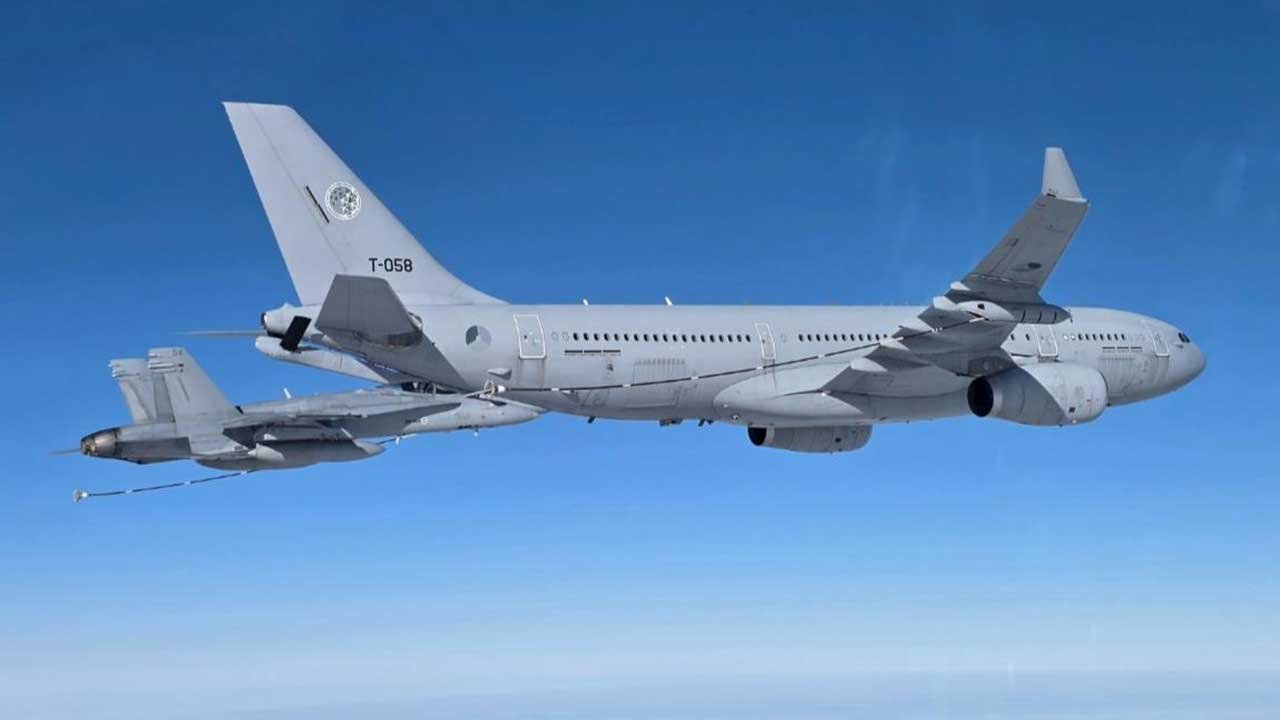
The mission also included support aircraft, including a French A330 MRTT and one Spanish A400M configured for air refueling. Romanian ground-based systems also participated by providing realistic threat scenarios.
The entire operation was coordinated by NATO’s Combined Air Operations Center (CAOC) i Torrejón and Spain.
Multi-domain exercise in the Baltic Sea region
The next day, 5. marsthe focus of the operation shifted to Northern Europe, covering the area from Baltic Sea to Finland. The exercise used the concept F2T2 (Find, Fix, Track and Target)which involves locating, identifying, tracking and ultimately neutralizing a target in a complex operational environment.
The mission gathered military resources from eight NATO countries and integrated capabilities from multiple domains:
- air forces
- ground-based systems
- cyber capabilities
- space-based resources
Among the participating resources were:
- Mirage 2000D from France
- F/A-18 Hornet from Finland
- A330 MRTT aerial refueling aircraft from France and the multinational MRTT unit

Air control and combat control centers from Poland, Estonia and Finland provided ground-based command and control, while ground-based air defense systems from Estonia, Great Britain and the United States also participated in the training.
Canadian Joint Operations Command contributed capacities within Intelligence, Surveillance and Reconnaissance (ISR).
This mission was coordinated by NATO’s CAOC in Uedem in Germanywhich is responsible for airspace control in the northern region.
NATO’s new air defense strategy
The initiative Eastern Sentry is part of NATO’s extended surveillance activity known as enhanced Vigilance Activity (eVA)and represents a new model for the alliance’s air defence.
Rather than relying only on fixed bases or permanent patrols, the concept builds on a dynamic and distributed defense positionenabling air forces to move rapidly along the entire eastern flank — from the Baltic States and Poland to the Black Sea.
According to NATO, this approach is increasing situational awarenessimproves coordination between allies and strengthens the ability to quickly respond to new threats.
The two missions carried out in March mainly aimed to:
- increase interoperability between allied forces
- improve tactics and operational procedures
- integrate multi-domain operations in complex scenarios
Through this, the alliance seeks to strengthen its air and missile defense position and ensure continuous protection of the member states’ airspace.
+ Israel’s defense publishes new video of the moment an F-35I shoots down an Iranian Yak-130
+ Meet the E-2C Hawkeye, the US Navy’s “flying radar”
Source and images: NATO. This content was created with the help of AI and reviewed by the editors.
