
More than a decade after U.S. officials first publicly reported mysterious neurological injuries while serving overseas, some military personnel are seeking recognition for what happened to them.
The government has long said it was unlikely these injuries were caused by a weapon, because no such weapon was known to exist. But this week on 60 Minutes, correspondent Scott Pelley reports on a classified mission that appears to have discovered just that — a directed-energy weapon that could cause the types of brain injuries associated with the condition widely known as Havana Syndrome.
The syndrome first drew attention in 2016 after U.S. personnel stationed at the American embassy in Havana, Cuba reported strange sounds and sudden health problems. Since then, hundreds of government employees have reported similar symptoms in locations around the world.
Victims say the attacks left them with lasting damage to their hearing, vision, balance and cognitive function.
“The worst pain I have ever felt”
Chris, a lieutenant colonel who worked on highly classified spy satellite programs, retired after two decades of work between the Air Force and Space Force. He told 60 Minutes he believes he was attacked repeatedly in his home in northern Virginia in 2020. He and his wife Heidi asked that their last name not be used publicly.
Chris says the attacks left him with severe neurological injuries.
“I had significant symptoms,” he said, explaining that doctors later discovered he had lost half the hearing in his left ear. “I had a lot of disorientation, confusion, dizziness. That also began the cognitive changes, particularly the anxiety.”
He said the fifth incident was the most severe.
“I woke up with a full-body convulsion,” Chris recalled. “The worst pain I have ever felt. It felt like a vice gripping my brainstem.”
The symptoms have been permanent. Chris — who said he had never heard of Havana Syndrome prior to the 2020 attacks — said he sustained significant damage to multiple organ systems and currently takes two neurological drugs daily. The Department of Veterans Affairs now considers him “100%, permanent and total” disabled.
When asked who he believes was responsible, Chris answered immediately: Russia.
“They’re the only country that I have ever essentially crossed in my career and who made themselves known that they were actively surveilling me,” he said, adding that Russian intelligence had previously shown active interest in his work.
Families seek acknowledgment
For Chris’s wife Heidi, the frustration comes not only from the injuries but from what she sees as the government’s reluctance to officially recognize them as attacks.
“Having served, being a spouse of someone who’s served for 20 years, I understand that that is much broader than our individual lives,” she said. “With that said, I do think that there is enough evidence out there now that some formal acknowledgment that this has happened is good for our nation.”
She says such recognition would also honor the service members and families who have suffered.
“You gave us your service and we acknowledge that you were hurt in the line of that service,” she said.
Debate over the Purple Heart
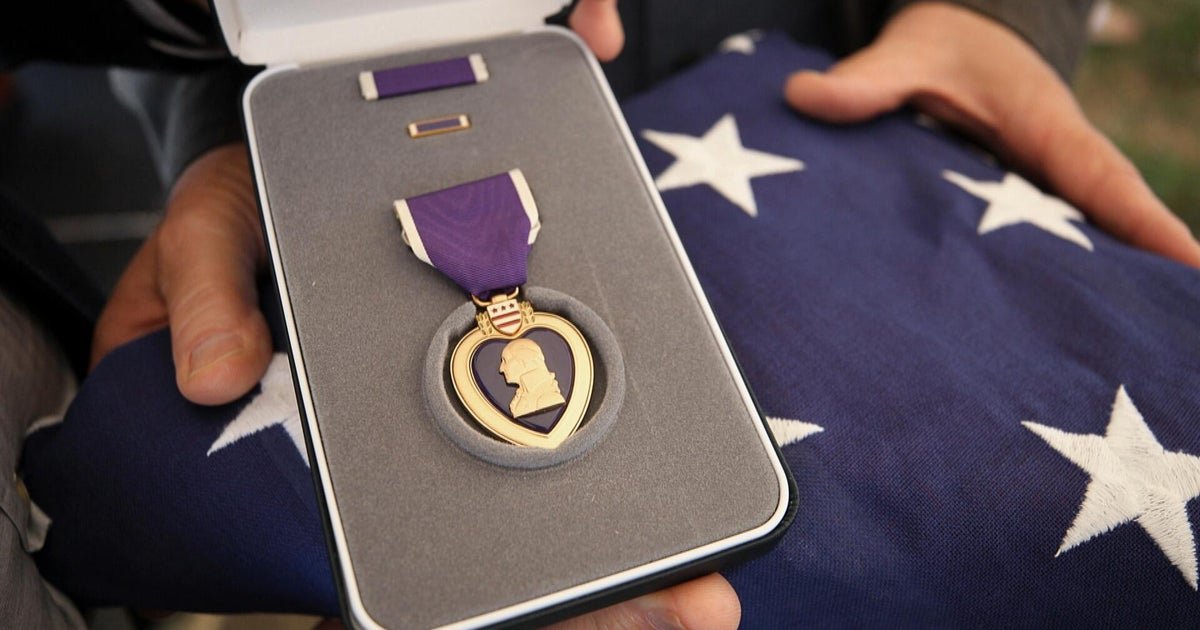
The question of recognition has become especially contentious when it comes to the Purple Heart, the U.S. military decoration awarded to service members wounded or killed by enemy action while serving.
The medal traces its roots to 1782, when George Washington created the “Badge of Military Merit,” which was shaped like a purple fabric heart embroidered with the word “merit.” For 150 years, only three people had ever received it. Then in 1932, Douglas MacArthur revived it in honor of Washington’s bicentennial and renamed the award the Purple Heart.
About 1.8 million have been awarded, but whether injuries linked to Havana Syndrome qualify is still being debated.
Former senior CIA officer Marc Polymeropoulos, who says he experienced a Havana Syndrome attack in 2017, argues the answer should be clear.
“It’s not something that should be all too controversial,” he said.
Polymeropoulos described a case involving a serviceman who was treated at Walter Reed National Military Medical Center and recommended for the Purple Heart by his superiors.
The award was approved, Polymeropoulos said, and a ceremony was scheduled. But at the last moment it was rescinded.
“How do you think that U.S. military officer, who has served faithfully — how do you think they feel?” he asked.
The intelligence community dispute
The U.S. government refers to cases linked to Havana Syndrome as “Anomalous Health Incidents,” or AHI, rather than attacks.
One source familiar with the rescinded medal case said the decision followed the 2023 Intelligence Community Assessment findings that it is “very unlikely” a foreign adversary is responsible for AHIs. In other words, AHIs have not been officially linked to enemy action, which is required for the Purple Heart.
This source said it was the Army who issued and then canceled the award.
At the time, the director of the Defense Intelligence Agency was Lt. Gen. Jeffrey Kruse, who declined to comment on the record.
Kruse was dismissed in August 2025 during the administration of Donald Trump. Reports at the time said his removal followed public disagreements between the agency and the president over U.S. strikes on Iran’s nuclear sites.
But Republican Rep. Rick Crawford, the chairman of the House Intelligence Committee, told 60 Minutes he had recommended at the time that Kruse be removed for reasons tied directly to “his actions in a specific AHI survivor’s case.”
Calls for a reassessment
Despite years of investigations, the government has maintained that it is unlikely the injuries were caused by a weapon because none had been conclusively identified.
The new reporting suggesting a possible directed-energy weapon could reopen that debate.
For victims like Chris, the issue is not only scientific or political — it is deeply personal. He says the government should revisit its conclusions and reassess the evidence.
Receiving a Purple Heart, he said, would bring something he has been waiting for since the attacks.
“It would tell me that they understand that I made that sacrifice for the country while serving in the military,” Chris said. “And give me that closure that I’m looking for.”
The video above was produced by Brit McCandless Farmer, Oriana Zill de Granados, and Michael Rey. It was edited by Scott Rosann.
