
When the United States launched Operation Epic Fury last Saturday, the Trump administration had a major communications question to figure out: how to explain to the American public, Congress, and the world why it had just started a war with Iran.
During war time, talking points and propaganda reflexively fly in every direction, but the Trump administration still hasn’t been able to land on one coherent answer.
Some contradict each other, and some contradict Donald Trump himself. Some – delivered hours apart by senior officials – are flatly incompatible.
Here is how the story has shifted over the first week of war.
The Truth Social video
28 February
Trump announced the war in an eight-minute video posted to Truth Social at 2.30am ET last Saturday, framing Operation Epic Fury as a defensive response to decades of Iranian aggression – and, in the same breath, a campaign for Iranian liberation. The objectives multiplied with each sentence.
We are going to destroy their missiles and raze their missile industry to the ground. It will be totally, again, obliterated.
He invoked the 1979 hostage crisis, Hezbollah, Hamas, Iranian-backed militias, and “47 years of Iranian aggression”. He urged Iranians to “seize this moment, to be brave, be bold, be heroic, and take back your country”. He called it a campaign to “eliminate the imminent nuclear threat”.
Later that same day
28 February
After the first bombs hit, Trump was already framing the conflict on his own elastic terms. Speaking to Axios on 28 February, in the hours after the initial strikes began, the president offered a breezy multiple-choice war:
I can go long and take over the whole thing, or end it in two or three days and tell the Iranians: ‘See you again in a few years if you start rebuilding [your nuclear and missile programs].’
…
In any case, it will take them several years to recover from this attack.
The remarks, which threatened total conquest and brief punitive strikes, set the tone for an administration that would spend the next week unable to settle on a single coherent war aim. Still, it suggested there could have been a diplomatic solution somewhere in the midst.
The Washington Post reported Trump told them separately the same day in a phone call that the goal was “freedom” for the Iranian people.
At the UN
28 February
Also on 28 February, the US mission to the United Nations rushed to construct a legal framework. The administration formally invoked article 51 of the UN charter – the self-defense provision – arguing that Iran’s missile arsenal and nuclear ambitions posed a direct threat to American forces in the region.
There, US ambassador to the UN Mike Waltz said:
The United States has made every effort to negotiate a peaceful resolution of this conflict with Iran, but Iran has failed to take that opportunity. So in close coordination with the government of Israel, the United States has taken lawful actions to address these threats, in line with article 51 of the charter of the United Nations.
Waltz also told the council: “You know who is not complaining tonight? The Iranian people, who are celebrating in the streets.”
Briefing to congressional staff
1 March
Pentagon briefers reportedly acknowledged to congressional staff on 1 March that Iran was not planning to strike US forces or bases unless Israel attacked Iran first, which directly undercuts the White House’s framing of an “imminent threat”.
Hegseth at the Pentagon
2 March
At the first Pentagon press briefing after the strikes, Pete Hegseth took an aggressive posture to frame the war as both retaliation for decades of Iranian behavior and a laser-focused military operation with clearly bounded objectives.
The mission of Operation Epic Fury is laser-focused. Destroy Iranian offensive missiles, destroy Iranian missile production, destroy their navy and other security infrastructure, and they will never have nuclear weapons.
…
This is not a so-called regime-change war, but the regime sure did change, and the world is better off for it.
…
Iran had a conventional gun to our head as they tried to lie their way to a nuclear bomb.
Hegseth also insisted the campaign was nothing like Iraq or Afghanistan: “This is not Iraq. This is not endless … This is the opposite … This operation has a clear, devastating, decisive mission.” He urged Iranians to “take advantage of this incredible opportunity” – the regime-change language that officials insisted was not a war aim.
Joint chiefs chair general Dan Caine would add his own caveat. “This is not a single overnight operation,” he said. “The military objectives Centcom and the Joint Force have been tasked with will take some time to achieve, and in some cases will be difficult and gritty work.”
Rubio’s admission
2 March
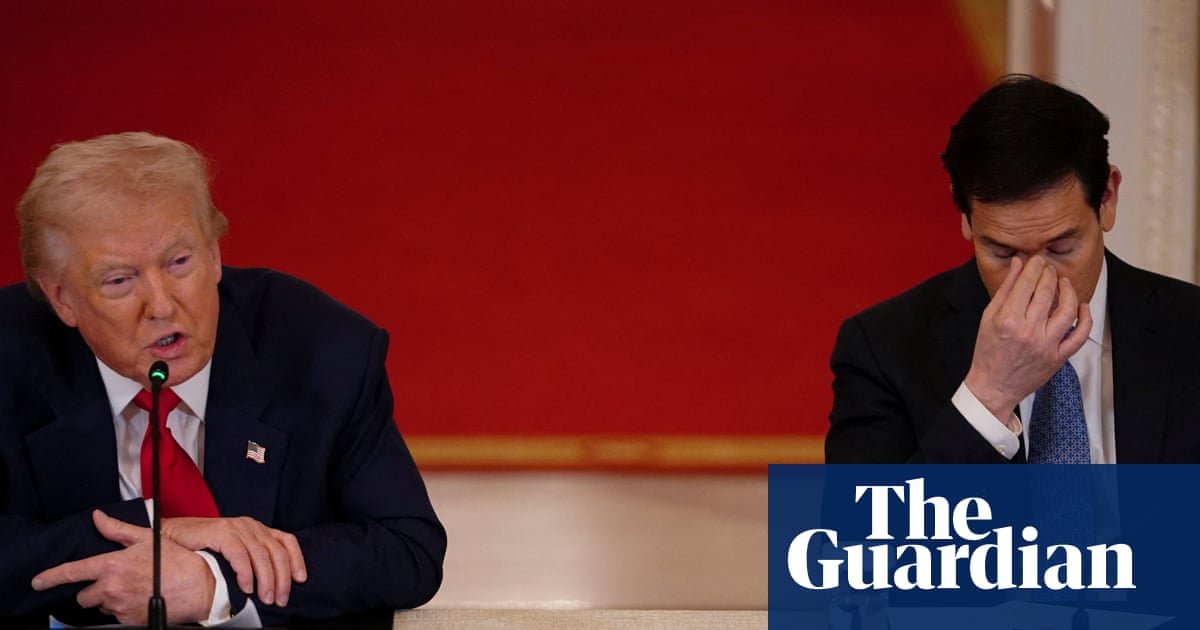
Hours after Hegseth’s briefing, secretary of state Marco Rubio offered reporters an entirely different explanation for the timing of the war.
Speaking on Capitol Hill before a classified congressional briefing, Rubio said Washington had known Israel was planning a unilateral strike on Iran, and that Tehran had pre-delegated authority to field commanders to automatically retaliate against US forces if attacked:
We knew that there was going to be an Israeli action. We knew that that would precipitate an attack against American forces, and we knew that if we didn’t preemptively go after them before they launched those attacks, we would suffer higher casualties.
He also told reporters:
There absolutely was an imminent threat, and the imminent threat was that we knew that if Iran was attacked, and we believed they would be attacked, that they would immediately come after us.
Rubio was, in effect, saying the United States had gone to war because an ally was going to act.
Trump contradicts Rubio, and Rubio contradicts himself
3 March
Trump flatly rejected Rubio’s framing, insisting the decision was entirely his own and driven by Iranian – not Israeli – intentions.
It was my opinion that they were going to attack first. They were going to attack if we didn’t do it.
Asked whether Israel had forced his hand, Trump went further: “If anything, I might have forced Israel’s hand.”
For those keeping score, there were now three incompatible explanations: Iran was an imminent nuclear threat, Iran would have retaliated against a coming Israeli strike, and Iran itself was about to attack.
Rubio attempted a partial retraction with reporters on the Hill. He insisted his remarks had been taken out of context and that the operation “had to happen anyway”:
The president made a decision, and the decision he made was that Iran was not going to be allowed to hide behind its ballistic missile program.
Hegseth’s second press conference
4 March
By the second Pentagon briefingHegseth explained the objectives as both near-victory and the start of a new chapter of the war, while six American service members had been announced as killed:
[The Iranian regime] are toast, and they know it, or at least soon enough, they will know it. And we have only just begun to hunt, dismantle, demoralize, destroy and defeat their capabilities just four days in.
….
Starting last night and to be completed in a few days, in under a week, the two most powerful air forces in the world will have complete control of Iranian skies, uncontested airspace.
It means we will fly all day, all night, day and night finding, fixing and finishing the missiles and defense industrial base of the Iranian military, finding and fixing their leaders and their military leaders, flying over Tehran, flying over Iran, flying over their capital, flying over the IRGC [Islamic Revolutionary Guard Corps]Iranian leaders looking up and seeing only US and Israeli air power every minute of every day until we decide it’s over.
He also introduced a new justification that had not previously featured prominently. “Iran tried to kill President Trump, and President Trump got the last laugh,” Hegseth said, announcing the killing of the IRGC unit commander behind an alleged assassination plot against the president.
Another Truth Social post
6 March
On Friday morning, Trump posted what amounted to a maximalist statement of total war aims on Truth Social:
There will be no deal with Iran except UNCONDITIONAL SURRENDER! After that, and the selection of a GREAT & ACCEPTABLE Leader(s), we, and many of our wonderful and very brave allies and partners, will work tirelessly to bring Iran back from the brink of destruction, making it economically bigger, better, and stronger than ever before. IRAN WILL HAVE A GREAT FUTURE. MAKE IRAN GREAT AGAIN (MIGA!) Thank you for your attention to this matter!
The post came after Iranian president Masoud Pezeshkian posted on X:
Some countries have begun mediation efforts. Let’s be clear: we are committed to lasting peace in the region yet we have no hesitation in defending our nation’s dignity & sovereignty. Mediation should address those who underestimated the Iranian people and ignited this conflict.
Trump’s post also appeared to directly contradict Hegseth’s earlier “limited objectives” framing, Rubio’s statements about the war’s defined military goals, and Trump’s own initial suggestion that the whole thing could be wrapped up in “two or three days”.
White House press secretary Karoline Leavitt would clarify to reporters that “unconditional surrender” simply means Trump determining “that Iran no longer poses a threat to the United States of America and the goal of Operation Epic Fury has been fully realized”.
