
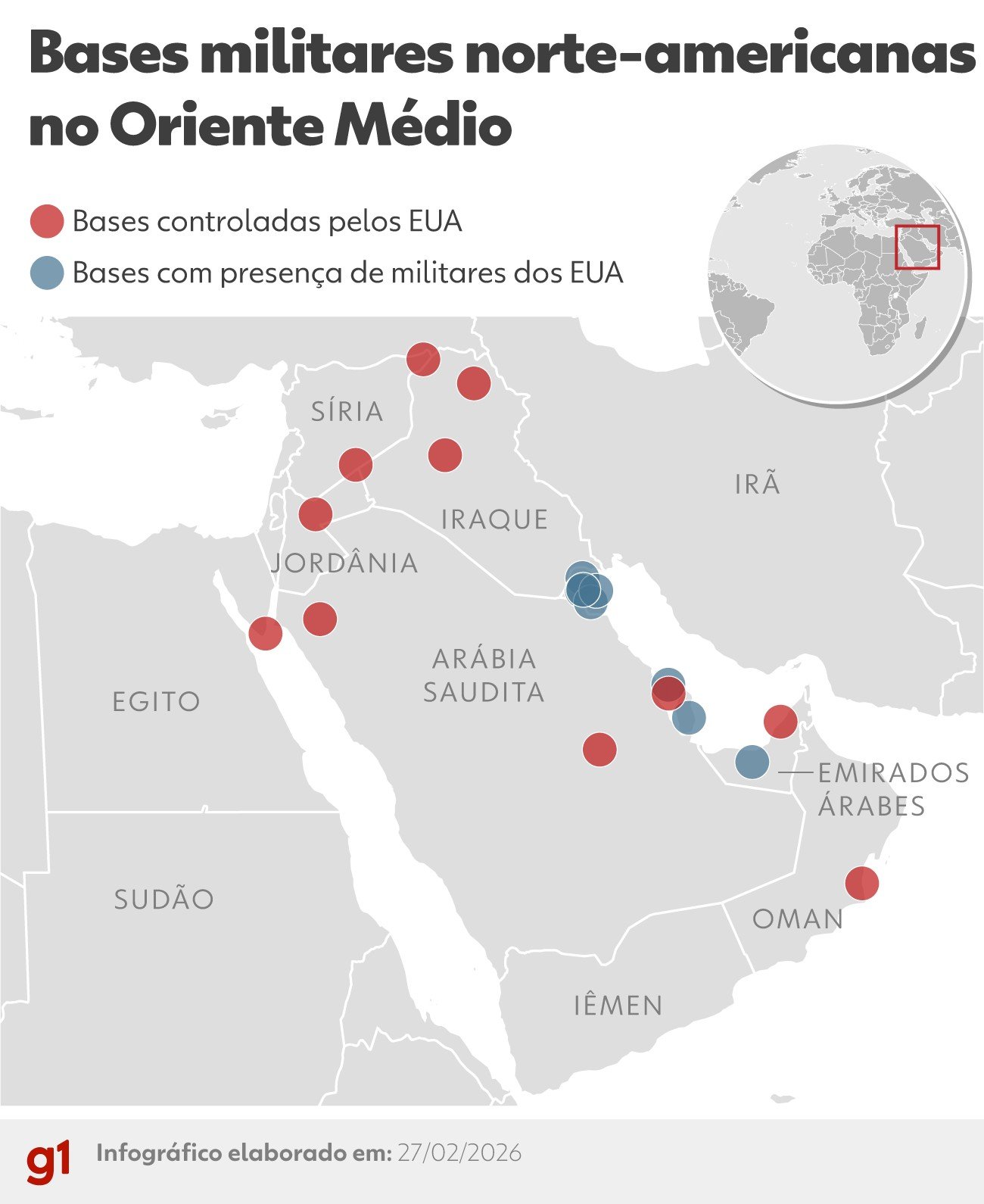
Iran appears to have built a strategy based on deterrence and resistance. Reuters via BBC Iran’s military stance in an escalating conflict with Israel and the United States suggests the country is not striving for victory in a conventional sense. It’s fighting for survival — and to survive on its own terms. ✅ Follow the g1 international news channel on WhatsApp LIVE: Follow the latest news about the war in the Middle East The leaders and commanders of the Islamic republic have been preparing for this moment for years. They knew that their regional ambitions could eventually provoke a direct confrontation with Israel or the US, and that a war with one would likely attract the other. This pattern was evident in the 12 Day War in June 2025, when Israel attacked first and the US joined days later. In the current round of fighting, both have launched attacks against Iran simultaneously. Given the technological superiority, intelligence capabilities and advanced military equipment of the US and Israel, it would be naive to think that Iranian strategists were planning a direct victory on the battlefield. Instead, Iran appears to have constructed a strategy based on deterrence and resistance. Over the past decade, the country has invested heavily in ballistic missiles, long-range drones and a network of allied armed groups across the region. Iran also understands its own limitations: the U.S. mainland is off limits, but U.S. bases scattered across the region — especially in neighboring Arab countries — are not off limits. Israel is already well within range of Iranian missiles and drones, and recent conflicts have demonstrated that its air defense systems can be penetrated. Each projectile that passes through these systems carries not only military but also psychological weight. Map shows US military bases in the Middle East. Kayan Albertin/Arte g1 Iran’s calculation is also based, in part, on the war economy. The interceptors used by Israel and the US are much more expensive than many of the drones and missiles employed by Iran. A prolonged conflict forces the US and Israel to expend high-cost resources to intercept comparatively cheap threats. Energy is another lever in the war economy. The Strait of Hormuz remains one of the world’s most critical chokepoints for oil and gas transportation. Iran does not need to completely close this narrow Gulf seaway. Even credible threats and limited disruptions have already raised prices and, if they continue, could increase international pressure for a de-escalation of the conflict. In this sense, escalation becomes a tool aimed not necessarily at defeating Iran’s adversaries militarily, but at raising the cost of continuing the war. This brings us to attacks against neighboring countries. Missile and drone attacks against countries including Qatar, the United Arab Emirates, Kuwait, Oman and Iraq appear to be designed to signal that harboring U.S. forces carries risks. Iran may hope that these governments will pressure the US to limit or halt operations, but that is a dangerous gamble. Expanding the attacks further risks hardening the hostility of these countries and pushing them more firmly into the US–Israel camp. The long-term consequences could outlast the war itself, reshaping regional alignments in ways that would leave Iran more isolated. If survival is the main objective, then expanding the circle of enemies is a high-risk step. Still, from Iran’s perspective, containment may appear equally risky if it is interpreted as a sign of weakness. Reports that local commanders may be selecting targets or launching missiles with relative autonomy raise new questions. If confirmed, this situation would not necessarily indicate the collapse of command structures. Iranian military doctrine, especially within Iran’s Islamic Revolutionary Guard Corps, has long incorporated decentralized elements to ensure continuity under intense attacks. Communication networks are vulnerable to interception and blocking. High-ranking commanders have been the target of attacks. US and Israeli air superiority limits central oversight. Under these conditions, pre-authorized target lists and delegation of launch authority may be deliberate measures against a “decapitation” of leadership. This structure may explain how Iranian forces continued to operate after the deaths of senior figures in Iran’s Islamic Revolutionary Guard Corps and even after the death of Iran’s Supreme Leader Ayatollah Ali Khamenei in the initial attacks conducted by the US and Israel on Saturday (2/28). But decentralization also brings risks. Local commanders acting with incomplete information could strike unintended targets, including neighboring states that sought to maintain neutrality. The absence of a unified operational framework increases the likelihood of miscalculations. If this goes on for too long, it can also result in a loss of command and control. Ultimately, Iran’s approach appears to be based on the belief that the country can withstand punishment for longer than its adversaries would be willing to bear the damage and costs of war. If so, this is a form of calculated escalation: resist, retaliate, avoid total collapse, and wait for political fissures to emerge on the other side. Still, resistance has limits. Missile stocks are limited and production lines are constantly under attack. Mobile launchers are hit on the move and replacing them takes time. The same logic applies to Iran’s adversaries. Israel has failed to fully rely on its air defense systems. Each loophole amplifies public anxiety. The U.S. needs to weigh regional escalation, energy market volatility, and the financial cost of prolonged operations. Both sides seem to assume that time is on their side. Both cannot be right. In this war, the Islamic republic does not need to triumph. She needs to remain standing. It remains to be seen whether this goal is achievable, without permanently alienating its neighbors.
Source link
Resistance and deterrence: Iran’s high-risk strategy for war
30

previous post