
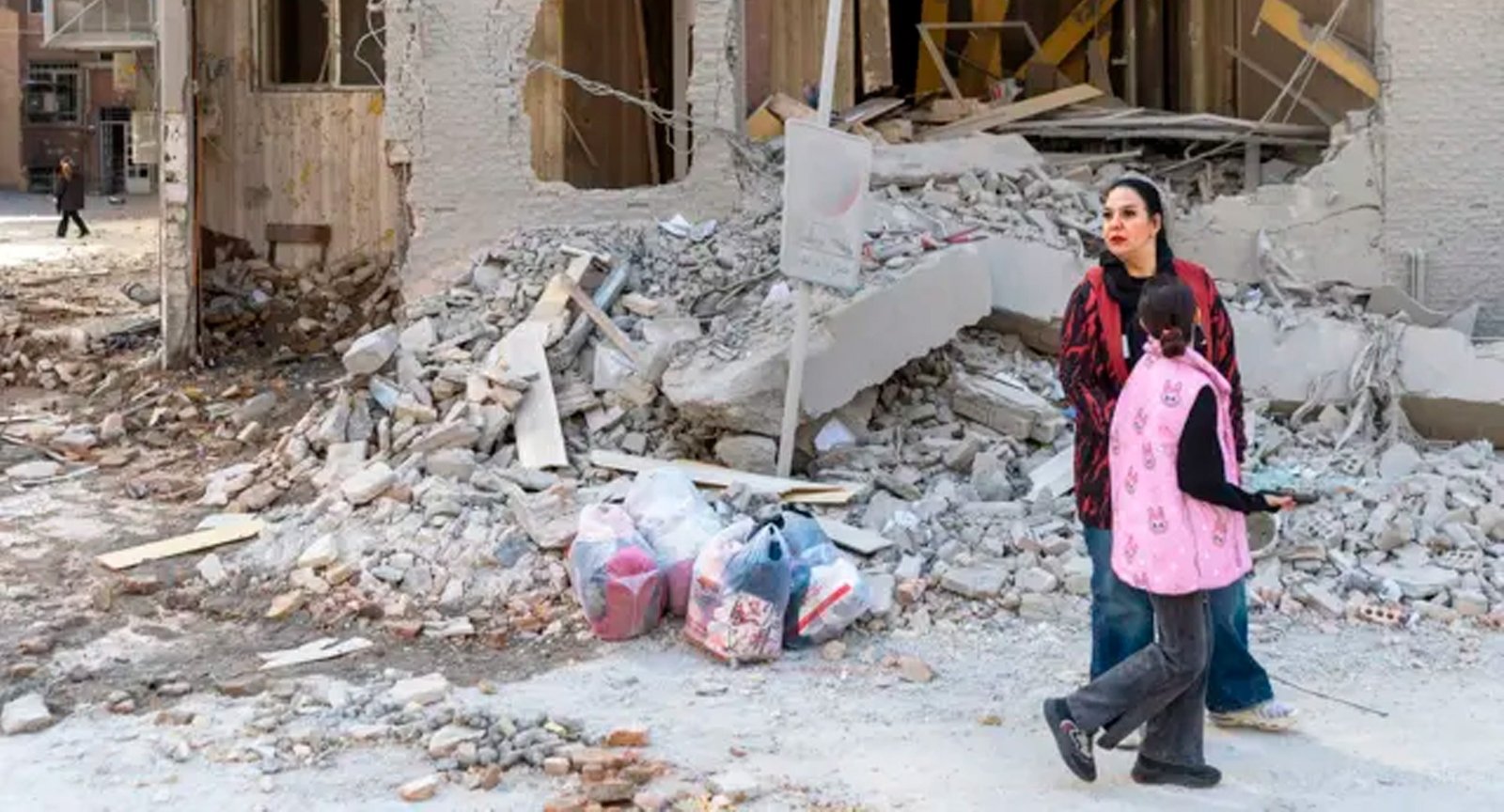
Iran’s capital, Tehran, has been under heavy attack since bombings began on Saturday (28/2) Getty Images via BBC “The number of explosions, the destruction, what is happening… is unbelievable,” says Salar, whose name has been changed for security reasons. Iran’s capital, Tehran, has been under heavy attack since bombings began on Saturday (28), as the United States and Israel target military installations and those linked to political power in an attempt to weaken the Islamic regime. Although the targets were initially of this nature, other areas were affected as a result of the attacks. Iranian authorities said more than 160 people, including children, were killed when a girls’ school was hit in the city of Minab on Saturday. The White House says the US is investigating the incident, but says it is not targeting civilians. “What we are experiencing now goes beyond what we experienced during the 12-Day War,” a Tehran resident told BBC News Persian, referring to the conflict between Israel and Iran in June 2025. While some Iranians say the ongoing attacks have left them fearing for their families, others describe the Iranian regime as fearful and express hope for the country’s future. The first wave of attacks killed Iran’s supreme leader, Ayatollah Ali Khamenei, but since then the airstrikes have shown little sign of abating. “Each day felt like a month,” says Salar. “The volume of attacks is so high.” According to him, a recent air raid made his entire house shake and he described having to leave the windows open so that the glass wouldn’t break. International news organizations are frequently denied visas to enter Iran, which severely limits their ability to gather information about what is happening inside the country. Blackouts in internet access make the situation even more difficult. Most people have been staying home and only going out to get supplies. The Iranian regime appears to have increased its security presence on the streets, which Iranians see as a response to dissent demonstrated following the ayatollah’s death. “There are checkpoints everywhere. They are afraid of their own shadow,” says a 25-year-old student in Tehran. “We are waiting for the big moment, the final moment, when we will all emerge and be victorious.” Satellite images show before and after bombed sites in Tehran, Iran. The price of basic items like eggs and potatoes has also skyrocketed, he said, and lines for gasoline and bread “are unbelievable.” A resident of the capital told the BBC that most stores are closed and some ATMs are out of service, although supermarkets and bakeries remain open. Tehran feels “empty” and anyone leaving home needs to have an “urgent reason”, she says. “On the first day, people were chanting slogans and everyone seemed happy. But now there are police forces everywhere.” Salar described threats from security forces against anyone who criticizes the country’s regime. While it is difficult to gain access to independent information, Salar says Iranian security forces have made their demands clear. “Every day they send text messages warning that if we leave the house, they will treat us harshly,” he says. “One message said, ‘if any of you come out and protest, we will consider you collaborators with Israel’.” He believes the tone of the message suggested that anyone who disobeyed would be treated with force, or even killed. BBC News Persian also spoke to Kaveh, whose name has also been changed for security reasons. He lives in Zanjan, a city about 275 km northeast of Tehran, which was also the target of attacks. “In the first three days, our city was heavily bombed,” he says. “We live in an area where fighter jets constantly pass over our heads.” He adds that, after the start of the war, the sky was constantly covered by columns of smoke rising from the sites of air raids — an image he describes as “simultaneously beautiful and terrifying.” Salar says he sent his parents to the north of the country, although it is uncertain which cities would be safe. Their home is in the Shariati neighborhood of Tehran, where many military installations have been targeted by attacks. “My mother was in a terrible state, she was very scared,” he says, adding that the current attacks are worse than anything she experienced during the eight-year Iran-Iraq war in the 1980s. More people continue to leave Tehran with each passing day, he adds, but that’s not an option for everyone. “A friend of mine’s grandmother is sick and they can’t take her.” Internet blackouts have also made it extremely difficult for Iranians to contact their families. Kaveh explains that, in addition to survival, his biggest concerns have been trying to maintain some contact with family and friends and gaining access to reliable news. He says his internet connection was interrupted around noon on the first day of the attacks and he was unable to get back online for two days. Both Kaveh and Salar are using VPNs, virtual private networks that allow them to “trick” government controls by hiding where a person is logging in. Using VPNs allows you to access websites blocked by the Iranian government, but this is not an easy task. When he can connect, Kaveh tries to help “friends outside of Iran who haven’t heard from their families, get updates or pass along messages.” Due to the tight security situation in Iran, it is not possible to gauge the general reaction to the death of the supreme leader. While some Iranians say the ongoing attacks have left them fearing for their families, others describe the Iranian regime as fearful and express hope for the country’s future EPA via BBC While some took to the streets to celebrate, others participated in public demonstrations of mourning led by government officials. Kaveh said that at first he had difficulty believing the news of Khamenei’s death. “I always imagined that this moment would bring happiness, but it didn’t,” he says. “Almost every year of my life and the lives of millions of people like me have been destroyed and thousands have lost their lives, and yet he himself was taken from the scene in a single moment, [o que] It made me really angry.” Salar says he didn’t expect the celebrations in the streets following the news of the supreme leader’s death. “The atmosphere in the city after the attack was one of heightened security. And it still is.” Neither man knows what the war will mean for them, their families or their country. “I doubt any of us will ever go back to being the same as before,” Salar says, adding that many people are under severe stress. “Those who are abroad, especially the monarchists,” he says, referring to supporters of the son of Iran’s former royal family who supported US and Israeli military action — “really don’t know what we are going through.” He adds: “I hope they never have to go through That’s why.” Kaveh says he feels the war “is not going to end as quickly as we think.” “But even so, my hope has not diminished. On the contrary, it grows stronger every day.” “I don’t know what will happen after this ‘operation’,” he says, but adds that, without it, “something worse would certainly have happened.” “So at least there is still a chance for life and for tomorrow.” Additional reporting by Alex Boyd, Ghoncheh Habibiazad, Caroline Hawley and Tom McArthur
Source link
‘Every day feels like a month’: Iranians describe routine under constant US and Israeli bombardment
21
