
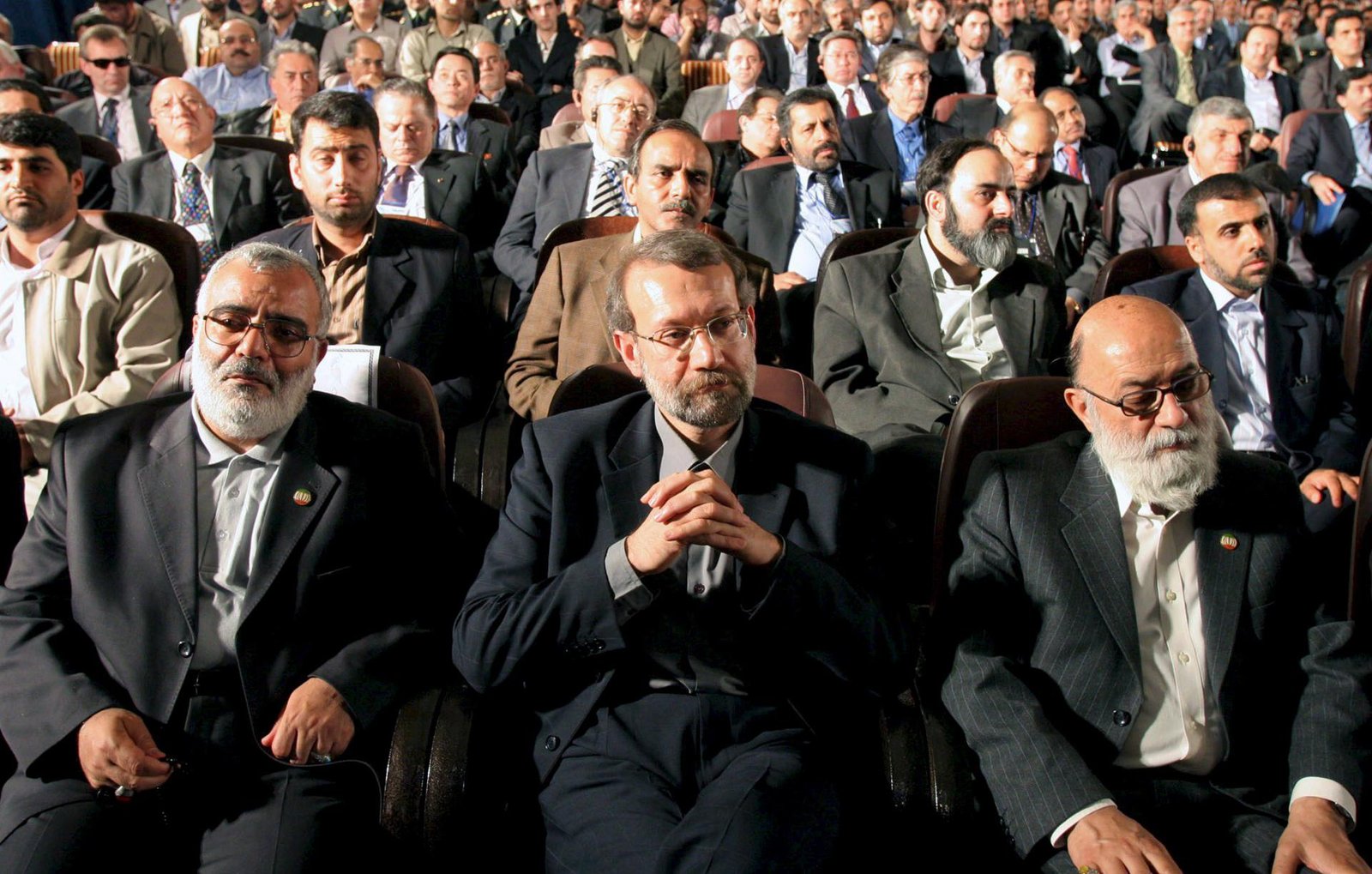
Iran is facing a period of political turmoil since the death of its supreme leader, Ayatollah Ali Khamenei, in a coordinated attack by American and Israeli forces last Saturday (28).
The war resulted in numerous losses in the Iranian top brass. One of the figures who emerged as the face of the regime in the midst of the crisis was Ali Larijania veteran politician considered the most powerful authority in the country’s security sector.
At the beginning of the week, three days after the start of the conflict, he verbally attacked President Donald Trump, saying that the Republican leader has plunged the Middle East into chaos with his “delusional fantasies” and that this will have negative effects on the United States. Larijani also closed any negotiation door with the countries involved in the war.
The power vacuum and the constant pressure from air strikes aimed at regime structures raise doubts about who will actually take over the Persian country in the post-war period and whether the current political system, marked by the influence of Islamic clerics, will continue.
An influential name emerges as guardian of the Islamic regime
The American government stated that it overthrew the Iranian regime with the ongoing war and the death of at least 48 military and political leaders in recent days. However, some of the most influential high-ranking names remain alive and active amid the conflict.
One of them is Ali Larijanihead of the National Security Council and trusted man of the late Ayatollah Ali Khamenei, whom he tasked with ensuring the regime’s survival. Iranian sources told the newspaper The New York Times this week that he had been effectively governing the country behind the scenes during the negotiations leading up to the war.
Larijani was recently targeted by Washington for sanctions due to his leading role in repressing protests against the Islamic regime, which resulted in hundreds of deaths. He has also been involved in recent years in nuclear negotiations with the US and has become an influential political coordinator with Russia and China, dictatorships that have moved closer to Tehran in the last decade.
Formally, he cannot succeed Khamenei as supreme leader because he does not meet the religious requirements that the position demands. He is not a cleric like Khamenei and his predecessor, Ruhollah Khomeini, despite his family having a history of high-ranking connections.
His father and brothers achieved such religious hierarchy. Sadeq Ardeshir Larijani, one of the brothers, received the title of ayatollah, heading the Iranian judiciary between 2009 and 2019. Another of his brothers, Mohammad-Javad Larijani, was an advisor to the late Ayatollah Khamenei.
Ali Larijani’s political trajectory, however, was built along a different path. He joined the Islamic Revolutionary Guard Corps in 1981 and served as a commander during the early years of the Iran-Iraq war. Years later, he attended a religious seminary, but ended up pursuing another degree, in computer science and mathematics.
In 2005, after passing through different sectors of the regime, he ran for president for the first time, but received less than 10% of the votes in the first round. After that, Larijani was appointed secretary general of Iran’s Supreme National Security Council (SNSC), at which time he also took charge of Iran’s nuclear negotiations, but ended up being fired by then president Mahmoud Ahmadinejad.
Last year, he returned to his former role as head of the Supreme National Security Council and rose to prominence as Iran’s top security official following the 12-day war with Israel last June.
What is the power structure like in Iran?
Despite the structural shock, the ayatollahs’ regime still survives. Shortly after the death of the supreme leader was confirmed, the Iranian state news agency IRNA reported that Iran’s president, the head of the judiciary and a jurist from the Guardian Council would take command during the transition period, without giving details of what would happen next.
The country’s fate remains uncertain, but some names remain influential in the midst of the war: that of the head of the judiciary, Gholam-Hossein Mohseni-Eje’i; Ayatollah Khamenei’s chief of staff, Ali Asghar Hejazi; Hassan Khomeini, cleric and grandson of Ayatollah Khomeini; and Khamenei’s son, Mojtaba Khamenei, the latter a strong name present in discussions about the country’s future, despite his father having rejected the position becoming hereditary.
This Thursday, President Donald Trump told Axios who needs to be involved in choosing a new leader for Iran, just as happened in Venezuela, where he allowed the regime to remain in power, under the command of Nicolás Maduro’s deputy, Delcy Rodríguez.
In the statements, the American leader rejected some suggestions, such as Khamenei’s son, who, for him, would be something “unacceptable” because he is “weak”. The president further argued that the choice must eliminate any candidate who maintains the late supreme leader’s policies, in order to avoid a new war “in five years” with the USA.
Asked at a press conference this week about prospects for future leadership in Iran, Trump also downplayed the possibility of exiled Crown Prince Reza Pahlavi taking over the country, saying he would prefer someone from within Iran to take command.
The White House leader assessed that, although “he seems like a very nice person”, it was more likely to choose a “popular” candidate, “someone who is there [no Irã]”.
Perspectives: regime continuity vs. internal crisis
Eduardo Galvão, a specialist in political risk and professor at Ibmec Brasília, considers the idea of an immediate collapse of the regime to be simplifying. “The Iranian system does not depend solely on a central figure. It is supported by a relatively cohesive institutional, military and ideological structure, especially by the Revolutionary Guard,” he explains.
This Thursday, the Iranian Armed Forces announced a series of attacks against the positions of Kurdish groups in Iraqi Kurdistan, which represents a new expansion of a war that reaches its sixth day.
Action came after the American press reported that President Trump spoke with Kurdish leaders in the region. The Washington Post newspaper reported that the American leader sought support from Tehran’s internal opposition as potential allies to foment a revolt against the regime.
Sources familiar with the matter said Trump made several calls this week to leaders of the Kurdish minority in Iran and neighboring Iraq offering “extensive U.S. air coverage” and other support for them to take control of parts of Iran.
White House spokeswoman Karoline Leavitt said “it is completely false that Kurdish forces will be armed with the hope of inspiring a popular uprising in Iran,” following speculation that the US Central Intelligence Agency, CIA, was behind destabilization action.
The Kurds are the largest ethnic minority without a state of their own, comprising 30 million people distributed mainly between Türkiye, Iran, Iraq and Syria.
Trump has called on the Iranian population to organize in the streets to overthrow the Islamic dictatorship. So far, however, the structure only seems shaky.
