
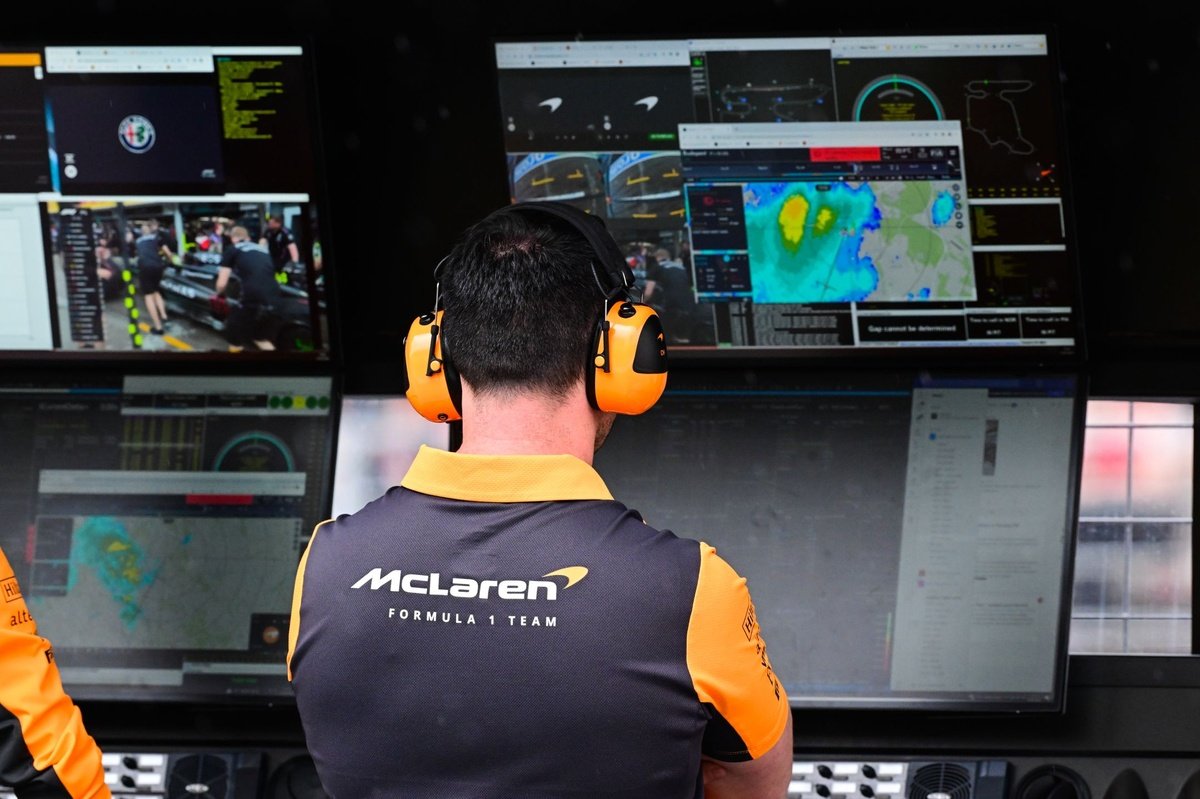
Success in Formula 1 rests on a delicate balance of several factors: the car, the drivers and the strategy. When performance levels are very close, it’s often the tactical choices made on the pitwall that tip the scales. Strategy has become one of the most complex disciplines in modern F1, with teams analysing dozens of possible combinations behind the scenes as they try to anticipate every race scenario. In today’s F1, the challenge is clear: the winning approach isn’t to respond, it’s to anticipate.
This is where a tool that has become invaluable to many teams comes into play: RaceWatch, the platform developed by Catapult and is also used by the FIA. However, its roots go back nearly 20 years, and season after season it has evolved alongside an increasingly complex F1, eventually becoming a strategic ally capable of turning data into competitive advantage.
A tool that has reshaped F1 strategy
To understand the importance and evolution of RaceWatch, we need to go back to 2008, when F1 was taking its first steps into a new era defined by complexity and data. It was in that context that the idea behind the platform emerged: consolidating scattered information, previously accessible only through separate tools, into a single environment capable of correlating, visualising and interpreting on-track action in real time.
This is where Gareth Griffith, Catapult’s CTO, and James Vowles, then Honda’s strategist and now Williams team principal, began shaping a platform that has since become one of the operational pillars of modern F1 and a forerunner of the strategic support systems now used across the series.
“We started working in Formula 1 with Honda’s strategy group back in 2008. At the time James Vowles was the team’s strategist, and together we began discussing how to improve the way team data was brought to television, since that was my background. But as we worked with James, it quickly became clear that the same visualisation capabilities could be just as valuable directly on the pitwall,” Griffith said in an exclusive interview with Autosport.
“At the time, Formula 1 had only just begun using GPS data alongside lap times, which were still very limited. All the systems were simple viewers: one screen for GPS, one for timing, but nothing that truly connected the information. James had even built some of his own tools — spreadsheets to combine the data and work on strategy. He’s a brilliant person.
RaceWatch: this is the interface developed for the FIA, but it is also very similar to the one used by the teams.
Photo by: FIA
“But in a way, it was becoming almost difficult to follow the race. That’s where the idea began to take shape: integrating analysis and the necessary tools directly into the video system, allowing teams to follow the race and work on strategy simultaneously within a single environment rather than across separate pieces of software. That was the core principle behind RaceWatch: bringing all sources together in one system and giving strategists the information they needed.”
The platform’s first real test took place at Monza in 2008, with an updated version rolled out just weeks later in Singapore. When Honda withdrew at the end of the season and reemerged as Brawn GP, RaceWatch remained a crucial tool for the team and, as Brawn GP started winning, the system quickly attracted attention, including from the FIA that at the time had only basic systems for tracking race activity.
It helps teams anticipate and understand how the race evolves
RaceWatch’s evolution for F1 teams has always followed two complementary paths. The first is all about reaction: understanding which pieces of information matter in a given moment and how to present them clearly when everything is happening at once, so strategists can make the right call in the shortest possible time, exactly when pressure peaks and the room for error reduces.
The second path is the most ambitious one: anticipating what might be required before an event even unfolds. This is where RaceWatch started to grow, turning into a platform that enables teams to simulate and forecast future scenarios.
Teams rely on it to shape their strategies, test different scenarios, identify pitstop windows and spot tactical opportunities. The platform ties directly with each team’s own data, like Mercedes and McLaren which have used it for many years, especially the models that describe car and tyre behaviour, giving strategists far more precise references when defining strategies.
The predictive models also integrate information about drivers’ characteristics
When shaping a strategy, teams evaluate a wide range of elements and parameters to build a clearer picture of how the race might evolve. In addition to more detailed tyre models, they also integrate overtaking models, competitor performance metrics, the impact of Safety Cars, fuel management considerations and other factors.
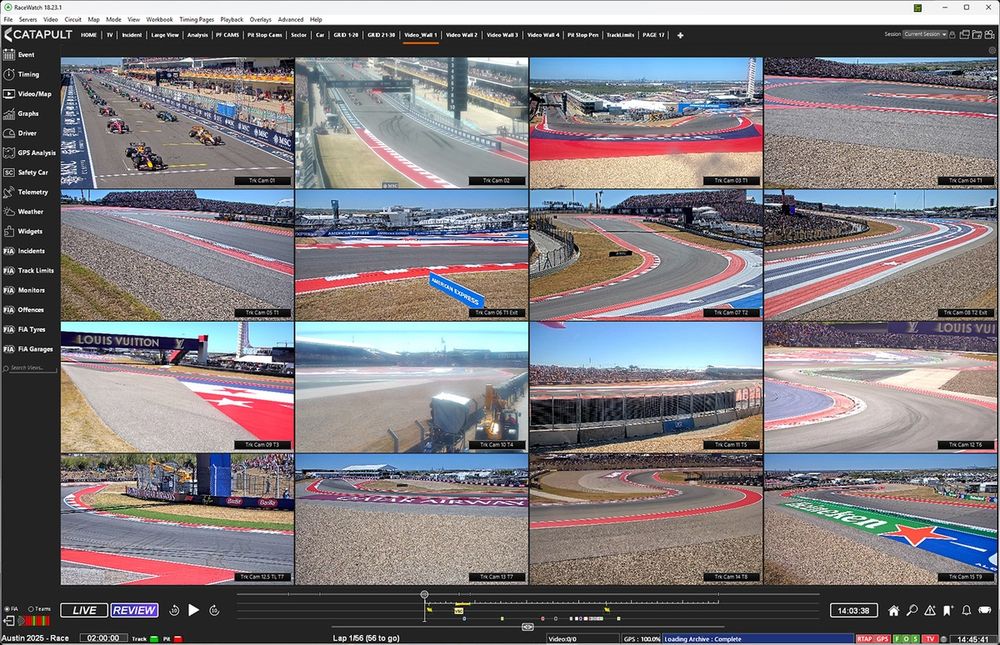
RaceWatch, the race management software developed by the FIA and Catapult with cameras along the circuit, including CCTV cameras
Photo by: FIA
Once the models are defined, teams move to a statistical process known as a “Monte Carlo” simulation, essentially running a virtual race built on the chosen parameters, which can be tweaked as needed. This method allows them to map out every possible outcome of a given scenario and understand the probability of each unfolding.
Each car’s base lap time, its reference performance, is taken and combined with several parameters, such as expected tyre degradation, to calculate its potential race pace. But the system goes well beyond that: it factors in pitstop time loss, overtaking probabilities at every corner based on both car and track traits, and even certain driver-specific characteristics.
“We have driver-specific models, because some are better at overtaking than others. We also estimate the probability of making a mistake. And then there’s the distribution of lap times: the best drivers are more consistent. All of this helps build a representation of the race that becomes a predictive tool,” Griffith explains. All these elements are then integrated into RaceWatch, providing both a system capable of forecasting what is about to happen and one that offers strategists real-time solutions.
The strength of any strategy also depends on the quality of the data feeding it, which is why the information collected during practice is so vital. “In FP1 and FP2, assuming it’s not a sprint weekend and the track is dry, you work on defining all these parameters: each car’s base lap time, how the tyres degrade. You’re essentially building the inputs for the race model. And from that point, the system begins constantly forecasting what could unfold.
“One of the areas where RaceWatch is strong is its ability to react to changes during the race. If degradation is higher or lower than expected, or if the car’s performance differs from the initial estimate, you can update the strategy. For example, if degradation is higher, the system can tell you whether a two-stop approach would allow you to recover the necessary time. It can model all of this and help you adapt.”
Teams operate with more than 200 channels
Data plays a crucial role, but understanding what is unfolding in a race also requires direct visual monitoring. In the past, with limited video feeds, teams that rarely appeared on the broadcast sometimes struggled to follow their own race. Today, RaceWatch includes a dedicated feature called “follow me TV”, enabling teams to observe both their own cars and those of their rivals, allowing them to analyse issues such as tyre graining.
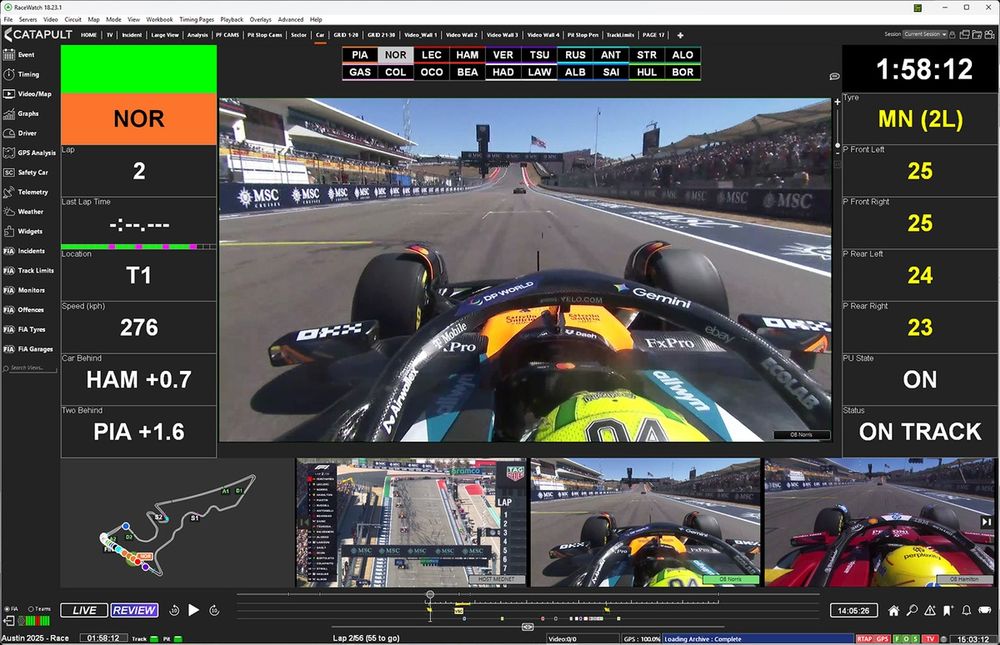
FIA RaceWatch: teams can also follow their rivals and have a personalised “broadcast”
Photo by: FIA
“By knowing at any moment which camera is filming a given car, we can follow it around the entire circuit. We have our own automated TV director, called Follow Me TV: you choose the car you want to track, and the system generates a dedicated television feed for that car as it laps,” Griffith explained.
“A team whose driver is running in the midfield might appear only rarely on the traditional TV broadcast; with this system, however, teams have a permanent video feed of their own car, allowing them to know where it is, how it’s performing, and to notice immediately if it stops or if something happens”.
To truly understand what is unfolding on track, teams rely on roughly 200 channels of video, audio and data, which are vital for sharpening their tactical decisions. RaceWatch then becomes a key strategic asset, allowing teams to track in real time elements like the pit window.
It’s a crucial piece of information in F1 where overtakes are becoming rarer: knowing whether you’re vulnerable to an undercut, or whether a pitstop could help to overtake a car, can be worth valuable points. But this is just one small component of the enormous operation behind a team, which also includes the remote garage where additional personnel back at the factory working on dedicated tasks.
This is why RaceWatch has evolved into a highly flexible platform for many teams, offering around 300 distinct visualisations that can be configured into role-specific dashboards. Strategists use it for race planning, while other engineers, leveraging GPS data, can advise the driver on where to gain time, such as by braking later or refining the corner line.
Today, strategy has evolved beyond pitwall decision-making into a sophisticated ecosystem combining predictive models, live analytics and expertise shared between trackside and factory operations. In this context, RaceWatch is the tool through which teams interpret the race and the compass that directs shapes their decisions and in 2025 it celebrated its 20th world title.
We want to hear from you!
Let us know what you would like to see from us in the future.
– The Autosport.com Team
