
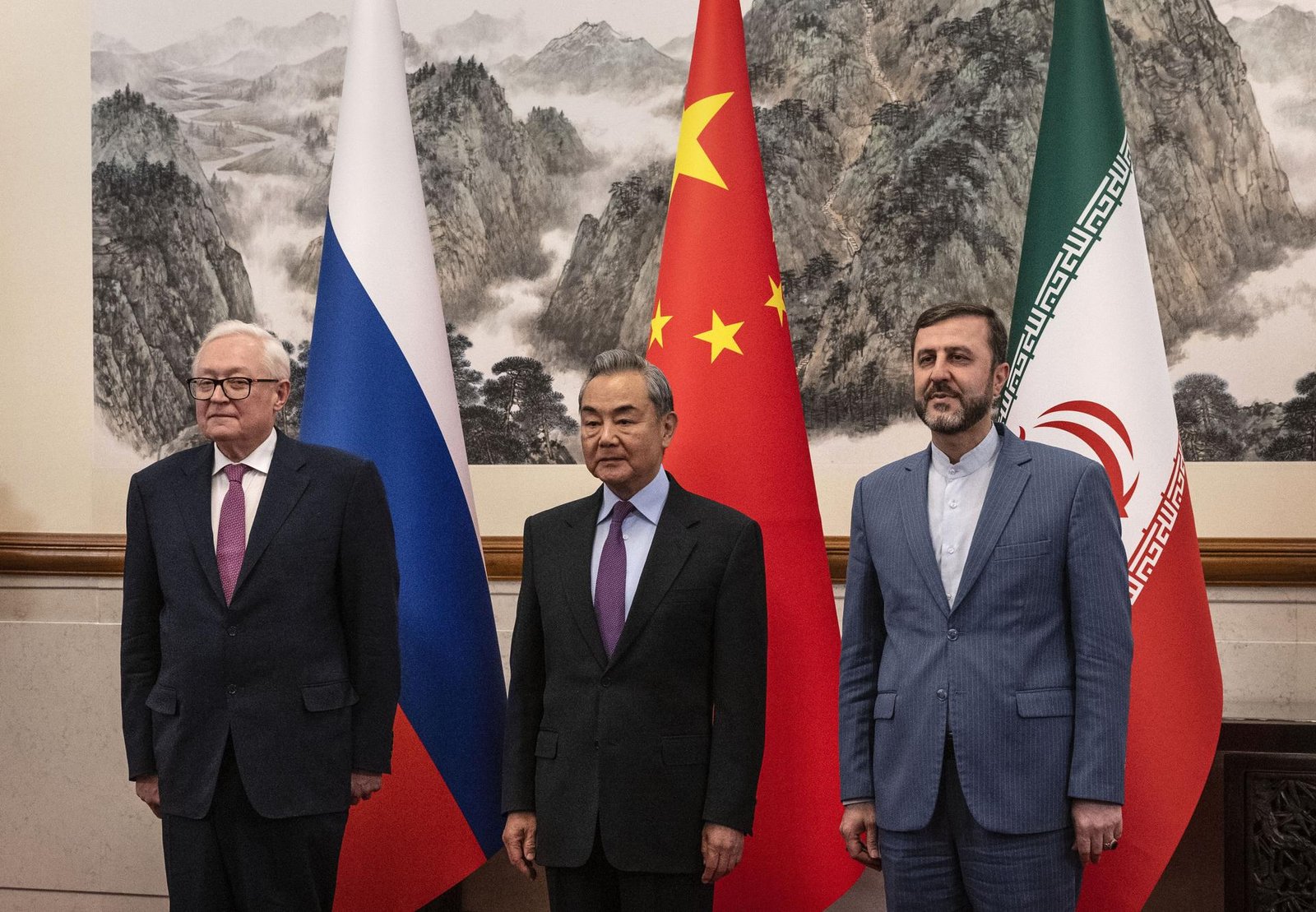
Hours after the attacks by the United States and Israel against Iran on Saturday (28), the Russian and Chinese regimes condemned the offensive, called for an immediate ceasefire and defended the resumption of diplomatic dialogue.
Despite their position, Moscow and Beijing avoided signaling any type of direct military support for Tehran, exposing the practical limits of the partnership that the two countries maintain with the Iranian regime.
At the United Nations (UN) Security Council, Russia classified the US and Israeli bombings against Iran as “acts of aggression”, while the Chinese regime’s foreign minister, Wang Yi, stated that it was “unacceptable” for the US to attack Iran in the midst of diplomatic negotiations and “even more unacceptable” for the US to assassinate “the leader of a sovereign country”, making reference to the death of Ayatollah Ali Khamenei. The statements, however, were restricted to the diplomatic field, without a threatening or warlike tone.
What’s at stake for China and Russia
Both China and Russia have strategic agreements signed with Iran in recent years, which have expanded political, economic and military cooperation between the three regimes.
In January this year, the countries announced the signing of a “trilateral pact” to reinforce diplomatic coordination and rapprochement on issues such as energy, trade and defense. The agreement, however, did not establish any mutual defense clause nor did it oblige either party to intervene militarily in the event of an external attack..
Iran is one of Moscow’s main supporters in the invasion of Ukraine. Since 2022, when dictator Vladimir Putin ordered a large-scale invasion of the neighboring country, the Islamic regime has sent hundreds of drones to the Kremlin, which have become widely used in attacks against Ukrainian cities and infrastructure. Military cooperation helped Russia offset part of the limitations imposed by Western sanctions and consolidated the strategic rapprochement between the two regimes.
In the Chinese case, the link is above all economic and energy. China is now the biggest buyer of Iranian oil, absorbing more than 80% of everything Iran exports. These purchases usually occur below the international reference price, which guarantees a financial advantage for Beijing and vital revenue for Tehran, which lives under Western sanctions.
The fact is also important that, in this conflict, the Gulf countries, which are under attack from Iran, absorb part of the investment from China’s Belt and Road Initiative (Belt and Road Initiative), also known as the “New Silk Road” – a strategy to expand Chinese economic and geopolitical influence that finances infrastructure works, trade agreements and investments in developing countries, with the aim of expanding China’s presence in these markets.
In an analysis published by the consultancy SpecialEurasia, geopolitical expert Silvia Boltuc states that attacks against Iranian infrastructure also threaten strategic commercial corridors that are of direct interest to Moscow and Beijing.
This scenario helps explain why An eventual fall of the Iranian regime would place China and Russia facing relevant strategic losses in the Middle East, albeit of different natures.. Despite this, analysts assess that neither regime has an interest in getting involved in the ongoing conflict, each for different reasons.
“I believe it is unlikely that global powers like China and Russia will want to bear the costs of direct involvement against the US,” said Ludmila Culpi, professor of International Relations at PUC-PR.
For China, facing the military power of the United States and Israel in the Middle East would mean, according to Evan Feigenbaum, vice president of China Studies, think tank Carnegie Endowment for International Peacetaking risks in a region that does not integrate its core priorities.
The Kremlin, in turn, is still trying to advance into Ukraine and taking heavy losses. Analysts at think tank Chatham House assess that Moscow would be unlikely to open a new front of direct tension with the United States while concentrating resources and military capacity on the ongoing conflict in Eastern Europe.
Analyst Grégoire Roos, director of programs for Europe, Russia and Eurasia at Chatham Housestated in an article published on the think tankthat the Kremlin does not intend to get directly involved in the conflict or offer concrete military support to Tehran, despite having condemned the attack by the United States and Israel.
“Russia, of course, will not enter into any type of military confrontation with the United States and Israel. Nor will it send Tehran any signal that it can offer any type of support [militar]”, wrote Roos. According to him, the “Kremlin’s next steps will likely be calibrated to preserve its credibility as a critical partner of the West, but without being drawn into a second high-intensity conflict.”
Distinct alliances
Unlike Western alliances, such as the North Atlantic Treaty Organization (NATO), the agreements signed between Russia, China and Iran do not provide for a collective defense clause. These are simply strategic partnerships aimed at political and economic cooperation and, in some cases, transfer of technology and weapons.
Although the Kremlin and Xi’s communist regime share Tehran’s opposition to American influence and Western sanctions, neither country has made a formal commitment to military protection for the Iranian regime, which, in practice, must face the US and Israel without guaranteeing direct support from its main strategic partners in the international community.
China’s military focus is on Taiwan and East Asia
For Beijing, the strategic military priority remains concentrated on the immediate surroundings of its territory, especially on the issue of Taiwan. The island is considered by Xi’s communist regime to be an integral part of China, and the Chinese dictatorship does not rule out the use of force to annex Taiwan or prevent any formal independence movement.
According to Feigenbaum, from Carnegie Endowment for International Peacemuch of Chinese military planning, including its naval modernization, the expansion of the air force and the development of long-range missiles, is currently directed at the East Asian scenario, which Beijing considers its zone of influence.
In this context, opening an indirect front of confrontation in the Middle East to defend Iran would mean for Beijing to divert resources, increase the risk of direct confrontation with the United States and compromise its main strategic agenda: the annexation of Taiwan.
Conflict may even benefit Russia in the short term
The ongoing conflict in the Middle East could generate certain positive economic effects for Moscow in the short term, as instability in Iran tends to put pressure on international oil prices, which, at the moment, is Russia’s main source of foreign revenue.
Analysts highlight that a sustained increase in commodity in the international market it favors exporters such as Russia, which remains highly dependent on energy revenues to finance its military budget and support its invasion of Ukraine.
“Putin must be beaming [com o conflito]because anything that raises the price of oil is positive for it”, said analyst Ellen Wald, a global energy researcher, to the American broadcaster CNBC.
Since 2022, Russian oil has been subject to a sanctions regime led by the United States and the European Union. Still, Russia has not stopped selling oil. Moscow began to export larger volumes to countries that did not fully adhere to Western sanctions, such as China, Brazil and India, often offering discounts in relation to the international reference price.
In January, aiming to prevent this Russian war financing, Trump gave the “green light” for the approval of a bill that provides for new sanctions against Russia and its trading partners. The proposal establishes secondary tariffs that could reach 500% on goods imported from any country that continues to buy oil, oil products or uranium from Russia. In practice, this means that countries that trade energy with Moscow could face severe tariff barriers when exporting to the United States. The project, for example, could reach Brazil, Moscow’s main diesel buyer.
