
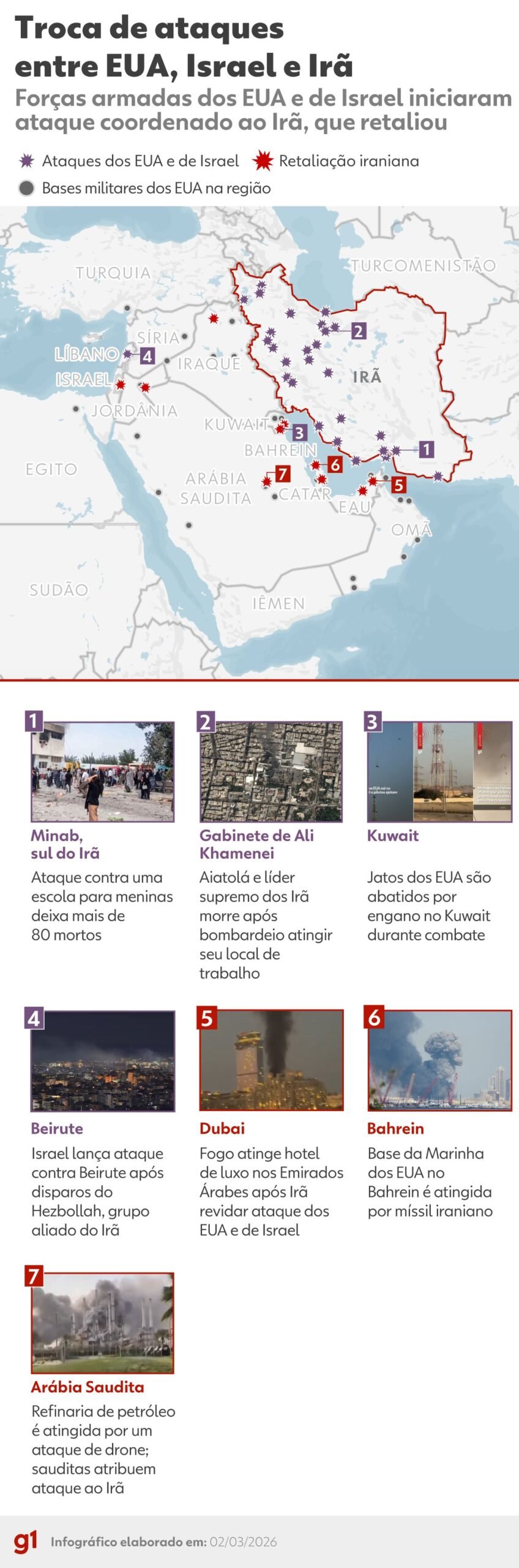
The Minister of Foreign Affairs, Mauro Vieira, held this Tuesday (3) a round of telephone conversations with Middle Eastern foreign ministers about the escalation of the war in the region. War in the Middle East causes oil prices to rise Mauro Vieira spoke with Jordanian ministers, Ayman Safadi; from Kuwait, Jarrah Jaber Al-Ahmad Al-Sabah; and returned to talks with the UAE Foreign Minister, Abdullah bin Zayed Al Nahyan. Before these calls, Vieira spoke by phone with President Luiz Inácio Lula da Silva (PT) to update him on the situation. According to a Brazilian diplomatic interlocutor, Brazil is working to seek the best information and the best assessment of the war scenario with partner countries in the region. One of the priorities is to seek to protect the interests of Brazilians who are living in or passing through conflict areas. Brazilian reports in the Middle East – gif home Arte g1 According to a note published by Itamaraty, in the conversation with the Jordanian chancellor, the two ministers “dealt with Iran’s attacks on Jordanian territory and possible scenarios for the conflict in the coming days”. “Minister Mauro Vieira conveyed Brazil’s solidarity to the Jordanian Minister and expressed concern about the military developments and the regional spread of the conflict”, says the note. Regarding the call with the Kuwaiti chancellor, Itamaraty reported that they dealt with “the impacts of the crisis and military actions on Kuwait, the region and the global economy, and also discussed the situation of the Brazilian community in that country”. Infographic: Map of attacks in the Middle East; Iran, Israel and the USA wage war in the region Editoria de Arte/g1 Vieira’s conversation with the Chancellor of the United Arab Emirates, Abdullah bin Zayed Al Nahyan, was the second after the attacks between the United States, Israel and Iran. Vieira and the country’s minister – also the target of retaliatory attacks by Iran – had already spoken on Monday. The two discussed the developments of the war in the Middle East and the closure of airspace in the region. Among Itamaraty’s concerns for the Arab country is the situation of Brazilians at Dubai and Abu Dhabi airports, given the flight restrictions. Impact assessment Currently, the Brazilian government is also assessing the impacts of escalating conflicts and possible diplomatic developments, including with the United States. On Monday (2), the special advisor to the Presidency of the Republic, ambassador Celso Amorim, spoke by telephone with President Lula about the escalation of conflicts. The two evaluated the most recent developments in the crisis and Brazil’s possible diplomatic initiatives, including the role of Itamaraty and the defense of a negotiated solution to reduce tensions in the region. During the call, Celso Amorim reminded President Lula of the efforts of Brazilian diplomacy, in 2010, alongside Turkey, for the Tehran Declaration — an initiative that had positive international repercussions, but ended up rejected by the United States. 🔎The Tehran Declaration was a proposal presented in 2010 by Brazil, Türkiye and Iran to try to reduce tension around the Iranian nuclear program. Under the agreement, Iran would send some of its enriched uranium to Turkey, where the material would be held in international custody, in exchange for nuclear fuel for a medical research reactor. The initiative sought to avoid new sanctions and open space for negotiations, but was rejected by the United States and did not advance. ‘We must prepare for the worst’, says Celso Amorim about conflict in the Middle East In an interview with GloboNews, Celso Amorim stated that Brazil “must prepare for the worst” scenario, as the conflict with Iran has the potential to spread.
Source link
War in the Middle East: Mauro Vieira holds talks with foreign ministers of Jordan, Kuwait and the United Arab Emirates
22
