
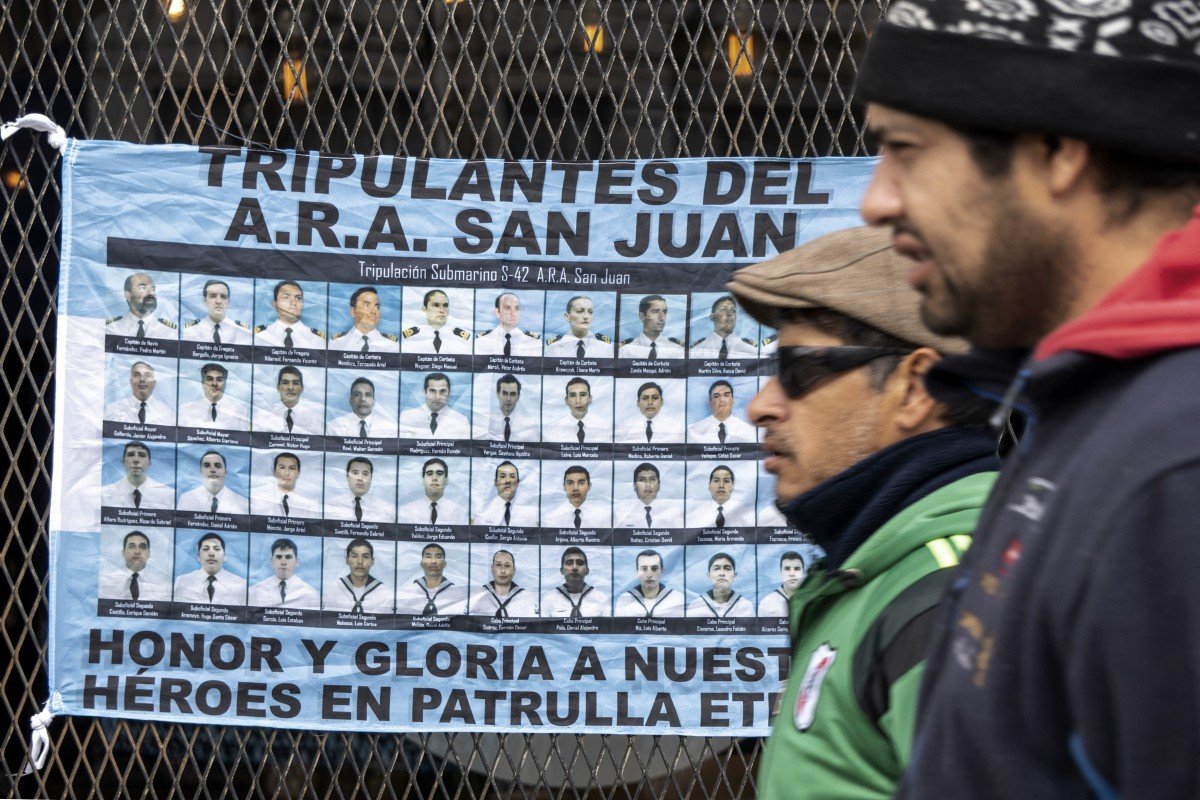
A flag with the portraits of the 44 members of the Argentine Navy who died during the sinking of the submarine ARA San Juan hangs at the entrance of a court in Santa Cruz WALTER DIAZ / AFP The Argentine Court is analyzing, this Tuesday (3), whether the implosion of the Navy submarine, which caused the death of its 44 crew members in 2017, was a predictable and avoidable tragedy, as argued by the Public Prosecutor’s Office and the prosecution’s assistant in Río Gallegos, 2,500 km south of Buenos Aires. The wreckage of the ARA San Juan submarine was located a year after its disappearance. They still remain more than 900 meters deep and 500 kilometers off the coast of the province of Santa Cruz, whose capital is the location of the trial. The hypothesis presented in court against the four accused former Navy officers is that “it was not a fortuitous event, but rather a predictable outcome, given the state of the unit that made the sinking possible”, according to the Public Ministry. The reports indicated that the recommended repair period had been exceeded by 26 months and that the deterioration meant “an increase in risk to the detriment of the physical integrity of its crew members”. “We are going to prove that these were preventable deaths, they were sent to their deaths”, said, upon entering the hearing, lawyer Valeria Carreras, representing 34 family members. The submarine had left on patrol seven days before its disappearance from the port of Ushuaia (south), and was returning to base in Mar del Plata (south of Buenos Aires). On November 15, 2017, he reported an electrical failure and the start of a fire. It was his last message. His search brought together efforts from dozens of countries and kept society and the government of former right-wing president Mauricio Macri (2015-2019) in suspense. At the entrance to the court, an Argentine flag placed anonymously displayed the faces of the 44 victims with the inscription “honor and glory to our heroes on eternal patrol”, the only allusion to the case in a desolate city indifferent to the process it hosts. “Nobody” None of the victims’ families, 43 men and one woman, were present at the opening of the trial, broadcast on YouTube. “They can’t even afford the photocopies, much less a plane and accommodation,” lawyer Carreras explained to AFP. “They are people without power, money or surname; they have felt like ‘nobody’ in these eight years, so there is a lot of expectation. Visibility is important so that forgetfulness and time are not accomplices to impunity”, he added. The possible sentences – from one to five years in prison – contrast with the scale of the facts. The accusations are non-compliance and omission of obligations and qualified negligence. The accused, who are free to stand trial, are the former head of the Training Command Luis López Mazzeo, the former commander of the Submarine Force Claudio Villamide, the former chief of staff of the Submarine Command Héctor Alonso and the former head of Operations Hugo Correa. In 2021, a War Council dismissed Villamide for negligence and punished other officers with up to 45 days in detention. “Invisibilize” The court rejected a request from lawyer Luis Tagliapietra, Alejandro’s father – who died in the ARA at the age of 27 – for the trial to be held in Mar del Plata, 400 km from the Argentine capital, where the crew and three of the four accused lived. Family members held protests in front of the Navy buildings in this location during the search period and also after the submarine was located, an exposure that bothered the force. They also denounced that they were victims of espionage, a case in which Macri was prosecuted and which the Supreme Court closed in 2025. Argentine submarine is found after a year and families ask for victims’ rescue “By taking the debate to Río Gallegos, so far from Buenos Aires, they seek to make the tragedy invisible,” the lawyer who represents around 20 family members and who followed the session via video conference told AFP. “This is the first process; the investigation into the other people responsible in the line of command, which reaches up to Macri, has not yet been completed”, added the lawyer. Carreras believes more than 90 witnesses should present evidence. During the instruction, ‘the memory of many failed, now that could change'”, he said. The trial The hearings will be held over four consecutive days, at intervals of one week. The hypothesis is that the submarine had a valve failure that allowed water to enter the battery compartment, triggering a fire and then an explosion. But, to prove it, it would be necessary to recover the wreckage, a multi-million-dollar operation. “It is very difficult to convict someone of a crime when you don’t really know what happened. The trial could end in acquittal,” Tagliapietra said.
Source link
Court decides whether 44 deaths in Argentine submarine implosion were ‘avoidable’
19
