
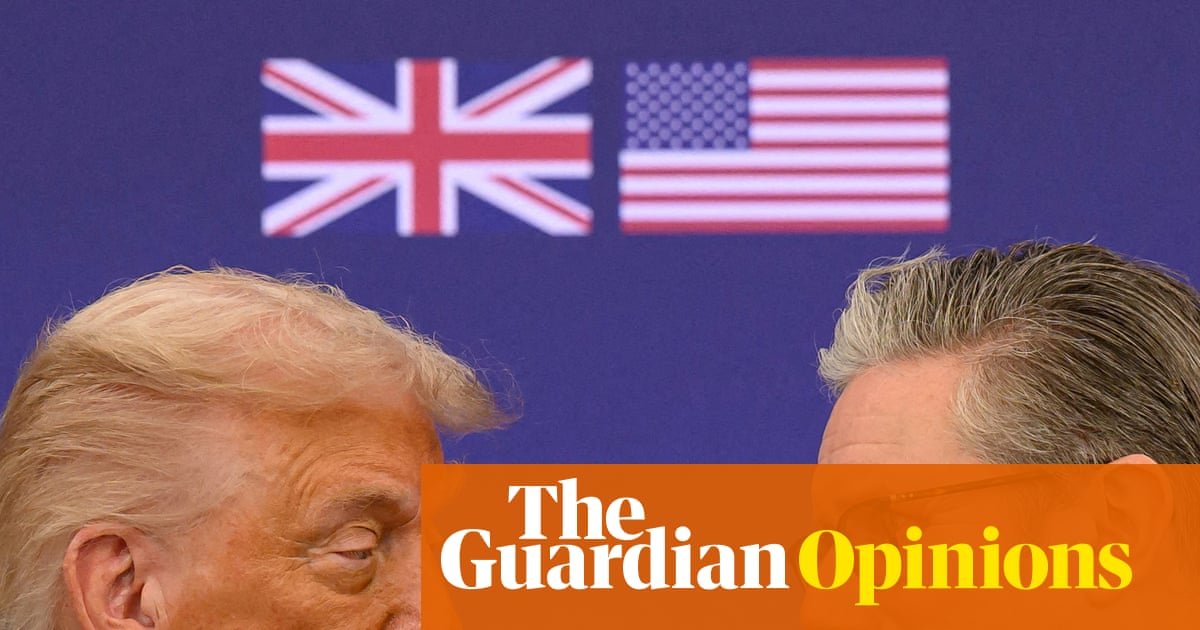
It is not easy being a friend of Donald Trump, but it is a lot less dangerous than being his enemy. There isn’t a huge range of options in between. War in the Middle East is exposing how limited the choices are for a British prime minister.
The US president doesn’t see alliances as long-term relationships based on mutual advantage, but as rolling transactions on a mafia model. The boss offers protection in exchange for tribute and loyalty.
This is a problem for all European democracies. For decades, their security has depended on a concept of western solidarity – institutions, values and laws – that Trump holds in contempt. For Britain, self-exiled from the European Union and acculturated to a “special relationship” with Washington, it is a crisis of geopolitical orientation.
Keir Starmer’s shifting position on US military action in Iran encapsulates the problem. At first, he withheld permission to use UK military bases, ostensibly on the grounds that there was no legal basis for war.
The Tehran regime is certainly murderous. Most of its victims are Iranians themselves. The Islamic Republic is also committed to harming the US and destroying Israel, but there is no evidence of any imminent action in pursuit of those goals to justify preemptive strikes. The more pressing motive seems to be Trump seeking thrills in the international arena because his domestic political revolution is running out of steam.
Within days, Starmer changed his position. Tehran’s “scorched earth” retaliations – firing missiles at US-aligned countries in the region – put British assets and civilians in jeopardy. To avert that hazard, RAF bases would be involved after all, but only in the interests of “collective self-defence”. British forces would not join “offensive action”. The lessons of the Iraq war would not be forgotten, the prime minister said on Monday.
The diplomatic and legal subtleties in Starmer’s position make sense as an effort to balance conflicting domestic and international pressures. But no one is satisfied. His stance towards the war is reluctant, but not opposed. He is compelled to honour the letter of the transatlantic alliance, but not with the fighting spirit that Trump and his fellow travellers on the right of British politics demand.
Nigel Farage and Kemi Badenoch backed the attacks on Iran without hesitation. The Conservative leader accuses Starmer of using international law as a pretext for inaction. His real concern, she says, is appeasing “groups whose political loyalties when it comes to conflicts in the Middle East do not align with British interests”. The inference is that Labour MPs with large Muslim communities in their constituencies are desperate for the government not to fight on the same side as Israel.
That may be a factor in some places, but in her culture-warrior zeal Badenoch misses a wider point. Ill-conceived, open-ended, speciously justified military adventures, undertaken at the behest of a gung-ho US president, are unpopular with a broad demographic sweep of British voters.
Expressing that wariness is an easy political win for Zack Polanski and Ed Davey. Greens and Liberal Democrats rightly highlight the risks of spiralling regional conflagration, all the inauspicious historical precedents and the improbability of conjuring up a less tyrannical Iran from a smoking bomb crater.
The warnings are salutary, and the critiques pertinent, but policy prescriptions are shallow. Davey wants Starmer to “get on the phone” to Trump and force him to plan a transition to Iranian democracy. Polanski urges the prime minister to condemn US action.
Then what? The default anti-war position is to assert the superiority of negotiated deals over military conquest. That was Starmer’s preference, too. But the US has already abandoned negotiation and assassinated Iran’s supreme leader. The world where Trump is regulated by a British prime minister’s phone calls and chastened by his denunciations exists only in the realm of opposition fantasy.
In reality, Starmer has to deploy what influence he has with the White House carefully. He must consider other strategic goals – the need to keep Trump onside in Ukraine, for example. And he must be mindful that Britain’s own military and intelligence capabilities are enmeshed with Pentagon systems. This is something the prime minister hints at whenever pressed to assert policy differences with Trump. It is what he means when he refers to the “indispensable” nature of the defence partnership. In private, ministers are more forthright. As one puts it, Britain would be “massively exposed” if a capricious US administration decided it no longer wanted our friendship.
The dangers of getting on the wrong side of Trump are not often articulated because no one has the incentive to admit such a colossal vulnerability. For Brexit enthusiasts on the right, it is ideologically inconceivable that having a seat at the top table of a continental European bloc amplified British power. Still less tolerable is the idea of the EU relationship as a hedge against overdependence on Washington.
Having fought for emancipation from phantom colonisation by Brussels, Reform UK and the Tories are stuck with a policy of total submission to Washington – vassals in trade, mercenaries in war.
On the liberal left, there is frustration with reliance on a rogue superpower and impatience for realignment with Europe. But there is also squeamishness about what that entails in terms of defence and security. The corollary of wanting foreign policy autonomy in a dangerous, volatile world is having the hard-power capabilities that Europe didn’t develop in the decades when Washington had its back.
Polanski calls for Britain to wean itself off US dependency and speculated about quitting Nato in favour of a more Eurocentric alliance. He doesn’t then call for higher defence budgets to replace the capabilities that would be lost in a rupture with Washington, and that would be required – are already needed – to deter Russian aggression on the continent’s eastern flank.
Strategic autonomy from a Trumpified US is not a delusional ambition for Britain, but it is an expensive project. It requires uncomfortable decisions that opposition leaders, especially those with a negligible chance of becoming prime minister, can conveniently gloss over.
That isn’t an option for Starmer. He might not be getting the balance right between Europe and the US – between asserting an independent foreign policy and retaining precious diplomatic capital in Washington – but unlike his critics, he confronts the agonising reality of those dilemmas every hour of every day. It is in the nature of politics that he will ultimately suffer for making bad choices, but history may reflect that he didn’t have good ones available.
-
Rafael Behr is a Guardian columnist
-
Guardian Newsroom: Can Labour come back from the brink?
On Thursday 30 April, ahead of the May elections, join Gaby Hinsliff, Zoe Williams, Polly Toynbee and Rafael Behr as they discuss how much of a threat Labour is under from both the Green party and Reform and whether Keir Starmer can survive as leader of the party. Book tickets here
