
After weeks that involved negotiations, ultimatums and increasing military and naval reinforcement in the Middle East, the United States, under orders from President Donald Trump, decided, with the support of Israel, to carry out a large-scale attack against the Iranian regime, hitting military installations, missile bases and part of the country’s leadership. The attacks eliminated, in one fell swoop, much of Iran’s top military and political echelon, including Supreme Leader Ayatollah Ali Khamenei.
The Trump administration maintains that the ongoing offensive, which began in the early hours of Saturday (28), represents the “last best chance” to eliminate threats considered intolerable against American interests and those of its allies.
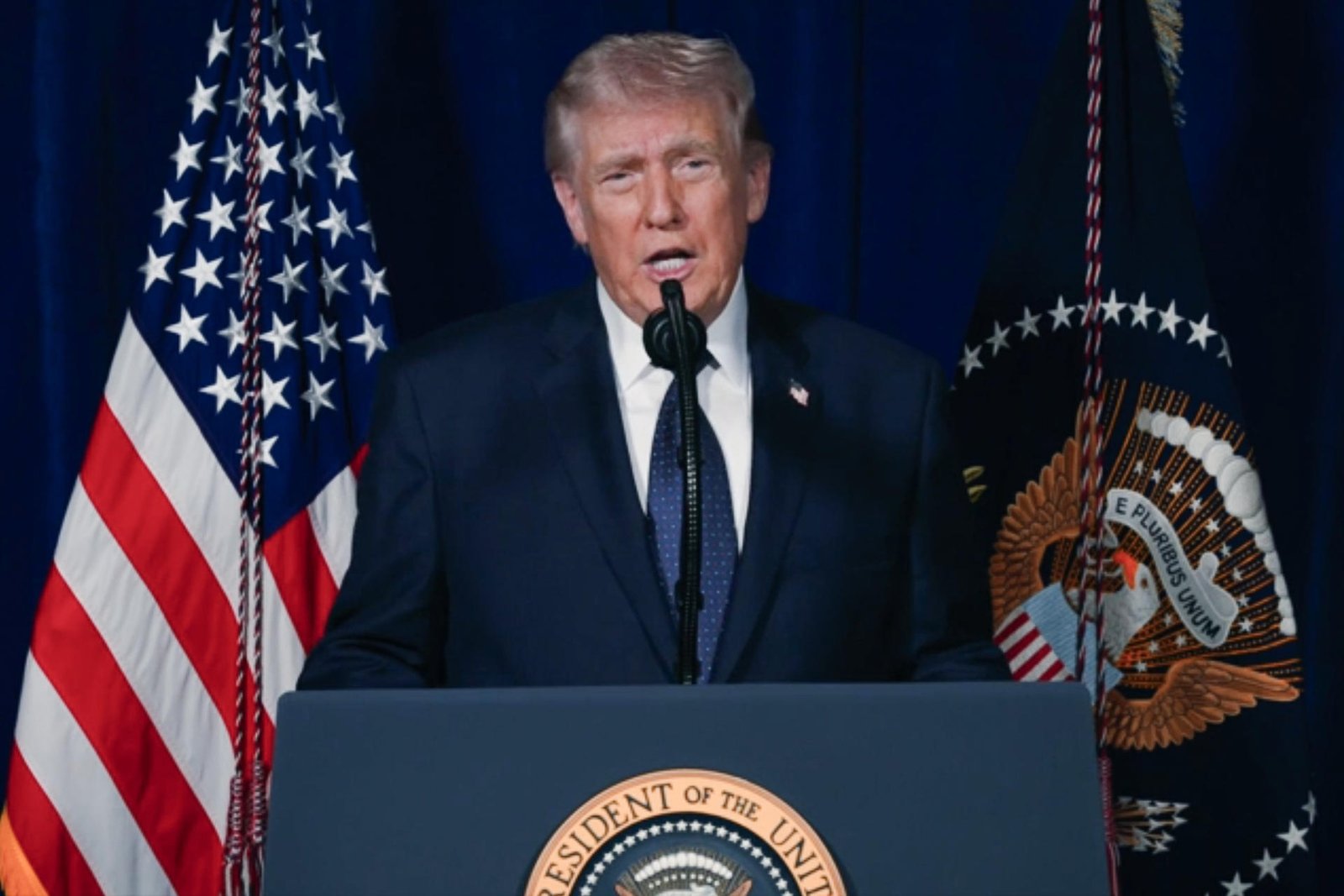
Trump stated in a speech at the White House this Monday (2) that the Iranian regime already had the capacity to develop missiles that could reach American bases abroad and that, despite the attacks carried out by the US last year, Tehran still had the capacity to quickly advance its nuclear program.
“They already had the capability to hit Europe and our bases, both locally and abroad,” Trump said.
In the speech, the president listed the four main US objectives in the ongoing conflict: destroy Iran’s ballistic missile capabilities, neutralize the regime’s Navy, prevent it from obtaining a nuclear weapon and cut off Tehran’s support for armed terrorist groups in the region.
Trump’s decision to authorize the attack against Iran was taken after a combination of the lack of progress in negotiations between representatives of the White House and Tehran, mediated by Oman, intelligence information shared by Israel about strategic movements by the Iranian high command and the assessment, according to Secretary of State Marco Rubio, that there was an imminent risk of retaliation against American forces in the region after a possible attack by Israel, the planning of which the US was already aware of.
This weekend, Trump told NBC News that the impasse in diplomatic negotiations between representatives of Washington and Tehran occurred because the Iranian regime refused to accept the American demand to stop uranium enrichment.
“They weren’t willing to say they wouldn’t have a nuclear weapon. Very simple,” the president said. According to information, Washington had conditioned any progress in ongoing negotiations on the suspension of uranium enrichment by Iran and the presentation of formal, verifiable guarantees that the regime would not seek to develop a nuclear weapon.
At the same time that diplomatic negotiations reached an impasse, intelligence services from the United States and Israel identified that Ayatollah Khamenei would meet with high-ranking members of the regime on the morning of the day of the offensive. The internal assessment was that the moment offered a unique strategic opportunity to simultaneously reach central leaders in Tehran’s power structure and have a greater impact on the regime’s chain of command.
In turn, Secretary Marco Rubio stated this Monday (2), after meeting with parliamentarians at the Capitol, that the offensive was also preventative in nature. According to him, Washington had prior knowledge that Israel would launch military action against Iran and estimated that Tehran would retaliate against American forces in the region.
“We knew there would be Israeli action,” Rubio said. “We knew this would precipitate an attack on American forces.” He classified Iran as an “imminent threat” and said the decision sought to prevent US troops from being surprised by direct retaliation.
Analysts point to three scenarios for Iran
On an immediate military level, the ongoing operation, dubbed “Epic Fury” by the United States government, has already produced significant impacts. The White House says more than a thousand targets were hit in the first 24 hours of the conflict, including military and missile launch bases, government headquarters and propaganda centers.
The elimination of Ayatollah Ali Khamenei and several military commanders weakened the Iranian regime’s chain of command and altered, at least for now, the internal balance of power. Still, uncertainty remains about who will consolidate control of the country and whether the current political system will in fact be dismantled.
Three main scenarios regarding Iran’s internal future are discussed by international analysts:
1) Consolidation of the hard line
The Iranian Revolutionary Guard, the military arm that defends the regime, can expand its political influence, strengthening an even more radical wing within Tehran. In this case, the country could adopt an even more warlike stance, including accelerating military programs, such as ballistic missiles and nuclear weapons, in a clandestine manner.
2) Prolonged instability
Internal disputes for power could generate a strong political crisis, institutional fragmentation and even internal clashes, such as a civil war. This scenario, for example, could increase the risk of migratory flows.
3) Opening for negotiation under new leadership
After being hit hard by the US, Tehran could opt for a more “pragmatic” leadership, which would seek to ease tensions and sanctions and reduce international isolation, opening space for negotiation with the West. However, there are no signs that this possibility is being considered internally.
Moments after confirming the death of Ayatollah Khamenei, the Iranian regime announced that the president Masoud PezeshkianChief Judiciary Gholam-Hossein Mohseni-Eje’i and Ayatollah Alireza Arafia member of the Council of Guardians, would jointly assume interim command of the country, forming a provisional leadership council. The movement may signal an attempt to preserve the institutional continuity of the regime in the face of conflict and pressure.
In an article published on the website The ConversationDonald Heflin, a career diplomat from the United States, former chargé d’affaires at the American embassy in Tehran, and professor of diplomatic practice at the Fletcher School of Tufts University, assessed that “a regime change [no Irã] it will be difficult” and added that he would be “surprised if we saw a popular uprising in Iran that would actually be able to overthrow the Iranian regime.” For him, the country’s current power structure is “sufficiently organized and armed to absorb the shock of the loss of leadership.”
The US and Israeli attacks have inflicted significant damage on Iran, but analysts assess that, at this point, Trump’s strategic objectives have only been partially achieved. “Trump may be on the path to temporarily limiting certain aspects of Iranian power, which is more fragile than ever, but it is still too early to say that it has ‘fulfilled’ its strategic objectives in a sustainable way”, says Ludmila Culpi, professor of International Relations at PUC-PR, remembering that the crisis could become more lasting and complex than initially declared.
For Frederico Dias, professor of International Relations at Ibmec Brasília, the current situation reveals a relevant military success for the US, but Iran still has the capacity to retaliate. He recalls that the country attacked 27 American bases in nine countries, killing six US soldiers.
“The theocratic system has succession mechanisms and resilient internal security forces. There is a considerable risk that, instead of a democratic transition, Iran will descend into a civil war or a state of chaos, with military factions fighting for control and the potential for even greater regional instability. Total collapse is a complex, uncertain and unlikely scenario without a military land invasion and occupation of the country”, explained the professor.
Impacts on the Middle East
Soon after being targeted by the US and Israel, Iran decided to retaliate by hitting US bases in several countries in the Middle East, escalating the geographic reach of the conflict to the region. In addition to Israel, the Iranian regime has launched attacks against more than a dozen countries in the region, including the United Arab Emirates, Bahrain, Kuwait and Qatar, where there are American bases.
The conflict also expanded to Lebanon, after the Hezbollah terrorist group launched bombings against military installations in northern Israel. Israel responded with an intense retaliatory campaign. One of the eliminated targets was the head of Hezbollah’s intelligence headquarters, Hussein Makled.
Dias warns that, in the event of internal disorganization in Tehran, the scenario in the Middle East could become even more unstable. “Regime change in Tehran could lead to a power vacuum and chaos, with the proliferation of weapons and the emergence of new non-state actors,” he said.
For the professor, even if Israel obtains an immediate strategic gain from the Iranian weakening, both the country and “the Gulf countries (Saudi Arabia, Bahrain, Qatar, United Arab Emirates, Iraq, Kuwait and Oman) would be exposed to new and severe risks”. This is because the instability generated by the conflict could place these countries at the target of militias and terrorist groups favorable to Tehran.
In the professor’s view, “the most likely scenario after this weekend’s attacks is a prolonged and unstable conflict”.
Domestic scenario in the US: “America First” under test and the midterms
This weekend’s attack also reverberated in the political debate in Washington and placed under scrutiny the coherence between Trump’s decision to authorize the military offensive against Iran and the “America First” doctrine, defended by his political movement: “Make America Great Again (MAGA)”.
During the 2024 presidential campaign, Trump advocated reducing US involvement in foreign conflicts. The current operation, however, has placed the White House once again in the lead in a conflict in the Middle East that has already resulted in the deaths of six American soldiers.
Research released this Monday by the broadcaster CNN points out that 58% of Americans disapprove of the attacks against Iran, while 42% support the decision. The survey also indicates that about 6 in 10 respondents fear that the United States will become involved in a prolonged conflict in the Middle East.
In a press conference held this Monday, the Secretary of the Department of War, Pete Hegseth, invoked the motto America First when justifying the offensive against Iran.
“If you kill Americans, if you threaten Americans anywhere on Earth, we will hunt you down without apology and without hesitation, and we will kill you,” he said.
However, the conflict against Iran could create tension within the MAGA base itself, especially if it generates more American casualties and economic pressure.
“We can highlight that the military escalation goes against part of the base’s expectations [eleitoral de Trump] which values fewer interventions, generating potential discontent among the electorate and business groups that support the government. The conflict is already a subject of political division in the USA, and could become a relevant electoral factor, with unforeseen effects for elections in [meio de mandato de] 2026”, explained professor Ludmila Culpi.
In the opposition field, the Democratic Party has already signaled that it must politically explore the episode both in the institutional and electoral debate. This year the US will hold legislative elections, the so-called “midterms”, where control of Congress will be up for grabs.
Democratic lawmakers are now questioning the legality of the offensive against Iran and argue that President Trump should have sought formal authorization from Congress before escalating hostilities.
In the institutional field, Democrats are articulating the presentation before Congress of a resolution based on the War Powers Act of 1973, which limits the use of military force without express authorization from the Legislature. The proposal aims to force the White House to submit any new phase of the military campaign to a vote in Congress and, if necessary, restrict financing for operations if there is no formal approval.
In the electoral field, the Democratic strategy tends to focus on the political and economic cost of escalation. Party leaders intend to explore the argument that the conflict can divert attention from domestic priorities such as inflation, the cost of living and economic stability.
Republicans, in turn, should electorally exploit the narrative of “firm leadership” and “defense of national security” to try to maintain control of Congress in the midterms. However, the electoral effect will depend on the duration of the conflict and its costs. If the escalation produces new casualties or significant economic impacts, the narrative of firmness could face resistance among moderate and independent voters.
