
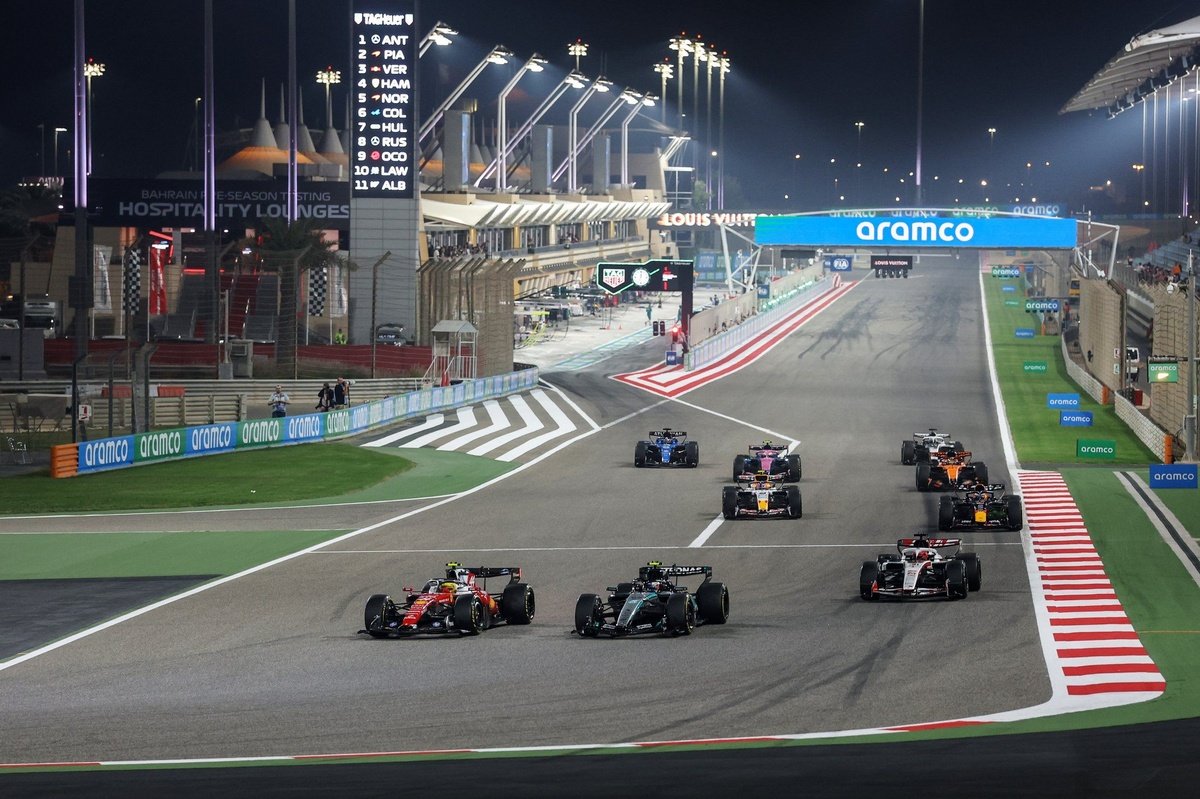
Ferrari team principal Fred Vasseur felt some degree of bewilderment when Formula 1’s starting procedure was put under scrutiny during testing ahead of the 2026 season, stating the need to manage turbo lag “was known from day one”.
As part of the wide-ranging technical regulation changes for 2026, the cars no longer carry the MGU-H – the motor generator unit attached to the turbocharger. Since this was used to spool up the turbo at lower revs, turbo lag – the time taken to get the turbine to spin at full speed – was effectively eliminated.
Without that, it thus takes longer to get the turbo rotating – and thus, the internal combustion engine does not have the full torque required to ensure a car can get away from the grid promptly.
Ferrari is believed to have produced a smaller turbocharger to reduce the inertia of the turbine, reducing the overall lag to ensure a clean getaway at the start. This was in response to the understanding that the FIA wouldn’t tinker with the start procedure, despite concerns having been raised during the rules’ gestation period.
On the grounds of safety, however, the FIA has added an extra five seconds between the final car reaching their grid position and the ignition of the start lights. This follows successful practice start tests in Bahrain testing, and should ensure all cars are able to spool up their turbos successfully.
Speaking exclusively to Autosport, Vasseur stated his surprise at the change in procedure.
“Without the MGU-H, it was clear that turbo lag would become a factor to manage, from drivability to race starts,” he stated. “This has been known from day one. When evaluating choices in defining the guidelines for a power unit, it’s not just about pure power, other aspects matter as well, and one of these is the start.
Frederic Vasseur, Ferrari
Photo by: Simon Galloway / LAT Images via Getty Images
“That’s why we made certain decisions, and the FIA has been quite clear from the beginning about not wanting to change the starting procedure, so I was surprised when this topic resurfaced in Bahrain.”
Vasseur added that “compromises” had been made in Ferrari’s design process to accommodate the previous situation, although the Ferrari-powered cars generally appeared to enjoy stronger getaways at the start of the race despite the application of the five-second hold period.
Other team figureheads had highlighted the safety issue as a motivation for the change, with the possibility that start-line crashes could be produced should a driver fail to react to a slow-starting car ahead, but there is also a performance element associated with this.
“I can say that it’s easy to ask a driver to raise a safety concern or similar, but in reality, it had been known for a long time,” Vasseur added. “When designing the architecture of an engine, compromises are always made: on one hand, you aim for maximum power, on the other, drivability. You have to make decisions.”
Haas team principal Ayao Komatsu, whose team uses Ferrari powertrains, felt that the five-second hold experiment had worked in smoothing over the anticipated safety concerns.
“If look at these practice starts, implementing the blue light for a five-second sequence, that’s been working really well,” Komatsu said. “If you look at those starts, the people who participated, they managed to get off the line okay. So I don’t think [it’ll be an issue].
“Initially, without those extra five seconds, I would agree that there might be a safety risk, but now with the pre-start preparation phase, I don’t see any safety risk at all.”
We want to hear from you!
Let us know what you would like to see from us in the future.
– The Autosport.com Team
