
Even before David Beckham swapped Madrid for Los Angeles, MLS has harbored a reputation as a “retirement league.” The notion is well-worn in banter circles. It’s tired, and also at least a little bit true.
Robbie Keane. Kaká. David Villa. Andrea Pirlo. Didier Drogba. Wayne Rooney. Zlatan Ibrahimović. All of them – and many others – enjoyed late-career stops in the United States. Today, three of the 11 players named to Fifa’s Dream Team after the 2014 World Cup play in the league: Lionel Messi (Inter Miami), Thomas Müller (Vancouver Whitecaps) and James Rodríguez (Minnesota United). When Son Heung-min (33 years old) arrived in Los Angeles after his decade with Tottenham, he reunited with longtime Spurs teammate Hugo Lloris (39), and ensured derby days against the LA Galaxy’s Marco Reus (36).
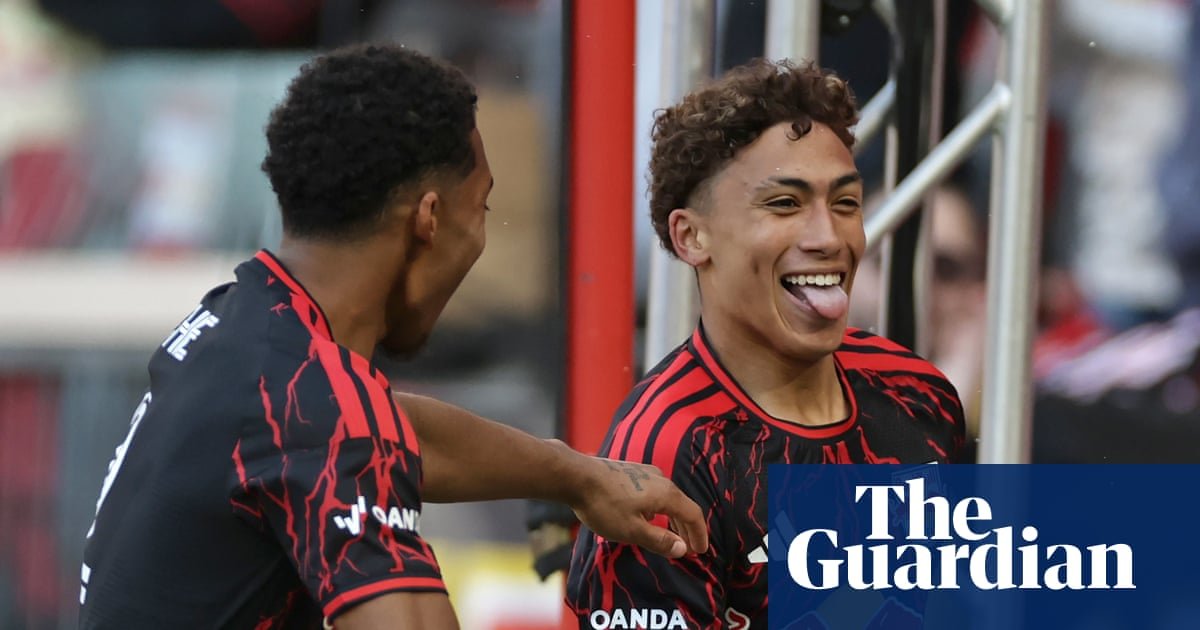
None of these players, though, are the bellwether. If that distinction belongs to anyone, it may just be 17-year-old Red Bull New York starlet Julian Hall; currently tied atop the MLS golden boot standings, and an invaluable part of one of the feelgood stories early in this season.
Hall has been electric in the first two weeks, which also happen to be the first two weeks of Michael Bradley’s top-flight managerial career. Hall’s breakthrough is made all the more impressive because it was far from a given that he would even start. Eric Maxim Choupo-Moting set a new career high with 17 goals for the Red Bulls in 2025, the first time he’d scored more than 10 times in the league in a season. Now, just three weeks shy of his 37th birthday, he’s a valuable training foil and mentor for Hall and others on a team beset with teenage standouts – Hall’s goal against the New England Revolution this weekend was assisted by 16-year-old Adri Mehmeti, while 17-year-old Matthew Dos Santos started and provided the initial ball.
The Red Bulls were among MLS’s first teams to sustainably develop young talent via their academy. Tyler Adams remains the program’s star graduate, now a vital midfield anchor for Bournemouth. Since he was sold in 2018, New York have often seemingly been preoccupied with extending their record 15-year streak of postseason qualification, with fewer and fewer young talents breaking through.
Last year, that playoff streak was broken, and now the team have gone back to their roots. Bradley was elevated to head coach after half a season leading their affiliate in MLS Next Pro, guiding Red Bulls II to the league title with an attacking-minded system.
It’s no wonder that Hall (who could only play afternoon games as a 15-year-old rookie due to New Jersey labor law) and Mehmeti, another member of last year’s Next Pro champions, are immediate mainstays of Bradley’s lineups. Mehmeti in particular has benefited from the offseason departure of midfielders Peter Stroud and Daniel Edelman.
Selling successful academy graduates to reinvest in the roster is well established in other leagues, and it’s finally gone mainstream in MLS. The Seattle Sounders have recently established themselves as midfield development specialists, selling 20-year-old Obed Vargas to Atlético Madrid this winter, then developing a succession plan that includes giving more minutes to another academy product, 18-year-old Snyder Brunell. Vargas’ emergence a few years ago afforded Seattle the ability to move on another pair of homegrown players: Danny Leyva (now with Necaxa in Liga MX) and Josh Atencio (a regular starter for Colorado).
MLS has helped encourage some of these efforts. Last winter saw the league finally allow teams to sell players to other MLS clubs for cash, rather than trading assets or players in-line with American sports custom. This winter, the league eased restrictions on interleague loans to increase the opportunity for cheap squad fillers and loan-with-purchase flyers alike.
Adams, like former Vancouver standout Alphonso Davies, helped clue the world into the talent that was starting to come through MLS academies. Their successes in Europe ultimately helped normalize MLS as a source for relatively low-cost, high-potential prospects.
That success extends beyond the U21 player pool. In the same winter that saw Adams and Davies leave their boyhood clubs, Atlanta United sold Miguel Almirón to Newcastle. These days, more players of a closer profile to the Paraguayan’s have used MLS as a vital step in their careers. Taty Castellanos (once of New York City FC) has quickly become a crucial forward for West Ham, while Thiago Almada (Atlanta) is seeing more starts in his first year with Atléti. Villarreal have a growing pocket of ex-MLS talent, led by Tajon Buchanan (New England), Tani Oluwaseyi (Minnesota) and Alex Freeman (Orlando). Patrick Agyemang (Charlotte) and Aidan Morris (Columbus) are key regulars for two Championship sides vying for promotion.
This season, though, has been all about the teenagers so far. So if it’s a retirement league, then at the very least there’s a mentorship program attached. Stars still help MLS’s teams stand out in a crowded sports and entertainment market, but it’s the league’s improving development chops that are making it climb up the global pecking order.
Messi is Florida Man
If the influx of teenage stars isn’t making you rethink the “retirement league” trope, then maybe the recent actions of one of the league’s oldest players will. Messi turns 39 this summer, but he showed in a comeback 4-2 win over Miami’s intrastate rivals, Orlando City, on Sunday night that he’s no less motivated (and increasingly cantankerous) as he nears the three-year anniversary of his MLS arrival. Even if this isn’t the Champions League or a World Cup, plenty still gets under his skin.
Last week, that meant suffering a 3-0 defeat at Los Angeles FC, and subsequently confronting referees in the tunnel (Messi avoided suspension, of course). On Thursday it meant participating in a rare mid-season, midweek friendly, in Puerto Rico, with both teams wearing all black, that saw him sign one pitch invader’s jersey and pose for a selfie with another before a third dragged him to the ground.
Messi looked little more than bemused in that instance, but Sunday was a different story. Down 2-0 at half-time in Orlando, Messi scored a brace, strikes two and four of Miami’s second-half glut, opening his 2026 scoring account.
Through it all, it was clear Messi still loves winding-up a rival. On Sunday, that meant repeated interactions with the Orlando City bench, culminating in his offering to sign an autograph for an opposing coach to cap another entertaining clash between the Floridian foes.
Allow content provided by a third party?
This article includes content hosted on embed.bsky.app. We ask for your permission before anything is loaded, as the provider may be using cookies and other technologies. To view this content, click ‘Allow and continue’.
Orlando will head south to visit Miami on 2 May, hoping to rediscover last year’s form that led to a pair of three-goal victories over the Herons.
The rule of Klauss
I normally wouldn’t write about a topic I covered just one week ago, but LA Galaxy forward João Klauss’ second goal in a 3-0 win over Charlotte FC is a prime example of one of MLS’s most enduring phenomena. Welcome to the Rule of Klauss, in which a 6ft 3in, blonde-haired, semi-balding Brazilian can go wholly undetected by defenders when dawdling in possession.
In the 13th minute, Charlotte executed a simple throw-in just inside their own half. Five seconds later, Klauss had a clear run at goal thanks to Andrew Privett’s carelessness.
Klauss made a name for himself in St Louis by scoring goals eerily like this, pouncing on giveaways for simple finishes. One would think those chances would dry up eventually. Apparently not.
