
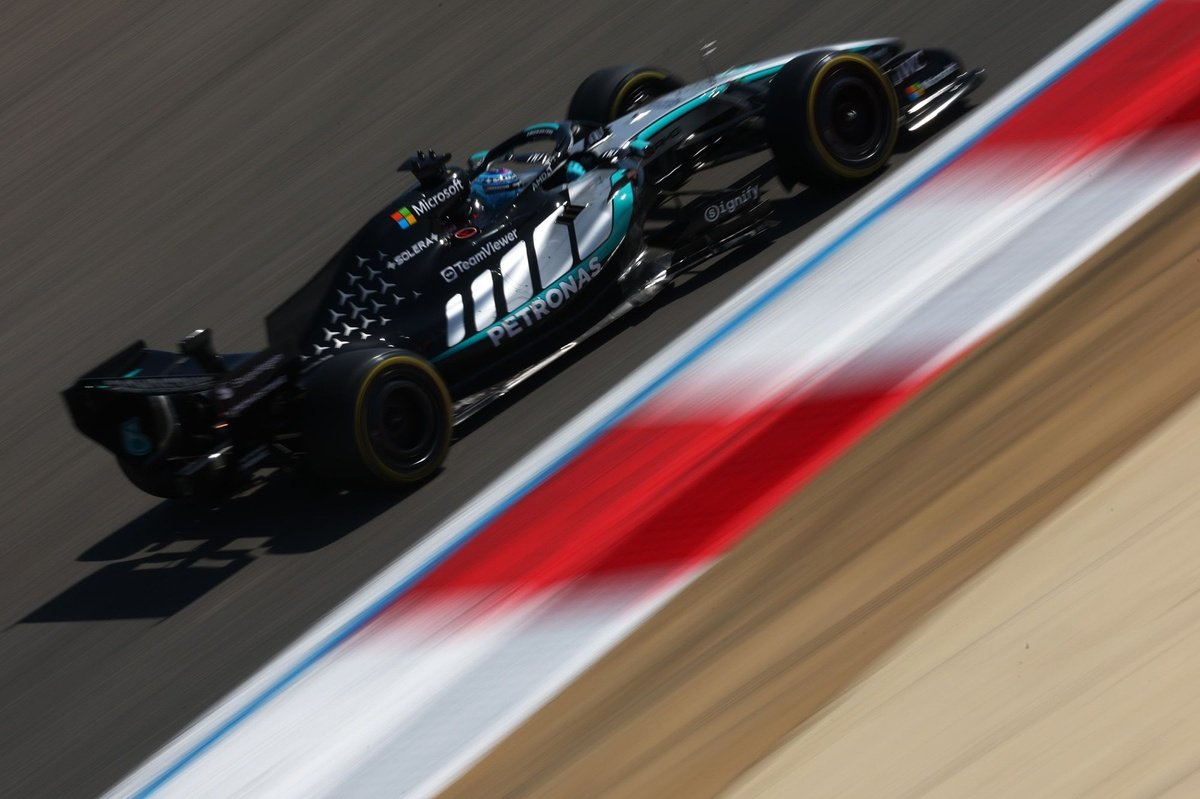
In the build-up to the new Formula 1 season, alongside energy management, much of the discussion has centred on two words: compression ratio. Put simply, it is the ratio between the volume of the cylinder when the piston is at the bottom of its stroke and the volume when the piston is at the top. To make the 2026 engine formula more accessible to newcomers and easier to work with fully sustainable fuels, the limit was reduced from 18:1 to 16:1.
The issue became political when competitors caught wind of the fact that Mercedes was able to comply with the 16:1 limit during static tests at ambient temperature, but could achieve a higher ratio when running. This is potentially linked to material expansion in the piston and connecting rod, although it should be noted that the reality today is far more complex than simply the material itself, as those components are often made up of numerous layers using advanced 3D-printing techniques.
An important nuance is that it was often too easily assumed that Mercedes would reach the full 18:1 of the previous era while running, whereas in reality the difference appears to be far more subtle. Nevertheless, rivals – led by Audi – were determined to eliminate this perceived advantage by sending a joint letter to the FIA, together with Ferrari and Honda.
Why did the FIA proceed with a vote?
Following a meeting of technical experts on 22 January, the FIA initially did not appear to see the need for change, although the picture gradually changed. This may have been the result of political pressure, but according to FIA single-seater director Nikolas Tombazis it was primarily due to another factor: the way the regulations were written was not robust enough to achieve the objective.
“There are a lot of nuances when discussing such a matter, because there’s what the regulations intend to be, and to keep the compression ratio at 16:1 was one of the core objectives when the regulations were discussed with the PU manufacturers back in 2022,” Tombazis said when asked by Autosport.
“And there’s also a topic of exactly what’s written in the regulation. It became obvious that with what was written in the regulations, there could be ways that one could have a higher compression ratio.”
Nikolas Tombazis, FIA Single Seater Director
Photo by: Andy Hone / Motorsport Images
Both sides could refer to different parts of the rulebook. Article C5.4.3 stated that the compression ratio would only be measured at ambient temperature, but Mercedes’ rivals could strengthen their case using the more general Article 1.5, which says: “F1 cars must comply with these regulations in their entirety at all times during a competition.” Since the 16:1 compression ratio is explicitly written in the regulations, those manufacturers argued that all engines must comply with that figure at all times.
In essence, both sides had valid arguments, meaning the FIA’s primary objective became tightening the wording of the regulations to remove any ambiguity.
“When the rules need improving, because they don’t achieve fully the objective, we try to make amendments. We want to keep the rules focused on what the objective is, and not to be evolving gradually when interpretations have maybe stretched them a bit in one or the other direction.”
A compromise even Mercedes can live with?
The follow-up question, naturally, is what an acceptable compromise would look like. The FIA had to actively search for such a compromise, given any change required a supermajority in the Power Unit Advisory Committee – in practice meaning four of the five engine manufacturers plus the FIA and Formula One Management.
In its statement, the FIA announced that the proposal was approved unanimously, implying that even Mercedes can live with the final outcome. That may sound surprising – especially given that the change will now take effect from 1 June rather than 1 August – but Toto Wolff had already hinted at this in Bahrain.

Andrea Kimi Antonelli, Mercedes, Toto Wolff, Team Principal and CEO, Mercedes-AMG
Photo by: Mercedes-Benz
“I think the way it’s been done now is that it needs to be compliant to the regulations when it’s cold and when it’s hot, so it doesn’t give anybody an advantage. I think the attempt from the other guys was to have it measured only hot, so they could actually have it outside of the regulations [when] cold. So now it’s a fair game for everyone.”
The fact that it will become a dual measurement – one cold and one at 130 degrees Celsius – was crucial for Mercedes. It prevents rivals from doing more or less the opposite of what Mercedes does. The manufacturer with the three-pointed star achieves a higher ratio when the engine is hot, whereas normally the ratio slightly decreases as the engine warms up.
Some competitors would therefore have preferred a hot-only check. In that scenario, they could comply with the 16:1 limit at 130 degrees Celsius, but in theory reach a higher ratio at lower temperatures. With the adopted solution, that possibility is excluded, which is why Wolff referred to it as “a fair game” on both sides.
The current outcome is a textbook example of an F1 compromise. By bringing the date forward from 1 August (the initial plan) to 1 June, the FIA ensured Mercedes’ rivals could accept it, while the decision to retain a dual test for the remainder of the year means Mercedes has also partially achieved its goal. Both sides have gained something from this debate.
If any manufacturer is required to make adjustments to its internal combustion engine to comply with the new procedures, the technical regulations provide scope for that –although everything does fall under the budget cap for PU manufacturers. From 2027 onwards, the compression ratio will only be measured with a hot engine, but by then all manufacturers will have had sufficient time to adapt.
Are there bigger issues still to resolve?
For the FIA, timing was crucial – and perhaps that’s true for all stakeholders. The governing body said from the outset that it felt the discussion had been blown out of proportion, and was determined not to let it overshadow the season opener in Melbourne.

The Formula 1 season starts in Australia next week
Photo by: Glenn Dunbar / Motorsport Images
“People get a bit too excited, and I don’t think this topic ever needed to get to this level of attention,” Tombazis said. “I’m not saying it’s not important, but does it merit all this excitement for many months? Frankly, no.”
The FIA wanted to draw a line under the matter before getting to Melbourne – a priority also recognised by the engine manufacturers, including Mercedes.
“We were pretty comfortable in even having a protest going on Friday in Melbourne, but is this what we want?” Wolff asked rhetorically, questioning whether that would be in the sport’s best interest.
“We said it all along that this looks like a storm in a teacup, the whole thing. Numbers were coming up that were, you know, if these numbers would have been true, I absolutely understand why somebody would fight it. But eventually, it’s not worth the fight,” the Mercedes team principal concluded.
Beyond that, those involved were primarily seeking clarity as quickly as possible –something Laurent Mekies also emphasised in an exclusive interview with Autosport.
“We’re asking for clarity. Tell us what we’re allowed to do, and the rest matters little: it’s essential to have a clear understanding of what is permitted, and then I believe every competitor should be free to reach the result by following the path they consider best.”
Clarity now exists regarding the compression ratio, although other – and perhaps even bigger – question marks still remain. These concern the racing as a whole under F1’s new ruleset, particularly at fast circuits such as Melbourne and Jeddah. McLaren team principal Andrea Stella has described these as “harvesting-poor” tracks, where drivers can recover significantly less energy under braking and during partial-throttle phases than in Bahrain.
On that front, the FIA still has several potential levers to pull – for example reducing the share of electrical power in race trim to 250 kW, or alternatively allowing super clipping up to 350 kW – although these topics are politically sensitive. A team with better efficiency will not easily give up a competitive advantage, since both measures would make the entire grid somewhat less “energy-poor.”
The next political battleground may therefore be on the horizon if the racing proves problematic, although the FIA has reiterated that it wants to wait for the opening races before taking any action. In practice, the governing body thinks the situation may prove less troublesome than some currently think or fear.
“The regulations introduced for 2026 represent one of the biggest changes in recent memory. All parties acknowledge that with the introduction of such significant regulatory changes, there are collective learnings to be taken from pre-season testing and the initial rounds of the 2026 championship. Further evaluation and technical checks on energy management matters are ongoing.”
The topic will undoubtedly resurface in Melbourne and Shanghai, but the FIA has succeeded in reaching a timely compromise on the issue that has dominated much of the pre-season discussion – at least for now.
We want to hear from you!
Let us know what you would like to see from us in the future.
– The Autosport.com Team
