
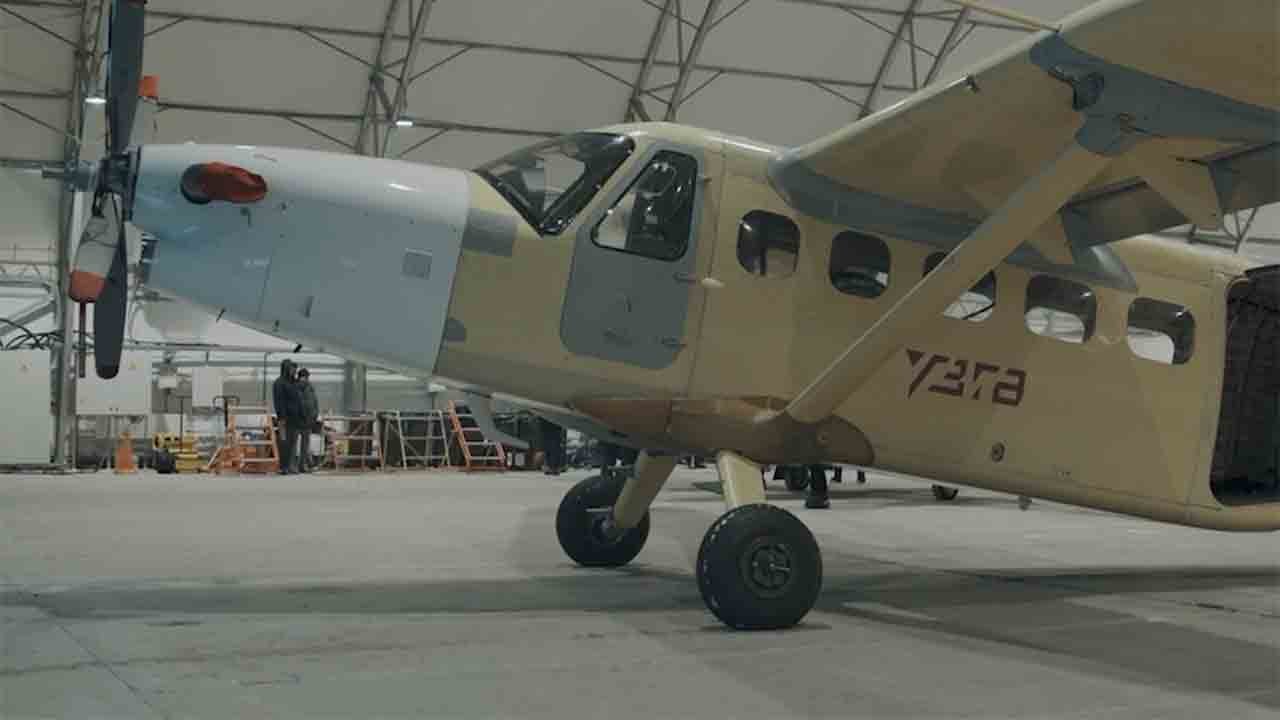
The fifth prototype of LMS-901 “Baikal”, identified as No. 0005 and the third ready-to-fly example, completed its first test flight at the airfield of the Ural Civil Aviation Plant (UZGA), which is part of the Union of Russian Machine Builders.
The test took place on the evening of 22 February. Equipped with the Russian VK-800 turboprop engine and an AV-901 propeller, the prototype completed a full circuit of the airfield and landed normally, marking another step in the aircraft’s certification program.
Before the flight tests began, UZGA implemented a number of technical changes on the new prototype, including:
- Reconfiguration of the front part of the cockpit to meet requirements for ergonomics and safety during emergency landings
- Reinforcement of the main landing gear supporting structures
- Changing the installation angle of the blades

The changes were designed to eliminate the tendency for premature separation of the landing gear during takeoff in high winds. All adjustments will undergo further evaluations both on the ground and in flight.
After the maiden flight, specialists began ground-based certification tests of the aircraft’s cable network. The purpose is to verify that the installation complies with the set technical requirements.
Observations and recommendations from the tests will be incorporated into the project until the end of the certification process for LMS-901 “Baikal”.
+ China surpasses US in nuclear submarine launches between 2021 and 2025, according to IISS

Replaces An-2 with a focus on regional routes
LMS-901 “Baikal” is a light multipurpose aircraft designed to operate on regional routes and perform a wide range of missions, including passenger transport, cargo and special operations.
The model was developed by order of the Russian Ministry of Industry and Trade as a replacement for the veteran An-2 in remote regions of the country.
Main specifications
- Capacity: up to 9 passengers
- Payload: up to 1,500 kg
- Maximum range: 1,500 km
- Maximum march speed: 250 km/t
The VK-800 engine
The VK-800 turboprop engine, also developed by UZGA, is intended for several national aviation programs, including:
- LMS-901 “Baikal”
- UTS-800 (trainer aircraft)
- LMS-192 “Osvei” (Russian-Belarusian regional program)
- Re-engineering of L-410 aircraft
The maximum power varies between 807 and 870 horsepower depending on the application.
The first flight of prototype No. 0005 represents an important step in Russia’s strategy to nationalize the production of aircraft components, especially in the engine segment, in a context characterized by international restrictions and the desire for greater industrial autonomy.
New Russian aircraft prototype makes first flight at UZGA
Source and recordings: Telegram @uwca_ru pic.twitter.com/GBFIPUtGCp
— saibadetudo.com.br (@saibadetudo25) February 25, 2026
Source and images: Telegram @uwca_ru. This content was created with the help of AI and reviewed by the editors.
