
Salesforce pulled out all the stops to convince investors that the AI revolution won’t be its death when it announced fourth-quarter earnings on Wednesday.
Salesforce reported a solid quarter of $10.7 billion in revenue, up 13% year-over-year. For the year, it reported $41.5 billion in revenue, up 10% over the previous year, with both results boosted by its $8 billion acquisition of data management company Informatica last May.
Net income landed at $7.46 billion, and the company offered strong guidance for the year ahead, projecting revenue of $45.8 billion to $46.2 billion — a 10% to 11% increase. It also said its “remaining performance obligation,” or RPO, is over $72 billion. That’s a figure that shows revenue under contact that has not yet been delivered or recognized as earned revenue.
The numbers, though, could only do so much. Software-as-a-service stocks, with Salesforce as their poster childhave been getting hammered lately. Investors fear the rise of AI agents will undermine these companies, making their per-employee-seat business models obsolete. The situation has been dubbed the “SaaSpocalypse.”
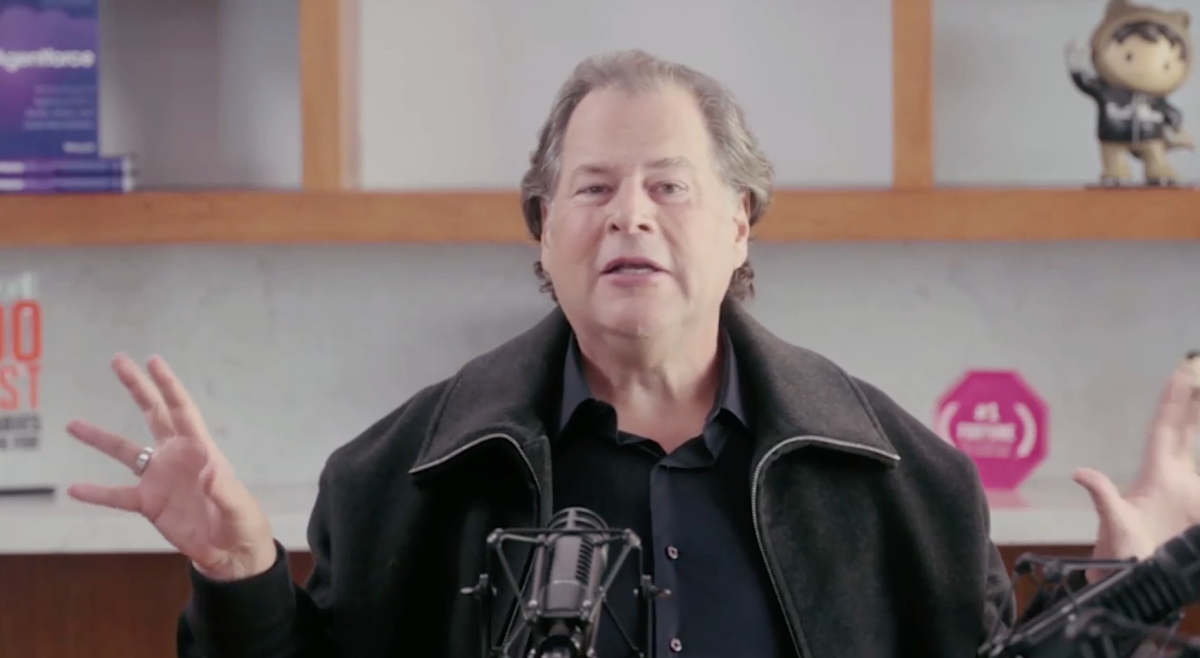
The concept hung so heavily in the air during the earnings call that CEO Marc Benioff mentioned the term at least six times.
“You’ve heard about the SaaSpocalypse? And it isn’t our first. We’ve had a few of them,” he said, later adding, “If there is a SaaSpocalypse, it may be eaten by the Sasquatch because there are a lot of companies using a lot of SaaS because it just got better with agents.”
In an attempt to convince the world of its continued health, Salesforce threw everything and the kitchen sink into this earnings report. The company increased its dividend by nearly 6% to $0.44 per share. It launched a new $50 billion share buyback program. That’s always a favorite with shareholders because it both creates a sturdy buyer of shares and reduces the number of shares in circulation (which can boost the stock price).
Techcrunch event
Boston, MA
|
June 9, 2026
The company also revamped the earnings call itself. It was part podcast, part infomercial, and part normal Q&A with a few questions from Wall Street analysts.
Instead of running through the numbers, Benioff interviewed three Salesforce customers on camera to testify to their love of its new agentic options: the CEO of home appliance company SharkNinja; the CEO of Wyndham Hotels and Resorts; and, just to hammer the point, the CEO of SaaStr, the software industry conference and media company. We’ll truncate the interviews to the shortest summary: They all love Salesforce’s AI agent products.
Salesforce also introduced a new metric for its agentic products: agentic work units (“AWU”). The idea here is that rather than simply counting “tokens” — the standard unit of AI processing volume — AWU attempts to measure something more meaningful: whether an agent actually completed a task, like writing to a record, rather than just generating text. (Salesforce logged 19 trillion tokens last quarter, which sounds like a lot but really is not in the AI world.)
“You can ask it a question and it can write you a poem, but that’s not really all that valuable in the enterprise world,” Salesforce president and CMO Patrick Stokes said on the call. So AWU is intended to measure when the agent writes to a record or does some other verifiable task.
On top of that, Salesforce also presented its own architectural vision of the coming world of agents. It shows SaaS software like itself owning most of the tech stackwith the AI model makers on the bottom as unseen, interchangeable, and commoditized work engines.
This was a direct counter to one of the causes of a SaaSpocalypse sell-off earlier this month, after OpenAI released its enterprise agent, Frontier. OpenAI’s architectural vision shows OpenAI owning most of the stack, with systems-of-record SaaS providers (the databases and business-software platforms where companies store their core data) on the bottom as the unseen engines.
And if all that wasn’t enough to influence investors: Benioff was dressed in a black leather jacket, echoing the signature look of the CEO clearly crushing it in the AI world: Nvidia’s Jensen Huang.
