
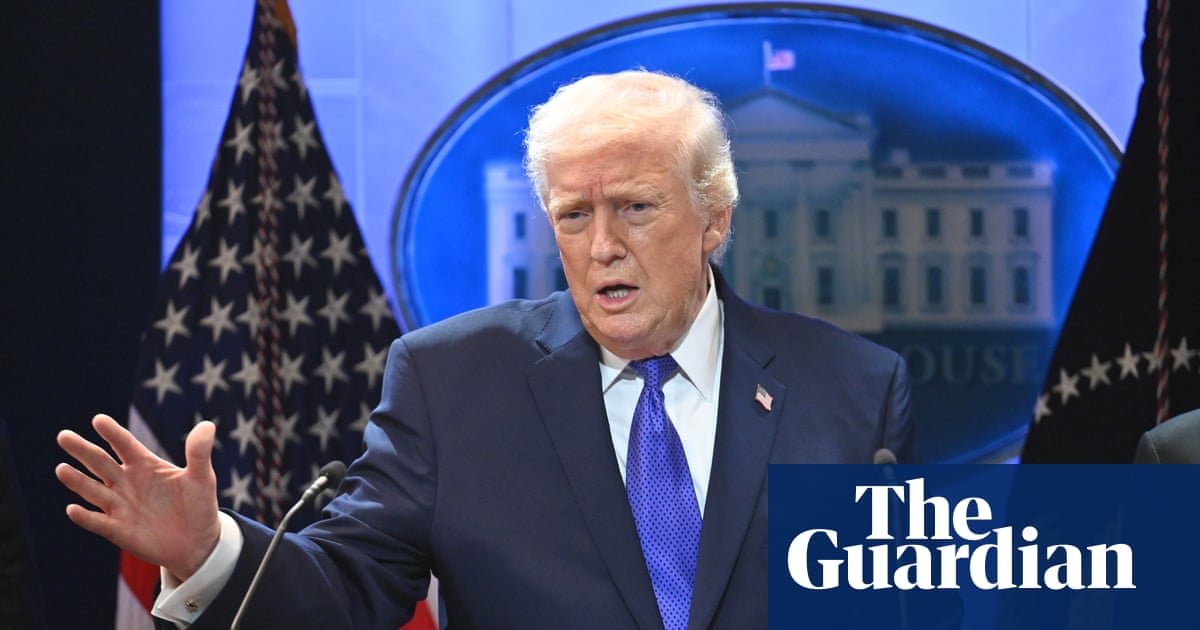
“America is WINNING again,” Donald Trump declared last week, unveiling the first batch of Japanese-backed projects under a mooted $550bn investment surge into the US as part of his trade pact with Tokyo.
After the US president tore up the global economic order in 2025, Japan was one among the countries scrambling to strike a deal. They pledged to dramatically increase investment in the US in exchange for lower US tariffs on Japanese exports.
But two days after Trump’s declared victory, his bid to reshape international trade suffered a damaging defeat at the US supreme court.
Ruling that much of Trump’s tariff regime was illegal, the court infuriated the president – and introduced fresh layers of confusion and uncertainty into an already confused and uncertain world. Global markets came under pressure on Monday as investors struggled to make sense of the decision.
The upshot, at least for now, is almost every nation – including those that bent over backwards to strike a deal with Trump – will face a 15% tariff on most of its exports to the US from Tuesday.
For months, officials from London, Brussels, Seoul, Jakarta and beyond worked rapidly to hammer out deals for their respective economies, reluctantly offering concessions to secure a preferential place. Now many find themselves in worse positions than if they had not struck deals at all.
China, India and Brazil have been handed significant tariff cuts without making a single compromise. At the same time countries like the UK may now face higher tariffs, despite making concessions.
“Under the pre-ruling regime, the spread was wide: countries like China and India faced [US] tariffs far above the global average, while Canada, Mexico, and most European exporters sat well below it,” Johannes Fritz, the chief executive at the St Gallen Endowment for Prosperity Through Trade, wrote in a blog post. The new 15% rate “compresses this spread significantly”, he added.
The European Union has paused ratification of its deal with the US, demanding “full clarity” on a US trade platform which is now as clear as mud.
“To be very frank, it’s a real mess,” Itsunori Onodera, a senior figure in the Japanese prime minister Sanae Takaichi’s Liberal Democratic Party, told Fuji Television on Sunday.
Countries that secured deals with Trump are no longer certain what they mean today, let alone tomorrow. And countries in talks to cut deals of their own are left wondering just what, exactly, they are negotiating over.
Earlier this month Trump claimed that India had agreed to stop buying Russian oil, in exchange for US tariffs on its exports falling from 50% to 18%. Indian officials also committed to purchasing $500bn in US goods over five years.
A delegation of Indian officials had been due to fly to Washington for trade talks this week. Their visit has now been delayed.
Arvind Subramanian, a former chief economic adviser to India’s government, said: “I think these negotiations are going to be on hold for a while, until the US itself figures out what it can, and cannot, do. The administration’s hand has been weakened, certainly. Some countries will want to try and get something out of that weakness.”
But Subramanian, now at the Peterson Institute for International Economics in Washington DC, said the US president still has “so many levers … to inflict pain”. “The fact one lever has been taken away doesn’t mean he can’t, or won’t, use other levers.”
Trump, ever keen to position himself as an economic strongman, is desperate to preserve his leverage – urging bewildered trading partners to maintain their side of deals, and threatening to impose new tariffs in a “much more powerful and obnoxious way” on those who fail to comply.
“The policy hasn’t changed,” Jamieson Greer, the US trade representative, stressed during an appearance on ABC’s This Week. But many other things have.
The Trump administration is leaning for now on a legal provision that only allows it to impose tariffs of up to 15%, and only until July. Section 122 of the Trade Act of 1974 – a provision never before used in this way – imposes a 150-day limit on its imposition. After that, the White House has outlined one element of what it is planning: using Section 301 of the same law to launch investigations over more tariffs.
The president is pushing aides to find other legal mechanisms to enforce his tariffs amid growing questions around just how successful they really are.
While his administration claims tariffs enable the US to tax the world, analysis by the New York Federal Reserve found that 90% of the economic burden has fallen on US companies and consumers. And official statistics last week revealed the US goods trade deficit – the gap between what it imports and exports – widened to its highest level on record in December.
All the while, some of Trump’s prime targets appear to be navigating the volatility and volume emanating from Washington with some success. Their exports seem stable in some cases, and robust in others.
Overall Chinese exports rose 6.1% last year, at least according to official state data published last month, as a 19.5% drop in exports to the US was more than offset by strong growth elsewhere. Indian exports to the world rose 2.2% on the year between April and January, according to official data released last Monday, as its exports to the US rose 5.85%.
And Japanese exports increased 16.8% in January, according to official data published last Thursday, as a jump in exports to China – despite a diplomatic rift – countered a 5% drop in US exports.
The US is “WINNING” thanks to tariffs, its president insists. As a growing number of Americans pay the price for Trump’s trade agenda, many of the countries in his sights say they’re doing pretty well too.
