
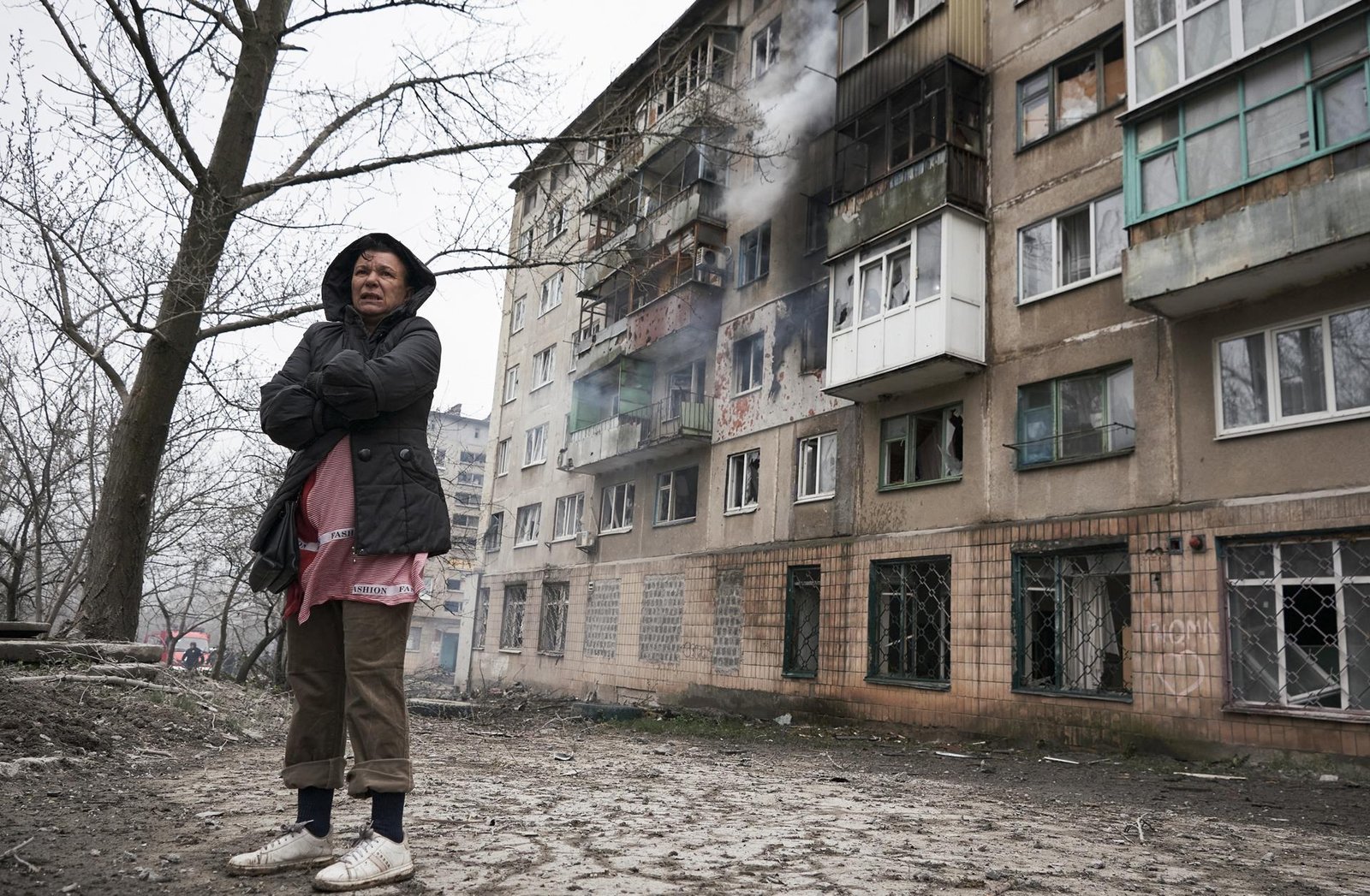
A Russia’s invasion of Ukraine completes four years this Tuesday (24). In recent months, the United States, under President Donald Trump, has stepped up efforts to broker a deal that ends the ongoing conflict. The negotiations, however, come up against territorial demands imposed by the Kremlin, especially on regions in eastern Ukraine that remain under Kiev’s control.
Recent negotiations held in the Middle East and Switzerland brought together Russian and Ukrainian delegations under American mediation. The meetings advanced on technical points, such as humanitarian issues, prisoner exchanges and mechanisms for monitoring a possible ceasefire. However, the central themes to close the agreement – territory and security guarantees – remain without consensus.
Washington has set the goal of seeking an understanding between Moscow and Kiev by the middle of this year, but diplomats involved in the talks told the international press that the impasse remains significant, making it difficult to reach an agreement within that period.
SEE ALSO:
-
Attention to the war in Ukraine drops after 4 years and community mobilizes in Brazil
-
Trump is in a hurry, but there will be no peace in Ukraine without putting pressure on Russia
The role of “fortress cities” in the fight against Moscow
At the center of the ongoing negotiations between Ukraine and Russia, mediated by the United States, is the fate of Donbas, a strategic region that brings together the provinces of Donetsk and Luhansk.
Currently, Luhansk is practically under total control of Russian forces. Donetsk, on the other hand, remains partially under Kiev’s control, mainly thanks to Ukrainian resistance in the so-called “cidades-fortalezas”: Sloviansk, Kramatorsk, Kostiantynivka and, even recently, Pokrovsk.
These locations form the core of the Ukrainian defensive line in the east since the start of the large-scale invasion in February 2022. Moscow claims to have already consolidated control of Pokrovsk, while Kiev maintains that the city remains partially contested.
According to Brazilian Army reserve colonel Marco Antonio de Freitas Coutinho, a specialist in international relations and master in International Political Science, these cities are more than just symbols of resistance, are pillars of Ukraine’s current defensive scheme in the east of the country.
Coutinho explained in an interview with People’s Gazette that Slovyansk, Kramatorsk and Kostiantynivka, which currently make up the fortress cities, began to be fortified during the Donbas War, between 2014 and 2022, when Ukrainian government forces built in these cities an extensive system of trenches, anti-tank ditches, bunkers and minefields to prevent the advance of separatist forces supported by Moscow.
The analyst highlighted that the Russian territorial objective in the conflict involves consolidating dominance over five strategic provinces: a Crimeaalready under Moscow’s control since 2014; Luhanskpractically conquered; Donetsk; Zaporizhzhya; e Khersonwhere Russian control is still partial and remains in dispute with Ukraine.
In Kherson and Zaporizhzhya, the Dnipro River acts as a natural obstacle to Russian military progression. But in Donetsk, containing Moscow’s advance depends almost exclusively on the fortifications built by Ukrainian engineering in these fortress cities, which turns them into the main blocking point for the full fulfillment of one of the Kremlin’s main territorial objectives.
“We can consider that the best defended cities in the Ukrainian defensive scheme are located in the Oblast [província] of Donetsk, where there are no relevant natural barriers, but only those built by military engineering, such as trenches, anti-tank ditches and minefields”, says Coutinho.
The analyst also explained that these fortress cities concentrate important transport hubs, which increases their strategic and logistical relevance.
The eventual conquest of Slovyansk, Kramatorsk and Kostiantynivka by Russian forces in the conflict, according to the analyst’s assessment, would characterize the complete domination of the Donetsk province, making Russia achieve one of its main war objectives through force, putting pressure on Kiev in the peace negotiations.
“The conquest by the Russians of these locations would characterize the total conquest of the Donetsk Oblast itself, which is one of the main Russian territorial demands. I remember that this demand has even been discussed in the peace negotiations in full swing. The Russians demand that the Ukrainians leave these cities and the areas of their municipalities so that a ceasefire can be established, which Ukraine does not agree with,” he said.
SEE ALSO:
-

Trump once and for all adopts the language of force and coercion
Urban resistance
As long as the fortress cities remain under Kiev’s control, Ukraine will be able to prolong its resistance capacity, says Coutinho. “It is on this basis that the Ukrainian attrition strategy is based,” he added.
In the military context, war of attrition is a strategy that seeks to continually wear down the enemy. Coutinho recalls that each Russian advance on Ukrainian soil increases the cost of an eventual negotiated peace, as it increases Moscow’s demands at the negotiating table.
The analyst notes that, in addition to the fortress cities located in Donetsk, two others deserve attention in the current conflict scenario: Kupyansk, located in the province of Kharkiv, already in the phase of urban combat, and Zaporizhzhya, capital of the province of the same name.
In the case of Kupyansk, the analyst states that the Kharkiv region has become the target of Russian interest both to expand its stock of territorial exchange currencies and to establish a buffer zone in the land border strip between the two countries.
Regarding Zaporizhzhya, the analyst highlights that the regional capital did not receive the same level of fortification as the Donetsk defensive belt, partly because it initially remained further from the front line. However, after the Russian advance on Pokrovsk and given the difficulty of breaking through the defenses of Sloviansk and Kramatorsk, Moscow would have redirected efforts to this sector. According to Coutinho, the Zaporizhzhya front became among the most active in terms of fighting this year.
The role of these cities in peace negotiations – and what is at stake
For international strategist Cezar Roedel, the fortress cities of Donbas today represent the most sensitive point in negotiations between Russia and Ukraine because they concentrate, at the same time, military weight, political impact and symbolic value.
On a military level, the analyst explains, these cities prevent Moscow from declaring full control of the Donbas or advancing over the entire country. In the political field, ceding these cities would mean recognizing, albeit indirectly, that the Russian invasion produced concrete gains for the Kremlin.
In the symbolic field, these cities can define, in a way, who can say that “won” the ongoing conflict, although the analyst remembers that the war in Ukraine is a “war of attrition, which in military doctrine is a highly costly war, with no winner, no loser”.
If Kiev continues to control these regions, it reinforces the image of resistance and that Russia has not been able to fully achieve its objective in the Donbas. If they are transferred or taken over by Moscow, they will serve as concrete proof, for the Russian domestic public, that the territorial goal has been achieved.
“Giving up one of these cities translates into the following: Kiev admitting that the war rewarded aggression in a certain way”, explains Roedel.
The transfer of disputed territories in Ukraine, however, is something that the White House, mediator of ongoing peace discussions, does not rule out as part of a possible peace agreement. In Roedel’s view, this American willingness to admit territorial concessions puts Kiev under direct pressure, because it turns precisely the most sensitive point of the war into a possible bargaining chip.
According to Roedel, if pressure from the White House for an agreement intensifies and if President Volodymyr Zelensky’s resistance to discussing territorial concessions loses strength, the Ukrainian government could be faced with two difficult solutions.
The first would be to officially recognize, in an agreement, the territorial losses, legally formalizing the cession of the areas occupied by the Kremlin. The second would consist of freezing the current front line without legal recognition, postponing the definition of the status of the disputed territories.
“This second format fits more into a package with strong Western guarantees”, assesses Roedel. “But these guarantees are still not clear”, he recalled.
For the analyst, including formal recognition of areas occupied by Russia in the peace agreement would send a worrying signal to the international community.
“This would set a toxic precedent: the message that borders change by force,” Roedel said. According to him, this directly conflicts with the principle of non-acquisition of territory by force, one of the pillars of public international law.
The analyst cited the case of Taiwan and China as a possible indirect outcome of an agreement along these lines. The full concession of Donbas to Russia could be interpreted by Beijing as a sign that annexations through the use of force have a manageable political cost.
