
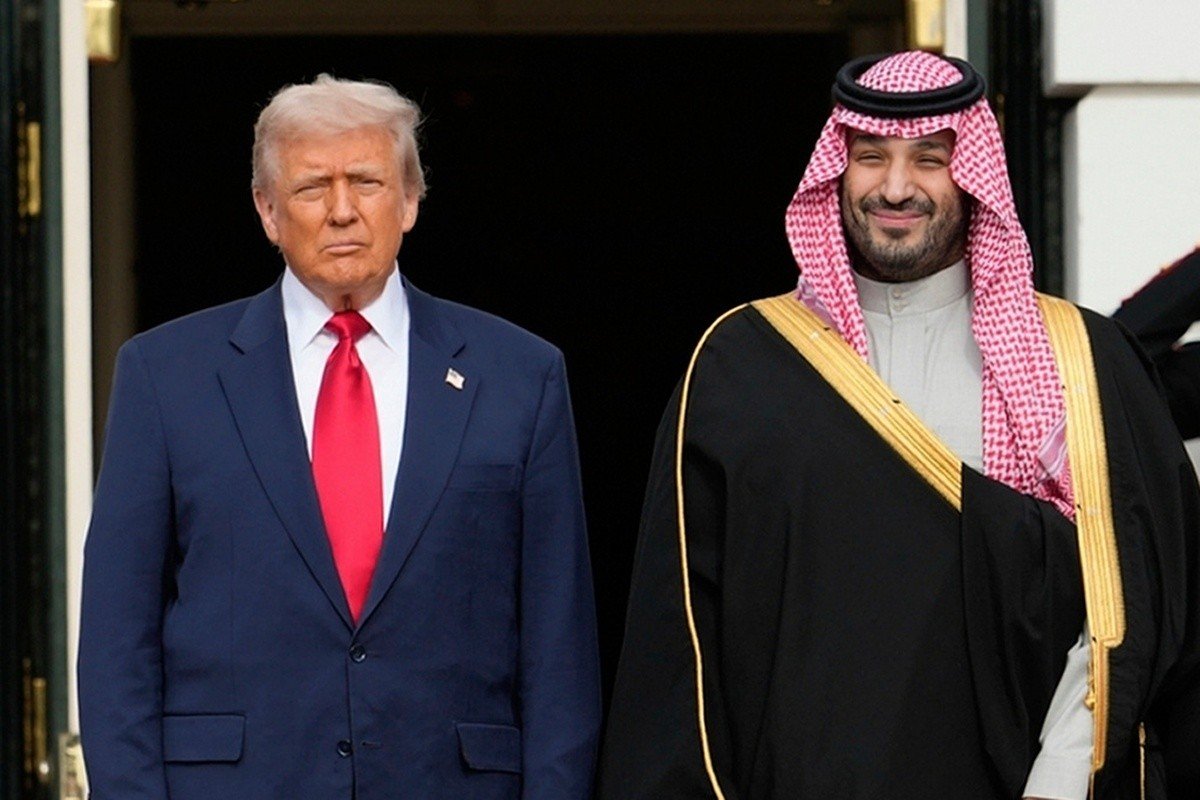
President Donald Trump poses alongside Saudi Arabia’s Crown Prince Mohammed bin Salman during his visit to the White House. Mark Schiefelbein/AP/File Saudi Arabia may have some type of uranium enrichment on its territory within a nuclear agreement being negotiated with the United States, according to documents from the American Congress and an arms control organization. The possibility raises concerns about nuclear proliferation amid the atomic standoff between Iran and the United States. US Presidents Donald Trump and Joe Biden have tried to strike a deal with the kingdom to share US nuclear technology. Non-proliferation experts warn that the operation on Saudi soil could pave the way for an eventual weapons program, something the country’s crown prince has already suggested he could pursue if Tehran obtains an atomic bomb. Last year, Saudi Arabia and Pakistan — a country that has nuclear weapons — signed a mutual defense pact after an attack by Israel on Qatar that targeted members of Hamas. MORE “Nuclear cooperation can be a positive mechanism for strengthening nonproliferation norms and increasing transparency, but the problem is in the details,” wrote Kelsey Davenport, director of nonproliferation policy at the Washington-based Arms Control Association. According to her, the documents raise “concerns that the Trump administration has not carefully considered the proliferation risks posed by the proposed agreement with Saudi Arabia nor the precedent it may create.” Saudi Arabia did not immediately respond to questions from The Associated Press. READ ALSO: US mobilizes greater air power in the Middle East since the invasion of Iraq in 2003, says newspaper Congressional report describes possible agreement The Congressional document, also analyzed by AP, indicates that the Trump administration intends to close 20 nuclear trade agreements with countries around the world, including Saudi Arabia. The contract with the kingdom could be worth billions of dollars. The text states that concluding the agreement “will promote the national security interests of the United States”, breaking with policies considered ineffective and allowing American industry to regain ground in the face of foreign competitors. China, France, Russia and South Korea are among the main exporters of nuclear power plant technology. The draft provides for the US and Saudi Arabia to establish safeguards with the International Atomic Energy Agency (IAEA), the UN body responsible for overseeing the nuclear sector. This would include oversight of areas “most sensitive to proliferation” such as enrichment, fuel manufacturing and reprocessing. The IAEA did not immediately respond to requests for comment. Saudi Arabia is a member of the agency, which promotes the peaceful use of nuclear energy and inspects countries to ensure they do not maintain secret atomic weapons programs. For Davenport, the proposal suggests that, once the bilateral safeguards agreement is signed, “the door will be open” for the kingdom to acquire uranium enrichment technology or capacity — possibly even from the United States itself. Enrichment alone does not automatically lead to the production of a nuclear weapon. A country also needs to master other technical steps, such as the coordinated use of high-precision explosives. Still, the process paves the way for militarization, a reason for Western concerns about the Iranian program. The United Arab Emirates, neighbors of Saudi Arabia, signed an agreement with the United States known as “123” to build the Barakah nuclear plant with South Korean help. The country, however, renounced uranium enrichment — a model considered by experts to be the “gold standard” for nations that want nuclear energy without the risk of proliferation. READ ALSO: Fears are growing that a possible US attack on Iran could trigger a war in the Middle East Proposal comes amid tension with Iran The advance in negotiations between the Saudis and Americans comes as Trump threatens military action against Iran if there is no agreement on Iran’s nuclear program. The military pressure comes after national protests in the country, violently repressed by the government, resulting in thousands of deaths and tens of thousands of arrests, according to reports. Iran has maintained for years that its enrichment program is for peaceful purposes. However, Western countries and the IAEA claim that Tehran maintained an organized military nuclear program until 2003. The country has also enriched uranium to up to 60% purity — a level technically close to the 90% needed for military use —, something unprecedented without the declared existence of a weapons program. Iranian diplomats cite statements by Supreme Leader Ayatollah Ali Khamenei as a fatwa — religious decree — that would prohibit the construction of an atomic bomb. Still, Iranian officials have more frequently mentioned the possibility of pursuing the weapons as tensions with the United States rise. Saudi Crown Prince Mohammed bin Salman, the country’s de facto ruler, has already declared that if Iran gets the bomb, “we will have to get one too.”
Source link
Saudi Arabia could enrich uranium after proposed deal with US, experts say
38
