
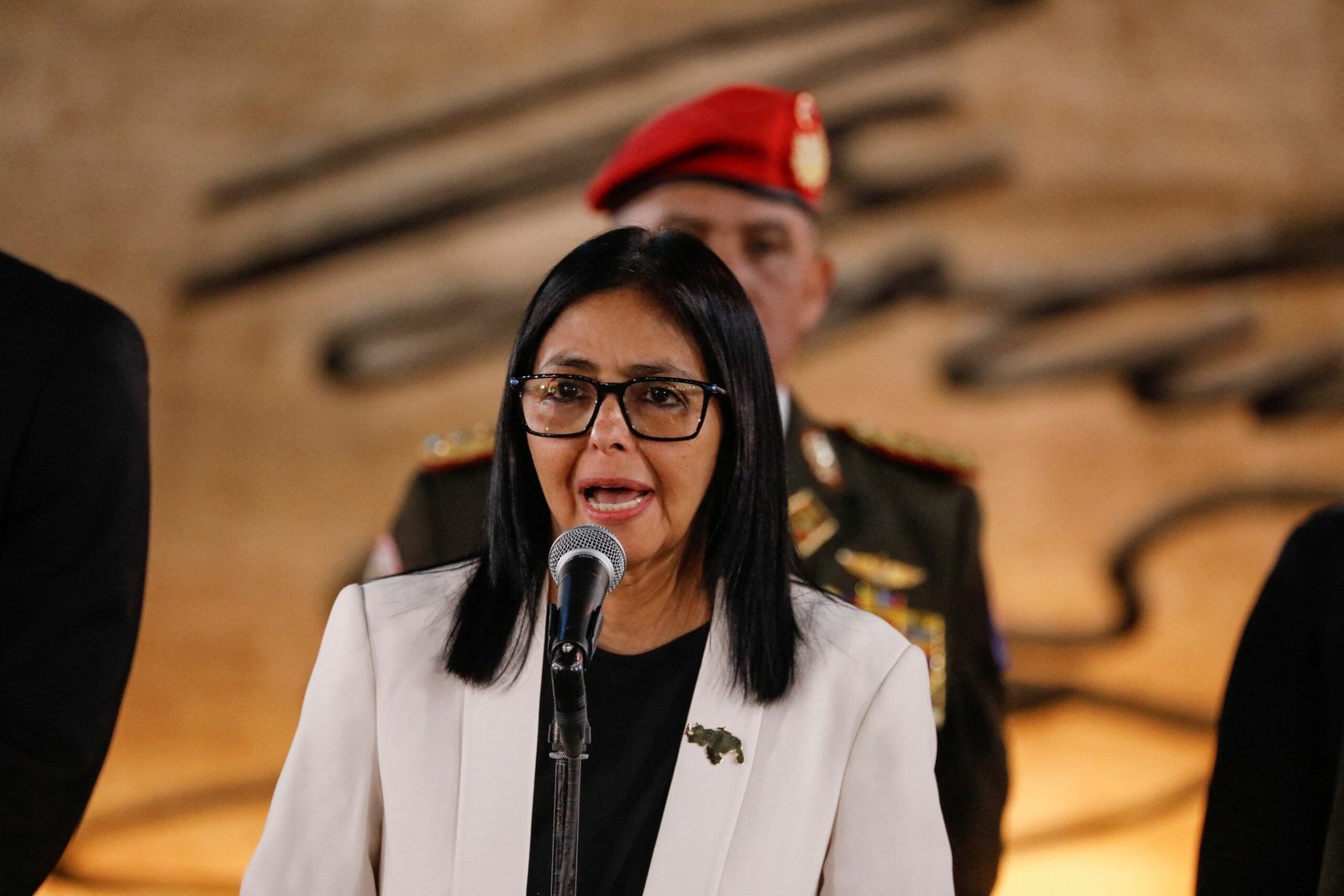
The interim president of Venezuela, Delcy Rodriguez, speaks on January 8, 2026 during the ceremony in honor of Venezuelan and Cuban military and security personnel who died during the US operation to capture President Nicolás Maduro and his wife, Cilia Flores Leonardo Fernandez Viloria/Reuters Venezuelan justice granted freedom to 379 political prisoners on Friday night (20), one day after the approval of a historic amnesty law, the parliamentarian announced responsible for the process promoted by the country’s interim government after the deposition of Nicolás Maduro. Hours earlier, interim president Delcy Rodríguez had defended the measure in a speech on state television, stating that it represents a step in the construction of “a more democratic, fair and free Venezuela.” The 379 people who received amnesty “should be released (…) between tonight and tomorrow morning (Saturday)”, announced deputy Jorge Arreaza, who chairs the legislative commission that drafted the law and monitors its implementation, in a television interview. Although Delcy Rodríguez’s government has granted parole to 448 opponents since Maduro’s capture in a US operation in early January, there are still almost 650 political prisoners behind bars, according to the NGO Foro Penal. Experts doubt the scope of this law promoted by Delcy Rodríguez and unanimously approved in Parliament on Thursday night. Hundreds of detainees, such as military personnel involved in activities classified as “terrorist”, could be left out. “Many of us are aware that the amnesty law does not cover our family members,” Hiowanka Ávila, 39, told AFP. His brother Henryberth Rivas, 30, was detained in 2018, accused of participating in an attempt to assassinate now-deposed president Nicolás Maduro with drones. According to the Minister of Defense and General of the Armed Forces, Vladimir Padrino, “this legal instrument […] it must be interpreted as a sign of maturity and political strength, as it represents a transcendental step towards achieving the stability of the nation.” For the interim president, the approval of the amnesty “was an act of greatness”, as she stated after the law’s approval. “You need to know how to ask for forgiveness and also receive forgiveness”, she added. ‘We need actions, not words’ Narwin Gil, a family member of a prisoner in the National Police prison in Caracas, known as Zone 7, did not hide his impatience. “We need actions, not words”, she asked. She was lying on an improvised bed in front of the prison, where a dozen women began a hunger strike on February 14, which ended when the amnesty was approved. Gil was the last to put an end to the protest. “We are waiting for these actions, and for them to be as soon as possible, because we need to go to our homes”, she declared. The families of political prisoners have been gathered outside Venezuelan prisons since January 8, when the government announced a release process that is progressing slowly. “Amnesty is not automatic,” said the director of Foro Penal, Alfredo Romero, at a press conference. He criticized the process of requesting amnesty before the courts, a controversial point in the bill that generated controversy in Parliament. Daniels, director of the NGO Access to Justice. He denounced “serious structural deficiencies” in the legislation. ‘Full freedom’ “With our people, with the people of Maracaibo in the Basilica”, opposition leader Juan Pablo Guanipa wrote this Friday in X, along with a video that shows how dozens of his followers welcome him with applause in the streets of the second largest city in the country. detained for nine months, accused of conspiracy and, a few hours after being released, he was arrested again on February 8, accused of violating his probation. Since then, he was under house arrest. This Friday he obtained “full freedom”. response to the measures taken. The interim president rules under pressure from Washington, which claims to be in charge of post-Maduro Venezuela. On Wednesday, the head of the United States Southern Command, General Francis Donovan, met in Caracas with Delcy, Padrino and the Minister of the Interior, Diosdado Cabello, who for years have propagated anti-imperialist speeches.
Source link
After approval of historic amnesty law, Venezuelan justice frees 379 political prisoners
18

previous post