
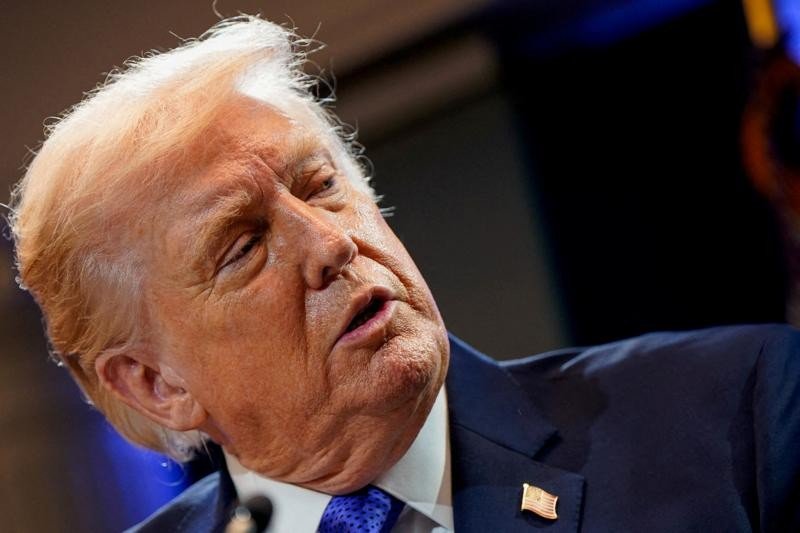
The President of the United States, Donald Trump, announced this Saturday (21/2) that he will raise global import tariffs to 15%. The announcement was made in a post on Truth Social, less than 24 hours after informing that it would use a new legal instrument to apply a 10% tariff on imported products, with immediate effect. Trump introduced tariffs on products entering the United States from most countries in the world. Trump introduced 15% tariffs on products entering the United States from most countries in the world. REUTERS/Elizabeth Frantz The American president argues that taxes will boost domestic industry and create jobs. Critics, however, warn of rising consumer prices and negative impacts on the global economy. On Friday (20/2), the United States Supreme Court struck down some of the most significant tariffs imposed last year. The Court ruled that Trump exceeded his authority by using emergency powers to implement them against dozens of global trading partners. By a vote of 6 to 3, the ministers concluded that the president could not use a 1977 law — the International Emergency Economic Powers Act (IEEPA) — to charge taxes on imports from practically all countries in the world. The decision left open the possibility that consumers and companies will receive refunds of the approximately US$130 billion generated by tariffs — an issue on which the Supreme Court did not rule and which could result in a new legal dispute. Hours after the judgment was released, Trump said he would replace these measures with a 15% global tariff, based on other legislation. He signed a proclamation based on Section 122 of the Trade Act of 1974, which allows him to impose a new temporary tariff of 10% on products from all countries. This Saturday, Trump published on social media that he would increase these new tariffs to 15%. See what is known about the next steps and the questions still open. What are tariffs and how do they work? Tariffs are taxes on imported goods. Normally, they correspond to a percentage of the value of the product. For example, a 10% tariff on a $10 product incurs an additional tax of $1 — bringing the total cost to $11. The tax is paid to the government by companies that import foreign products. These companies can pass on some or all of the additional cost to their customers — American consumers and other U.S. businesses. They can also choose to import fewer goods. Trump claims that tariffs increase government revenue, encourage the consumption of products made in the USA and encourage investment in the country. He wants to reduce the United States’ trade deficit (the difference between the value of imports and exports). The president maintains that the country was exploited by “cheaters” and “plundered” by foreigners. Trump also used tariffs as an instrument of political pressure. When announcing tariffs against China, Mexico and Canada, he said those countries would need to do more to curb migrants and the illegal trafficking of fentanyl into the US. He also threatened to impose additional 10% tariffs on eight European countries that opposed his plans to take control of Greenland, before backtracking. Some tariffs were changed, postponed or revoked after the announcement. Which tariffs were considered illegal and why? The Supreme Court ruling, released on February 20, concerns only tariffs established under IEEPA, which gives the president the power to regulate commerce in response to an emergency. Trump first resorted to the law in February 2025 to tax products from China, Mexico and Canada, claiming that fentanyl trafficking from these countries constituted an emergency. Months later, on what he called “Liberation Day”, he imposed tariffs of between 10% and 50% on products from almost every country in the world. In this case, he stated that the United States’ trade deficit — when the country imports more than it exports — represented an “extraordinary and unusual threat.” The Court stated that it is up to the United States Congress — and not the president — to create new taxes, and that regulation based on IEEPA does not involve revenue collection. Still, several tariffs imposed over the past year were not tied to emergencies declared under IEEPA and may remain in effect. These include sectoral tariffs on steel, aluminum, lumber and automobiles, implemented under Section 232 of the Trade Expansion Act of 1962, under the argument of national security. New temporary tariffs based on another law After the Supreme Court decision, Trump issued a proclamation to impose a 10% global tariff on almost all imports into the United States, based on Section 122, a provision never used before. On Saturday, it said it would raise the global tariff to 15%. Section 122 allows you to impose tariffs of up to 15% for 150 days, after which Congress must intervene. There is, however, the possibility of bypassing the Legislature. Section 122 does not expressly prohibit the president from letting tariffs expire after 150 days and then declaring a new emergency to reinstate them, according to the Cato Institute. According to the White House, Trump is using Section 122 “to address fundamental problems in international payments” and rebalance American trade, as well as evaluating whether he can impose tariffs based on Section 301 of the Trade Act of 1974. This legislation allows the United States Trade Representative (USTR), currently held by Jamieson Greer, to investigate the trade practices of other countries and impose tariffs when concluding that they are “discriminatory” or “unfair.” The administration could also continue to impose Section 232-based tariffs. Treasury Secretary Scott Bessent has said the combination of tariffs should keep revenue largely unchanged through 2026, offsetting the loss of IEEPA-based tariffs. Will there be a refund? One of Trump’s arguments is that tariffs strengthen the US Treasury. According to estimates, the government raised around $130 billion (£96 billion) from the tariffs considered illegal. According to estimates, the government raised around $130 billion (£96 billion) from the tariffs considered illegal. REUTERS/Brendan McDermid The Supreme Court has not determined whether the government should return these amounts. Trump stated that any refunds could be tied up in court for years. Bessent said the issue could drag on. The expectation is that the issue will be decided by the US international trade court. Experts say that, if there is a refund, larger companies tend to be the main beneficiaries. Alex Jacquez, director of public policy at the liberal-leaning think tank Groundwork Collective, told BBC partner CBS that more than 1,000 companies had already requested refunds of fees before the decision. According to him, this number tends to grow. Democratic Illinois Governor JB Pritzker also called on the White House to issue a $1,700 refund check to every American family for the illegal tariffs. On several occasions, Trump even publicly mentioned the possibility of sending tariff refund checks to Americans. What tariffs are in effect now? The new rates were due to take effect on February 24, at 12:01 am (US Eastern Time). A White House official told the BBC that countries that have entered into trade deals with the United States — including the United Kingdom, India and the European Union — will also be subject to the global tariff under Section 122, rather than the previously negotiated rates. Some products will be exempt for economic or strategic reasons. Exemptions include certain critical minerals, metals, energy products, natural resources, agricultural crops, medicines, electronics, automobiles, trucks and aerospace products. “Informational materials (such as books), donations and accompanied baggage will also not be taxed.” Products covered by the USMCA — an agreement between the USA, Mexico and Canada — remain exempt. Canadian Prime Minister Mark Carney has stated that Canada is among the countries with the lowest tariff burden due to the agreement. Trump also maintained the end of the so-called de minimis exemption, which allowed goods worth up to US$800 to enter the US without tariffs. And how does this impact Brazil? In April 2025, when announcing what he called “reciprocal tariffs” on what he called “Liberation Day”, Trump applied a 10% tax on Brazilian products imported by the US — then the lowest level applied to the affected countries. In November, Trump had already removed 40% tariffs on several Brazilian products, after direct negotiation with Lula. Getty Images In July, however, the republican imposed a new tariff on Brazil of 40%, raising the total rate to 50%, in an attempt to influence the trial of former president Jair Bolsonaro (PL) for an attempted coup d’état. The measure, however, was accompanied by an extensive list of exceptions, which left out the additional 40% rate items such as orange juice, civil aircraft, oil, vehicles and auto parts, fertilizers and products from the energy sector. The taxation came into force on August 6th. In November, after Bolsonaro was sentenced in September to 27 years in prison under an initial closed regime, the US removed the 40% tariff on new items, including coffee, meat and fruit. The decision was taken after Trump began direct negotiations with President Luiz Inácio Lula da Silva (PT), months after praising the Brazilian in a speech at the UN. In practice, the Supreme Court’s decision this Friday overturns tariffs of 10% or more that had been applied since April 2025 to most of the United States’ trading partners — including the 10% then imposed on Brazil. However, specific tariffs on steel and aluminum imports, which also include Brazilian products, are not affected. It is still unclear how the new 15% global tariff announced by Trump this Friday will affect Brazilian exports to the United States.
Source link
Trump’s new global tariffs: how do they work and what happens now?
24
