
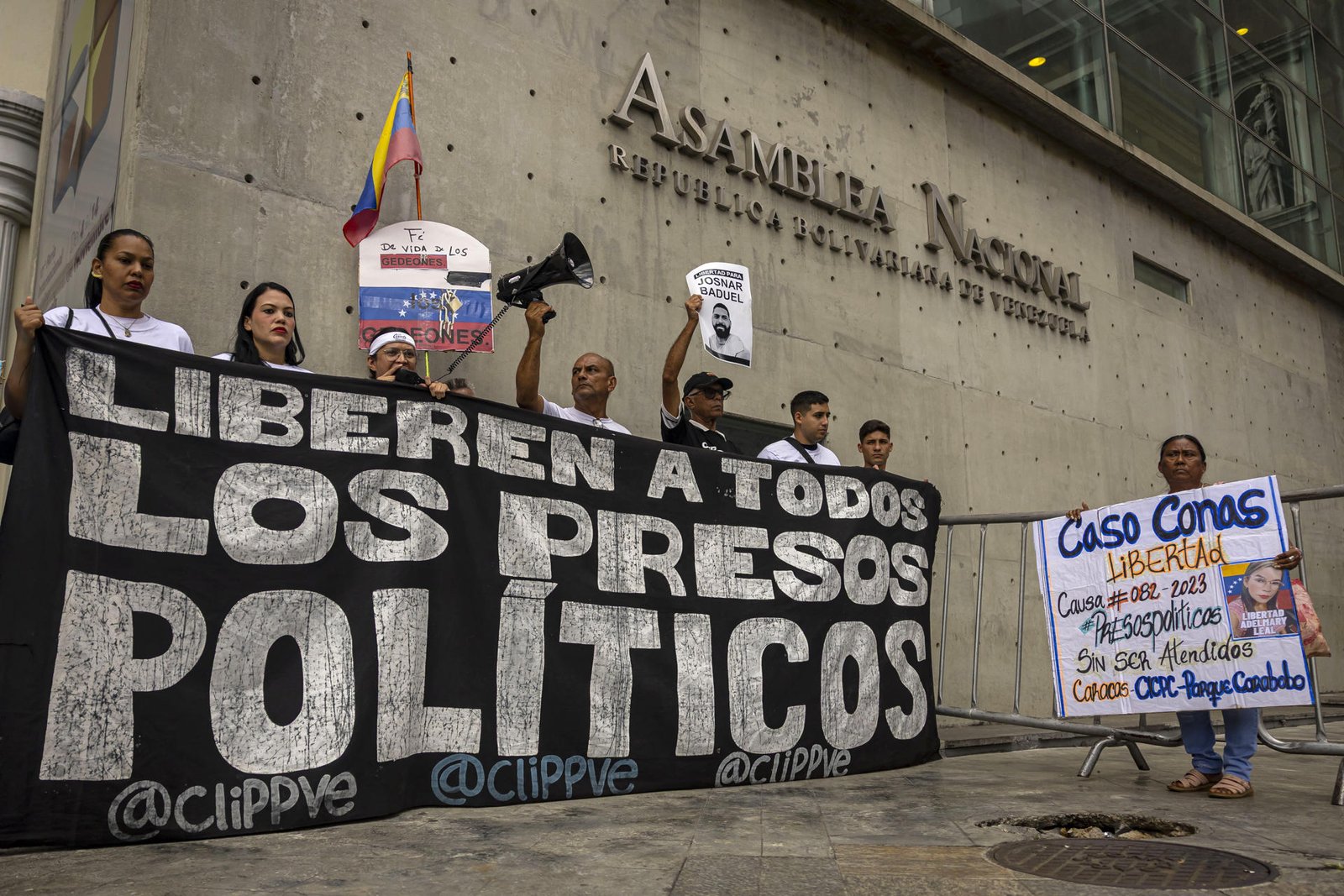
One day after sanctioning the amnesty law, the Venezuelan court ordered, on Friday night (20), the release of 379 political prisoners. The measure is part of the process led by the regime after the fall of former dictator Nicolás Maduro and was confirmed by a parliamentarian involved in the implementation of the new legislation.
Before the announcement of the releases, interim leader Delcy Rodríguez declared, in a statement broadcast on state television, that the amnesty represents progress towards “a more democratic, fairer and freer Venezuela”.
In recent months, Delcy has granted parole to 448 opponents after the United States captured Maduro in early January.
In an official statement, the Minister of Defense and Commander of the Armed Forces, Vladimir Padrino, stated that the law symbolizes political maturity and represents a decisive step towards national stability.
The amnesty is part of a set of measures defended by Rodríguez, which include greater openness to the oil sector and an attempt to restore relations with the United States, which have been severed since 2019.
The amnesty law had already been approved in the first round at the beginning of the month and passed, this Thursday (19), the second and final vote before proceeding for promulgation. After the approval, the president of Parliament, Chavista Jorge Rodríguez — brother of Delcy Rodríguez — announced the creation of a special commission with 23 deputies to guarantee the application of the rule and analyze cases according to the established criteria.
SEE ALSO:
- Lula criticizes Maduro’s arrest by the US and asks the Venezuelan court to judge the dictator
NGO says 400 political prisoners were left out of Venezuela’s amnesty law
The NGO Foro Penal reported, however, that around 400 political prisoners were left out of the new amnesty law, as the text only covers arrests that occurred in 13 specific periods between 1999 and 2026. According to the entity’s director-president, Alfredo Romero, this group mainly includes people linked to military operations, but also civilians — some accused of crimes that, according to him, they did not commit.
Romero defended the release of all political prisoners, which currently number more than 600, even after the release of 448 people since January 8th.
The NGO’s vice-president, Gonzalo Himiob, criticized the fact that the law leaves around 15 years beyond its reach, stating that political persecution was continuous during this period. He said that the amnesty arbitrarily selects specific months in the years 2002, 2003, 2004, 2007, 2009, 2013, 2014, 2016, 2017, 2019, 2023, 2024 and 2025 — which, combined, do not reach 20 months, although the measure should cover the entire interval between 1999 and 2026.
On the other hand, 2,742 people detained between 2024 and 2025, in the context of the political crisis, are automatically included in the amnesty. Of the total, the Court has already released 2,186 people with precautionary measures, keeps 321 prisoners and granted full freedom to 235 or has not analyzed them.
