
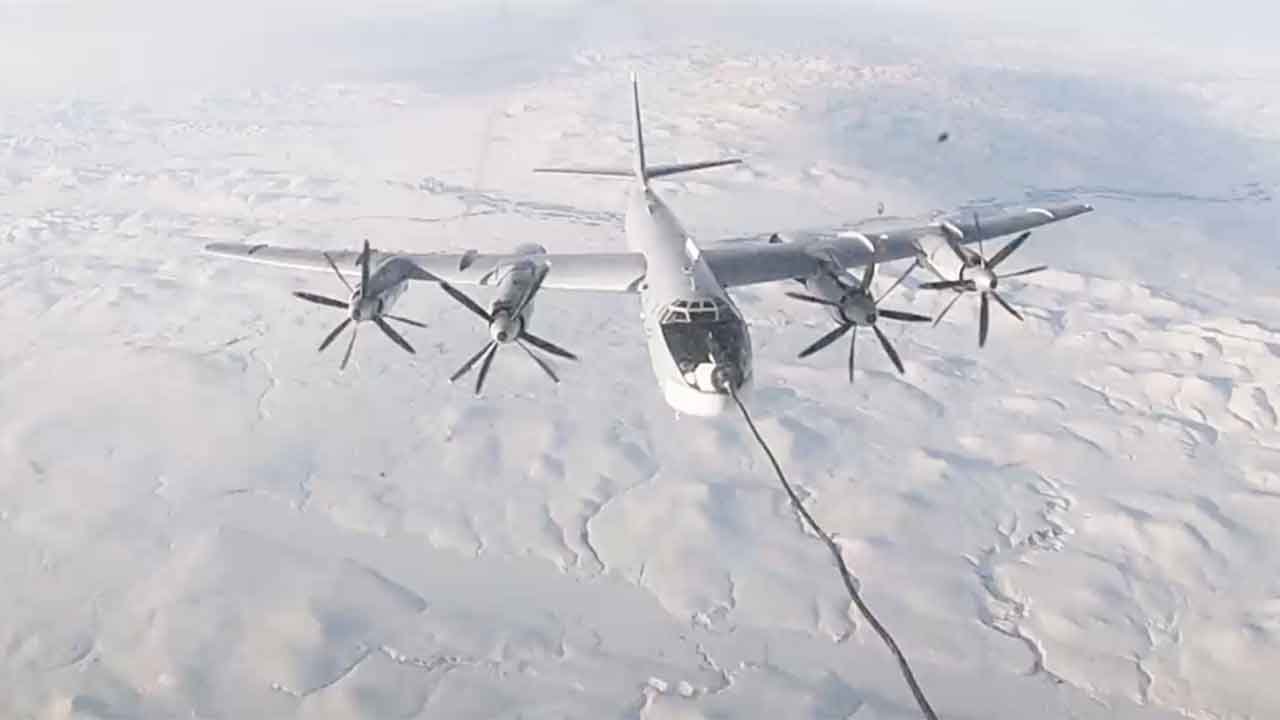
On the night of February 19-20, local time, American fighter jets took off to intercept Russian military aircraft operating near the coast of Alaska.
The information was confirmed by the North American Air Defense Command (NORAD).
According to the joint US-Canadian command, two Russian Tu-95 strategic bombers, two Su-35 fighters and an A-50 early warning aircraft were identified while flying in the Alaska Air Defense Identification Zone (ADIZ).

Interception and escort
NORAD said two F-16 fighters, two F-35s and four KC-135 air refueling aircraft were dispatched to track and monitor the Russian aircraft.
American fighters intercepted Russian bombers near Alaska
Source and photos: North American Aerospace Defense Command, X @NORADCommand pic.twitter.com/OEFix6iB5q
— saibadetudo.com.br (@saibadetudo25) February 20, 2026
According to the official statement, Russian planes did not violate the sovereign airspace of the United States or Canada. The action was described as a “routine event” in the region and was not considered an immediate threat to national security.
Alaska’s ADIZ is a strip of international airspace beginning outside the sovereign territory of the United States and Canada. In this zone, prior identification of aircraft is required as a precautionary defense measure.
Russian version: scheduled patrol
On the Russian side, the Ministry of Defense reported that long-range Tu-95MS strategic bombers carried out a planned patrol mission lasting more than 14 hours over the neutral waters of the Bering Sea, between the Russian Far East and Alaska.
The planes, capable of carrying missiles with nuclear warheads, were to be escorted by multi-role Su-35S and Su-30SM fighters. According to Moscow, they were accompanied by foreign fighters during some phases of the flight.
The video released by the Russian ministry shows the take-off of one of the Tu-95MS, shots from inside and outside the cockpit during a patrol, as well as mid-air refueling and landing.
Russia says its long-range bombers regularly conduct patrols over international waters in the Arctic, North Atlantic, Pacific Ocean, Baltic Sea and Black Sea, always in compliance with international rules on the use of airspace.
The role of NORAD
NORAD was established in 1957 under bilateral agreements between the United States and Canada and is responsible for the air defense of the North American continent.
The command integrates the U.S. Air Defense Command, the Royal Canadian Air Force, CONAD/NORAD-related naval forces and the U.S. Army Air Defense Command.
Headquartered at Peterson Space Force Base in Colorado, the permanent command center operates in a fortified bunker built inside Cheyenne Mountain.

The incident highlights the routine nature of interceptions in the Arctic and North Pacific regions – areas considered strategic by both Washington and Moscow, especially in the context of continuing geopolitical tensions between the two powers.
Source and photos: North American Aerospace Defense Command, X @NORADCommand | Telegram @mod_russia. The content was created using AI and verified by the editorial team.
