
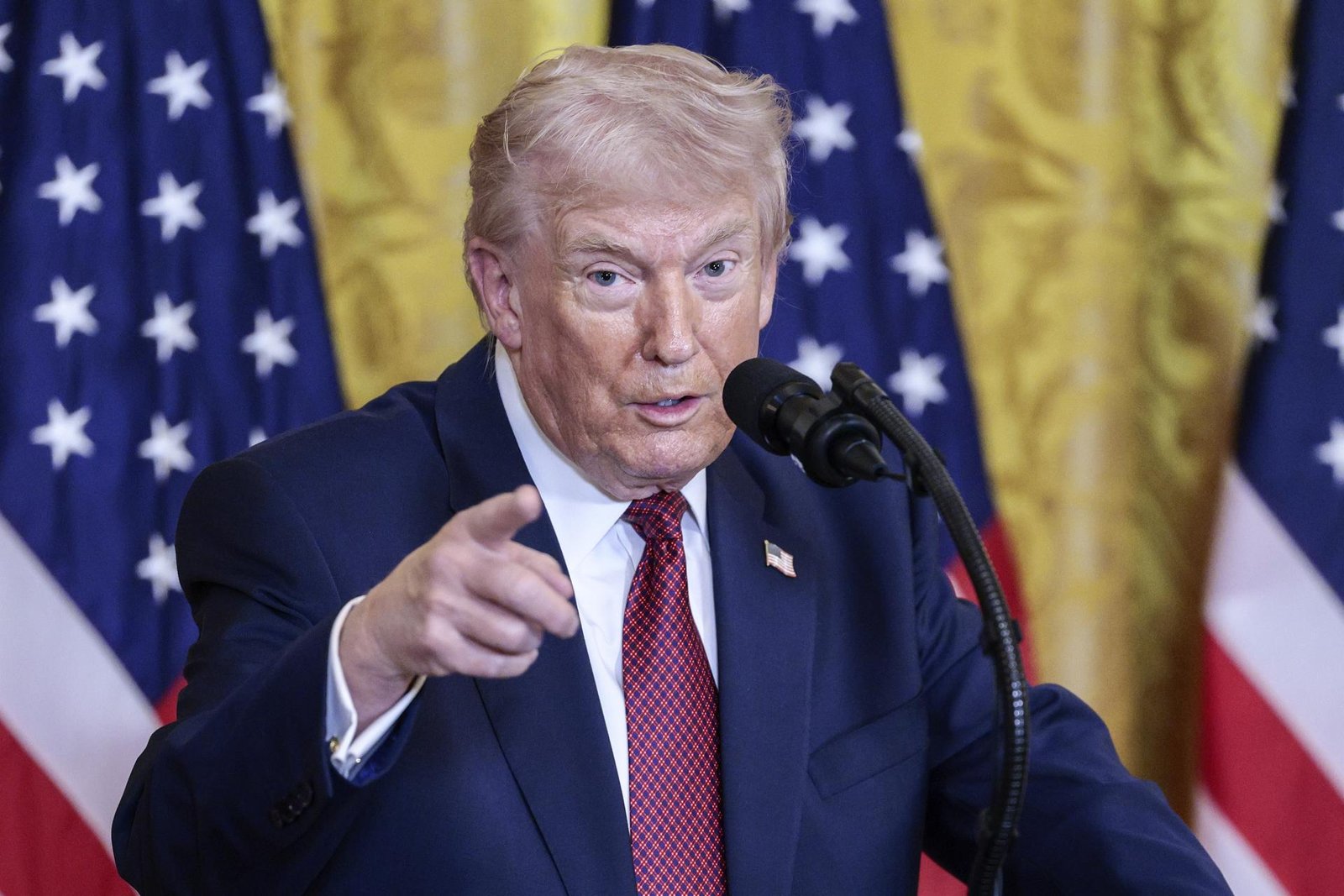
US President Donald Trump reacted this Friday afternoon (20) to the unfavorable decision in the Supreme Court involving tariffs, announcing new global charges of 10%.
The Republican leader presented the measure in parallel with the press conference, on which occasion he harshly criticized the judges who ruled against him, describing them as “unpatriotic and disloyal to the Constitution”.
At Truth Social, he detailed that he will sign decrees to maintain comprehensive charges, using other legislative tools at his disposal, echoing statements from government officials in recent months. The decree to impose 10% tariffs should come into effect within three days and remain in place for a period of five months, according to him.
The American cited some options, such as the Trade Expansion Act of 1962 (Section 232); the Commerce Act 1974 (Sections 122, 201 and 301); and the Tariff Act of 1930 (Section 338).
Trump’s top trade negotiator, Jamieson Greer, said last month that the administration would move quickly to replace any emergency tariffs invalidated by the court with other fees. In his speech, the president emphasized that tariffs that cannot remain in force will be replaced by others soon.
At the press conference, he also said that the sentence is “very disappointing” and that he feels “ashamed of certain members of the court.” The vote in the high court was 6 votes in favor of overturning the comprehensive tariffs against 3.
In his speech, he accused the judges of being influenced by “foreign interests”, without giving details of what he meant by that statement. Trump further declared that “the decision [da Suprema Corte] made him more powerful.”
The US Supreme Court declared this Friday that the American government exceeded the emergency powers invoked by President Donald Trump to impose tariffs on the country’s trading partners, in a severe setback to the Republican’s tariff policy.
On behalf of the majority, Chief Justice John Roberts indicated that the government does not have inherent powers in peacetime to impose tariffs based on the International Emergency Economic Powers Act (IEEPA) of 1977, invoked by Trump as a pillar of his trade war.
In its decision, the Supreme Court considered that Trump’s use of this legislation would represent an excessively broad delegation of the taxing power that the Constitution reserves to Congress, as the court understands that tariffs are a type of tax on citizens.
Among the tariffs affected by this decision are the 10% base global tax on foreign imports and so-called “reciprocal” tariffs on trading partners in the world’s largest economy, as well as additional 25% tariffs imposed on Mexico and Canada to pressure those countries to stem the flow of drugs, such as fentanyl, across their borders into the US.
