
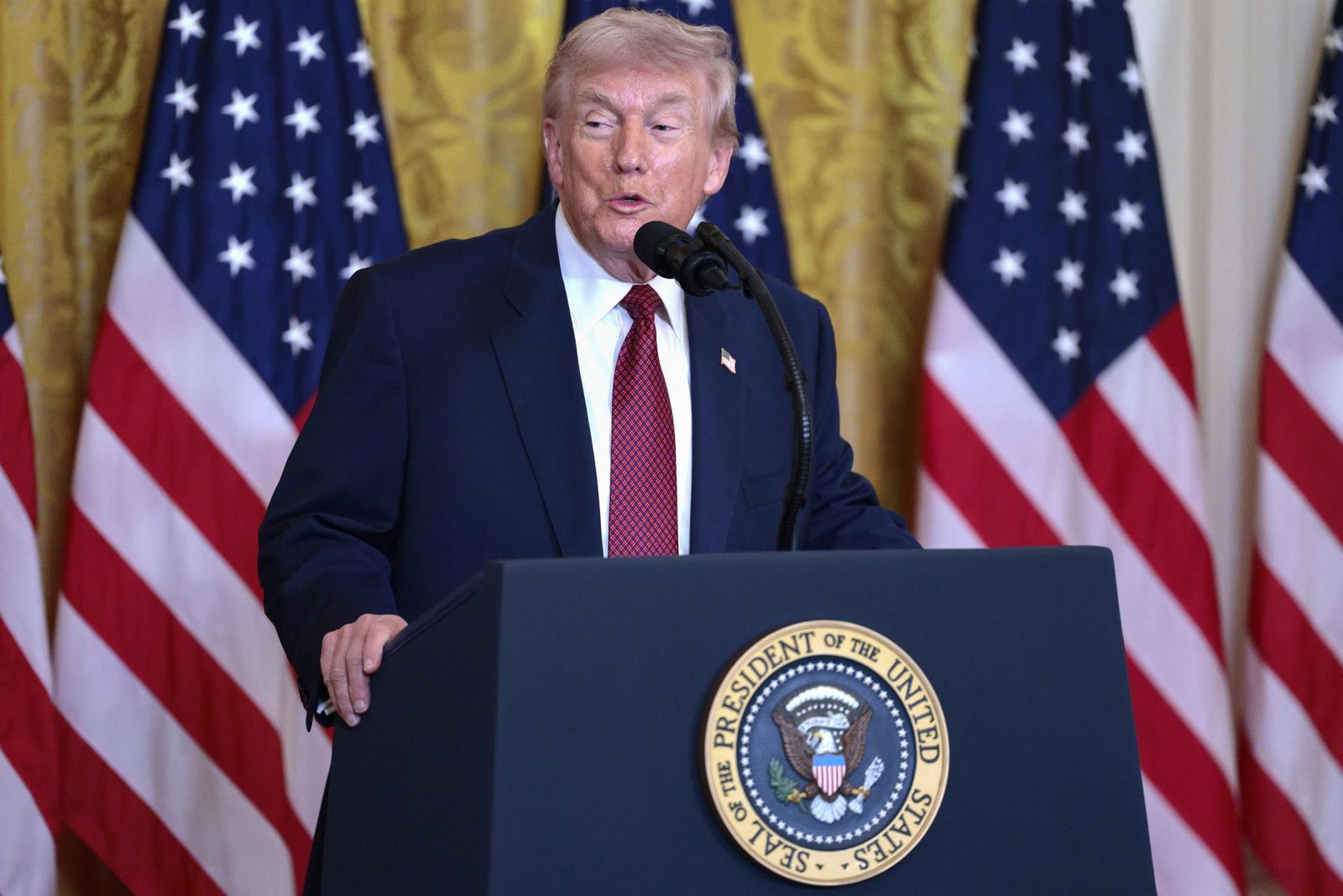
Last week, United States President Donald Trump won a legislative victory relevant to his electoral rules reform agenda in the United States upon seeing the Chamber of Deputies approve, by a small margin, the “SAVE America Act”.
The bill establishes the national requirement for documentary proof of citizenship for voter registration and makes it mandatory to use official identification with a photo when voting in federal elections. The text is an expanded version of a similar proposal already approved in the Chamber last year, but which ended up being unsuccessful in the Senate. Now the project must again face a decisive test in the Upper Chamber.
The discussions take place just a few months before the mid-term legislative elections — the so-called midterms — scheduled for November. In them, American voters will choose the 435 members of the House and 35 senators (about a third of the Senate). Currently, both houses are controlled by Republicans.
The text of the “SAVE America Act” was presented by Representative Chip Roy, from the Republican Party, and has Republican Senator Mike Lee as one of its main sponsors in the Senate. Proponents of the measure claim that it will strengthen the integrity of the federal electoral system and prevent, for example, illegal immigrants from participating in the voting process.
Currently, although federal legislation already determines that only American citizens can vote in federal elections, there is no national requirement for documentary proof of citizenship at the time of voter registration – the stage in which the voter registers on the electoral lists administered by the states in order to vote.
What changes in practice
The “SAVE America Act” requires states to require documentary proof of citizenship – such as a US passport or birth certificate – for federal voter registration.
The proposal also establishes:
- Official document with photo is mandatory to vote in person.
- Stricter rules for voting by mail, with a requirement for a copy of valid identification to be sent with the ballot.
- Determination for states to adopt continuous measures to verify electoral lists.
- Penalties for election authorities who register voters without required documentation.
Voting in the Chamber took place practically in party blocs, with 218 votes in favor and 213 against. Only Democratic Representative Henry Cuellar voted with the Republicans.
After approval, the President of the House, Republican Representative Mike Johnson, pressured the Senate to approve the text. “We hope some Democrats in the Senate come to their senses and do what’s right for the people. If they don’t, they’ll have a lot of explaining to do,” he said.
In an interview with Fox Business last week, Johnson called the project a priority for the Republican caucus in Congress earlier this year and for President Trump. He also accused Democrats of resisting the proposal out of political interest.
“They [os democratas] they want [imigrantes] illegals vote. That’s why they opened the border for four years under [o governo Joe] Biden e [Kamala] Harris,” the House Speaker said. “They need to cheat, frankly. And that. They need to allow [imigrantes] illegals participate in elections to continue winning,” he added.
Trump talks about “nationalizing” elections in some states
Trump has publicly defended the proposal as an instrument to prevent what he considers electoral fraud in the US.
“The United States elections are rigged, stolen and a laughing stock around the world. Either we will fix them, or we will no longer have a country”, wrote the president on the 8th in Truth Social, when calling for unity among Republicans to pass the “Save America Act” in Congress before the midterms.
Earlier this month, Trump also defended the federalization of elections as a way to avoid possible irregularities. Currently, the organization of elections in the United States is the responsibility of each state, as provided for in the Constitution.
“I want elections to be honest, and if a state can’t hold an election, I think the people who support me should do something about it,” the president said. Trump argued that the federal government should supervise this year’s elections now.
The White House has in recent days promoted the argument that “American citizens, and only American citizens, should decide American elections.”
Operation against irregularities in the 2020 election
The Trump administration’s pressure on the issue also occurs through other means. In late January, the FBI carried out a raid on the election center in Fulton County, Georgia, as part of an investigation into possible irregularities related to the 2020 presidential election, when Trump failed to win re-election after being defeated by Democrat Joe Biden.
The agents served a court order authorized by a federal court, as part of a lawsuit filed by the Department of Justice, which sought access to 2020 election materials.
During the operation, electoral records were seized, including used and canceled ballots, signature envelopes and digital files linked to the election. According to the US press, the authorities want to check whether there were errors or violations in the ballots, in the counting of votes and in the keeping of electoral records.
In Georgia, Trump lost to Biden by just over 11,000 votes, a margin that led to recounts and formal reviews of the result at the time. On that occasion, the Republican accused the Democrats of “stealing votes”.
Georgia is considered one of the “swing states” in American elections, which can swing between Democrats and Republicans, being decisive in presidential disputes. At the time, Georgia was already led by the current governor, Brian Kemp, from the Republican Party.
Decree requiring identification to vote has been challenged in court
In March last year, Trump signed an executive order to strengthen citizenship verification in the federal electoral process. The document, entitled “Protecting the Integrity of American Elections”, determined measures aimed at tightening electoral registration and inspection rules.
Among the determinations were the reinforcement of citizenship checks in voter registration, the sharing of federal databases with the states to verify eligibility, the inspection of state rules on counting votes by mail and the conditioning of federal transfers to states on compliance with electoral integrity standards.
The decree, however, began to face strong opposition in the American courts. States controlled by Democrats, including California, filed several lawsuits alleging that Trump was exceeding his constitutional authority as president, since the organization and conduct of elections are primary responsibilities of the states, as provided for in the United States Constitution.
The states argue that the federal executive cannot unilaterally impose changes to electoral procedures administered by state authorities without congressional approval.
Federal courts in recent months have issued injunctions suspending central parts of the decree, such as the requirement for documentary proof of citizenship on the national voter registration form. In January of this year, the District Court of the state of Washington, in a lawsuit brought by the states of Washington and Oregon, permanently blocked other parts of the measure, including enforcement of state rules on counting mail-in votes.
In light of these court decisions, allies of the White House began to defend the approval of a federal law by Congress as a way of consolidating changes in electoral inspection rules and establishing, at a national level, mechanisms to prevent registration and voting by people without American citizenship.
“This legislation is a fundamental step towards restoring electoral integrity by ensuring that only United States citizens vote in federal elections and present identification. More than 80% of Americans – from different parties and racial groups – support the photo ID requirement because it is simple, reasonable and common sense”, said the author of the proposal, Representative Roy, after approval in the Chamber.
Project will face challenge in the Senate
In the Senate, however, the “SAVE America Act” must face an enormous challenge to pass. To advance in the Upper Chamber, 60 votes are needed to overcome the call filibustera regulatory mechanism that allows the minority to prolong the debate and prevent the final vote on a project that does not reach this minimum level of support.
Right now, Republicans hold 53 seats in the Senate, while Democrats have 45. Democratic leaders in the house have already signaled that they will try to block the proposal. Democrats argue that the new requirements could make it more difficult for American voters to vote, especially the poorest, young people and women who do not have all the documents.
Republican Senator Lisa Murkowski, from Alaska, has also declared opposition to the project, which could make the chances of approval in the house even more difficult without broad bipartisan negotiation.
Cases involving votes by “non-citizens” are cited by entities
The organization Judicial Watch reported in January last year that 388 “non-citizens” – people who do not have US citizenship, including illegal immigrants – voted in the November 2024 presidential election in the District of Columbia.
According to the entity, the data was obtained through official local records. In the District, “non-citizens” who have resided in the region for at least 30 days can vote in municipal elections, but not in federal elections. Judicial Watch highlighted that more than 230 of those voters were registered as Democrats and fewer than 20 as Republicans.
The conservative think tank Heritage Foundation maintains a database on electoral fraud in the USA that has recorded more than 1,600 confirmed cases of electoral irregularities in different states across the country.
Based on this data, researcher Jesse Richman, associate professor of Political Science and International Studies at Old Dominion University, pointed out, in a compilation released in 2024 – when the presidential election was won by Trump – 79 cases of “non-citizens” who registered to vote between 2002 and 2022. Of these, 67 actually voted, some more than once.
