
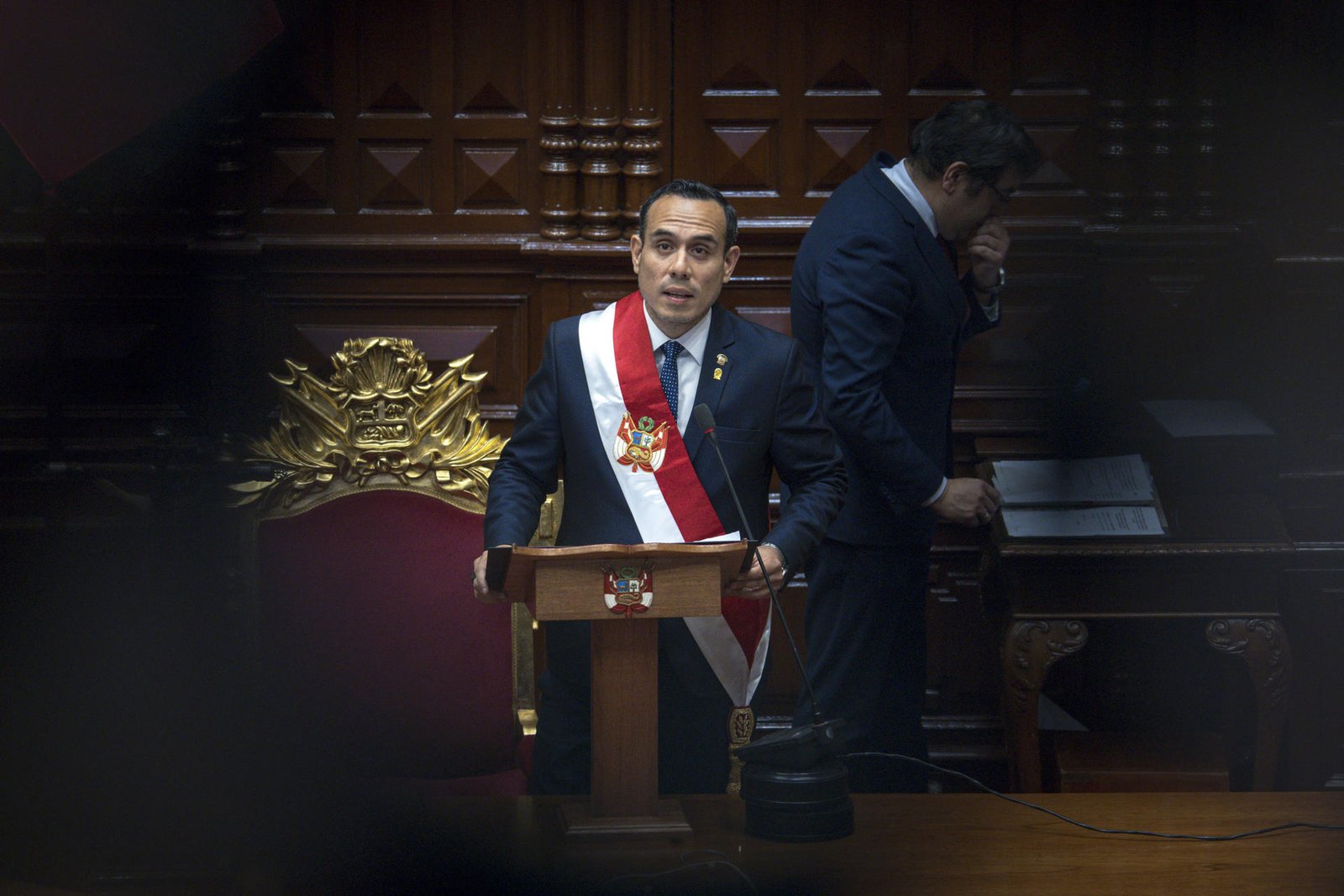
The persistent political crisis in Peru seemed to have offered the Andean nation a brief reprieve just before the elections – which were scheduled to take place in two months, but new scandals involving José Jerí, who served as interim president until his dismissal this Tuesday, ended up costing him his position and plunging the country into yet another power vacuum.
Jerí assumed the presidency just four months ago, after having been president of Congress when former president Dina Boluarte was impeached by the Legislature. He focused his government on fighting crime, which gained him considerable support among Peruvians during his first months in office.
Now, the conservative politician, censured by Congress, becomes the protagonist of the eighth presidential change that the Andean nation has experienced in almost a decade of political instability, which began after the 2016 elections.
A new president should be chosen by Congress this Wednesday (18).
What led to Jerí’s dismissal?
The popularity of Jerí, a 39-year-old lawyer, suffered a setback when a series of meetings with Chinese businessmen came to light. The most controversial of these was a meeting he attended, hooded, in a restaurant owned by one of these businessmen, which led to the opening of an investigation by the Public Ministry for illegal sponsorship and aggravated influence peddling.
Furthermore, it was widely reported in the local press that at least five young women obtained government contracts after meeting Jerí at the Government Palace, one of them after spending the entire Halloween night there and leaving the presidential residence the following morning.
These revelations led to the presentation of several motions of censure against Jerí, which obtained enough signatures to be processed, even with Congress in recess until March.
This Tuesday, the motions were approved with 75 votes in favor, 24 against and 3 abstentions. As he was a federal deputy and served as interim president, his dismissal required a simple majority vote in Parliament.
Upon being censured as president of Congress, Jerí was automatically prevented from continuing as president.
Elections on the Horizon
This situation arose less than two months before the general elections scheduled for April 12.
Several parties, which had supported Jerí’s ascension to the presidency from Congress, were eager to avoid being affected at the polls by the unpopularity that the former president had been facing in recent weeks.
Peru is on track to choose its eighth president in ten years
Ollanta Humala (2011-2016) was the last president to complete a full term. Since then, in almost a decade, seven presidents have occupied the Government Palace in Lima.
Peru’s Congress will choose the country’s new interim president this Wednesday, in an extraordinary plenary session. This will be the eighth interim president since 2016.
There is no clear favorite for this short-lived presidency, as the majority of parliamentarians will participate in elections for the Senate and Chamber of Deputies. Furthermore, the low popularity, investigations and controversies surrounding many of the potential candidates make the search for consensus even more difficult.
Who are the candidates to assume the presidency?
Two right-wing congressmen, María del Carmen Alva and Héctor Acuña, together with two left-wing congressmen, Edgar Reymundo and José Balcázar, presented their candidacies on Tuesday to assume the Presidency of Congress and, consequently, the Presidency of Peru, following the dismissal of José Jerí from both positions.
The candidacies were formalized in separate letters sent before the deadline on Tuesday afternoon to the secretary of Congress, Giovanni Forno.
Alva is a lawyer, 58 years old and a member of Ação Popular (AP), a party that held the presidency of Peru three times: with its founder, Fernando Belaúnde, from 1963 to 1968 and again from 1980 to 1985, and with deputy Valentín Paniagua leading the transitional government between 2000 and 2001, after the resignation of Alberto Fujimori (1990-2000).
Acuña is a civil engineer and businessman, having joined Congress as a representative of his brother’s party, the right-wing Alliance for Progress (APP), although he later left due to differences and moved between different blocs before joining Honor and Democracy, largely made up of retired high-ranking officers from the Armed Forces.
Reymundo was mayor, in the 1980s, of the district of Chilca, in the central Andean region of Huancayo, for the United Left alliance, and also a federal deputy from 2006 to 2011 for the centrist Union for Peru party, before returning to the current parliament for the left-wing party Together for Peru.
Balcázar, who was a magistrate and member of the Supreme Court of Justice of Peru, arrived at Congress as a representative of Peru Libre, the party that won the Presidency of Peru in 2021 with candidate Pedro Castillo, who was later removed from office and is currently serving a sentence for his failed coup attempt at the end of 2022.
