
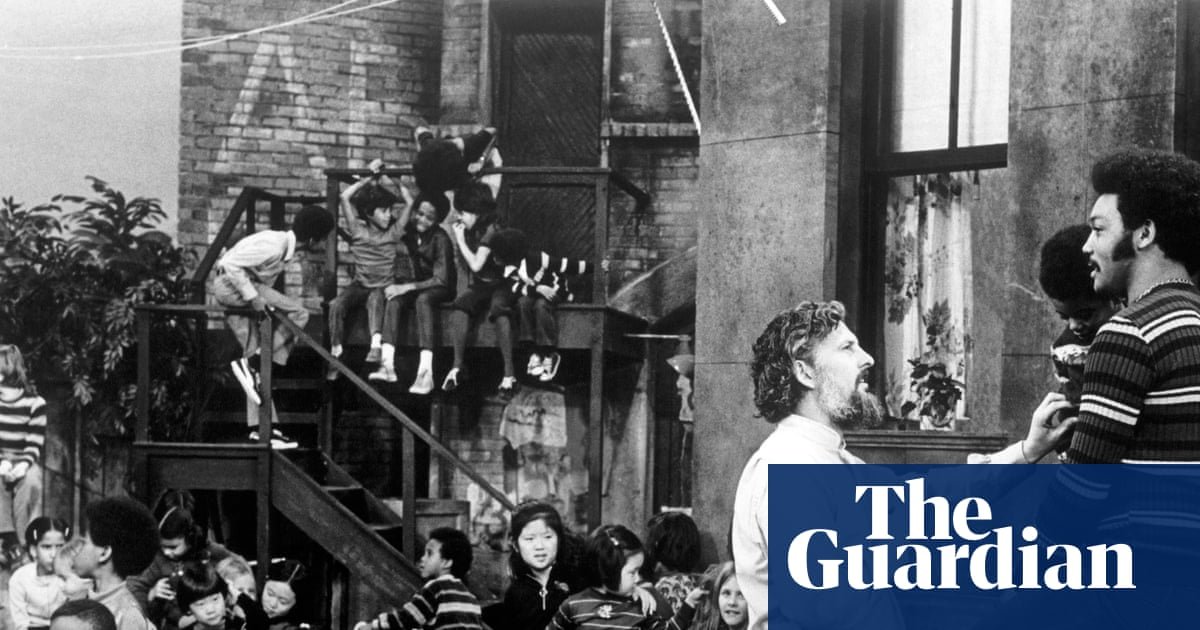
In a 1972 episode of Sesame Street, Jesse Jackson, then 31, is standing against a stoop on the soundstage modelled after an urban neighborhood block. He’s wearing a purple, white, and black striped shirt, accented with a gold medallion featuring Martin Luther King Jr’s profile. The camera cuts to reveal a group of kids, the embodiment of Jackson’s Rainbow Coalition – children under the age of 10 from every ethnicity and racial group. He leads them in a call-and-response of his famous liberatory chant: “I am somebody.”
The adorable, cherub-cheeked kids light up the camera with their enthusiasm as they repeat the same words back to him. They are fidgety, giggly and powerful when they respond to Jackson in a cacophonous and slightly out-of-sync roar: I am somebody. The call-and-response is a wall of activating, energetic sound.
If you pay close attention, you can hear a smile behind every word Jackson speaks and feel the shared energy between him and the kids. It is an incredible artifact of a time when the United States teetered on the precipice of a different world order in the wake of the civil rights era and the waning years of the Black Power movement. The episode is a document that demonstrated to Americans the possibility of what a beloved community could look like, integrated and brimming with youthful promise.
This one minute and a half video clip is a small part of Jackson’s legacy, who died Tuesday at the age of 84, and whose life in service of the expansion of the rights of Black Americans and all dispossessed peoples is as revolutionary today as it was then. It is a memento mori for generations born after those movements to actively affirm their dignity as human beings.
I wasn’t born yet, but I would later see replays of this video growing up and well into adulthood via YouTube clips and other social media. Its cultural resonance lived beyond the final decades of the 20th century, penetrating deep into Black American culture as adults repeated “I am somebody” to children in school or in church or at home. The call of “I am somebody” was always met with an even more fervent echo: “I am SOMEBODY.” Born in post-civil rights era US, generation X and millennials were the children putting the work of the beloved community into action. It didn’t matter anyone’s background in terms of class, race, ethnicity or appearance; we were all somebody worthy of human dignity and respect.
In the present climate in the US, it’s difficult to fathom this kind of programming on public television or streaming platforms without it fomenting some sort of nonsensical backlash. Still, those kids on Sesame Street, now adults, would be the ones who demonstrate the neighborism, the agape love that Martin Luther King Jr so eloquently spoke of, and that Jackson made so clear:
“But I am somebody.
I am Black,
Brown, or white.
I speak a different language
But I must be respected,
Protected,
Never rejected.
I am God’s child!”
As news of Jackson’s passing spread on Tuesday, countless people shared this Sesame Street clip across social media, as well as the audio from the 1972 live recording from the Wattstax musical festival in Los Angeles.
“Rev Jesse Jackson’s ‘I *am* somebody…’ remains one of the all-time great pieces of 20th century rhetoric / agitprop,” one Bluesky user noted, highlighting how powerful, activating and simple Jackson’s poem by way of chant moves people to action and connects to King’s concept of agape love. “And he could deliver it at a Black separatist meeting, the Democratic National Convention, or on god-blessed Sesame Street.”
The idea of “somebodiness” was a thread that ran throughout the rhetoric of movement leaders and participants during the civil rights era. Jackson was with King and others from the Southern Christian Leadership Conference to support the 1968 sanitation workers strike in Memphis. The workers took to the picket line after a Black man was killed because he was trapped and compacted in the rear of sanitation truck on account of being prohibited from sitting in the driver’s cab because of his race. Those strikers wore placards and signs that read “I Am A Man”– the mantra “I am somebody” captured in direct protest action.
It was King who first articulated somebodiness in writing in his 1963 Letter from Birmingham Jail, the canonical work that best defined the nonviolent philosophy and moral imperative for direct civil disobedience.
“I began thinking about the fact that I stand in the middle of two opposing forces in the Negro community,” King wrote. “One is a force of complacency, made up in part of Negroes who, as a result of long years of oppression, are so drained of self-respect and a sense of ‘somebodiness’ that they have adjusted to segregation.”
King, who had also been a mentor to Jackson, understood that part of his role was to disrupt those feelings that stripped somebodiness from African Americans’ world. It was no coincidence that there is footage from as early as 1963 of Jackson offering the poem as a benedictory battle cry to young activists and protesters. If King’s language is lofty, Jackson’s rallying call is direct. And if one can tell by the fervor of the audiences over the decades who chanted back at him: “My clothes are different/ My face is different/ My hair is different, But I am somebody”, the chant cuts through constricting beliefs of worthlessness and, like alchemy, transforms despair into action.
