
Thomas Clements’ eyes begin dancing as he recalls in vivid detail his first trip to Highbury. It was 1995 and Ian Wright was among the scorers as QPR were defeated. Clements – named after Mickey Thomas, scorer of Arsenal’s decisive second goal against Liverpool in their 1989 title win – points to his dad, Kevin, standing a metre away. “I was sat on his shoulders in the North Bank,” he says.
That is, in itself, not unusual for a child of the 1980s. However, whereas most regular match-goers might take for granted the seemingly small things – travel arrangements, the journey to the stadium, grabbing food and drink, meeting friends and family, entering and exiting the ground – for disabled supporters such as Clements, careful thought and planning go into all arrangements.
Clements, who was born with cerebral palsy – a condition that affects his movement and posture – uses a mobility scooter and is speaking as he enjoys a hot chocolate in Arsenal’s disabled supporters’ lounge, a long throw-in from the ground.
He works as a PE teacher and is a qualified cricket, football and basketball coach. He is also a former Panathlon competitor. “I’ve done quite well for myself,” he grins. “Without these little extra touches, the matchday experience wouldn’t be what it is. Whatever you need help with, Arsenal will sort it out. They make it seamless. It makes a massive difference.”
Across the room sits a group chatting away and among them is Andrew Birch, founder of Game Day Vision. He had the idea for the company after attending a concert at the Tottenham Hotspur Stadium. The ground catered brilliantly for those with visual impairment but access to and from the venue was more challenging. “I was with a friend who had driven,” he begins. “But I know other disabled people who go to things alone and, if I was on my own, I’d get myself into trouble – either lost or I’d have hurt myself.”
Birch established that while many disabled fans have a regular match partner, nowhere provided for those without such support or for the times when a regular companion was unavailable. He contacted Aaron Heskins, Arsenal’s disability access manager, on a Wednesday with the idea. By that weekend, a beta version of the service was in place.
Game Day Vision works also with other teams, including West Ham, Colchester, Ipswich and, most recently, Crystal Palace. “I really enjoy it,” Birch says. “Logistically, it can have a few issues, when trains get delayed, or if a supporter doesn’t have a phone.”
Originally it was just for supporters with sight impairment – Birch has severe sight loss – but it is expanding to provide for those with other disabilities. “Everyone needs bespoke help,” Birch says.
Users can request assistance from home or a station, and Birch will try to facilitate it. Matthew Shaw, who travels in for every game from Norwich, was an early Game Day Vision user. “I can’t do without them,” he says. “Coming on your own is no fun. It’s nice to meet up with people.”
Shaw’s regular companion is Tony Saunders, a videographer who initially helped Birch with a promotional video. They stayed in touch and, for the past two seasons, Saunders has been one of a group of about 40 volunteers helping to keep the service running.
Saunders also sometimes accompanies Daniel Bailey, the chair of the Arsenal Disabled Supporters’ Association, who travels from Exeter to take his North Bank seat. Bailey’s uncle inducted him into the ways of Arsenal and he has followed them in England and abroad since the Invincibles’ days. The association has close to 600 members, including those with hearing, visual and physical disabilities.
When a member highlights a problem , theassociation liaises with Arsenal to solve it. Bailey is independent but hugely appreciates “the security of having the assistance of someone with sight. Football is a massive part of my life and without it I think I’d struggle. Football is my escapism.”
Bailey also sings the praises of a specialist radio service that Arsenal, like many clubs, offer via the volunteers of Alan March Sport. “Because they specifically cater for the blind and visually impaired, they’re a little bit more descriptive. The mainstream radio commentary is great, but they aren’t focused on just us.”
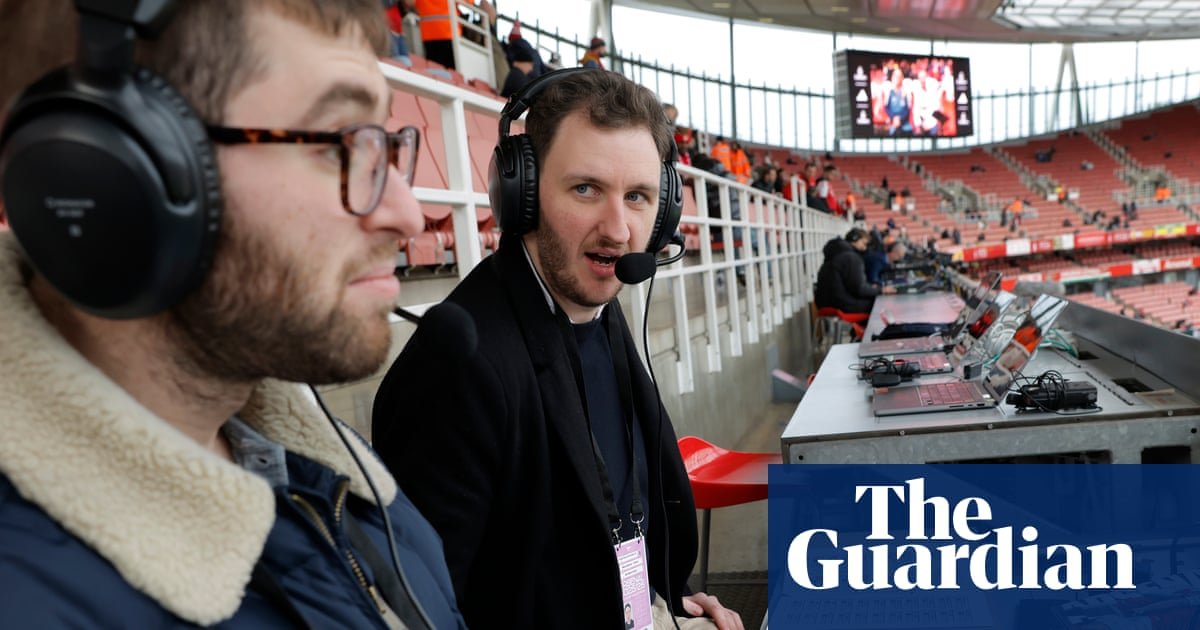
Up on the gantry, Manus Bonner-Tymms is one of the regular voices in the ears of Bailey, Shaw, Birch and many others. A season-ticket holder, he saw an advertisement on the club’s website. Commentating was never on his radar, but it intrigued him. Having passed selection and training, being involved has become “the highlight of my week”.
There are two commentators a game, but instead of the traditional lead and analyst pairing, they interchange roles. “It’s much more granular,” Bonner-Tymms says. “It’s very much ball first and player second. That’s the most important thing.”
All of this is proudly facilitated by Arsenal, who are far from the only Premier League club striving for inclusivity. As Heskins puts it: “We compete on the field but not off it.” Clements attests to that, even praising Tottenham and West Ham for their access services.
The approach is collaborative, with Heskins and his Premier League peers meeting biannually to share ideas and plan improvements. “If we see something working elsewhere, we will pick up the phone and ask them about it.”
Inside the Emirates the pitchside show has full British Sign Language integration, with big-screen content also accompanied by BSL. Arsenal were pioneers on this front, with several others following suit. Outside, tactile guidance pathways help fans navigate around the stadium, and in the summer hearing loops were installed on the concourses. Deaf fans can connect their cochlear implants via Bluetooth and background noise is then reduced, making socialising easier. An audio-only version of the programme is available every matchday.
All of these things, each consequential in themselves, add up to something much bigger. “You are different, but you are the same,” Clements says. Clubs are striving to make that just so.
