
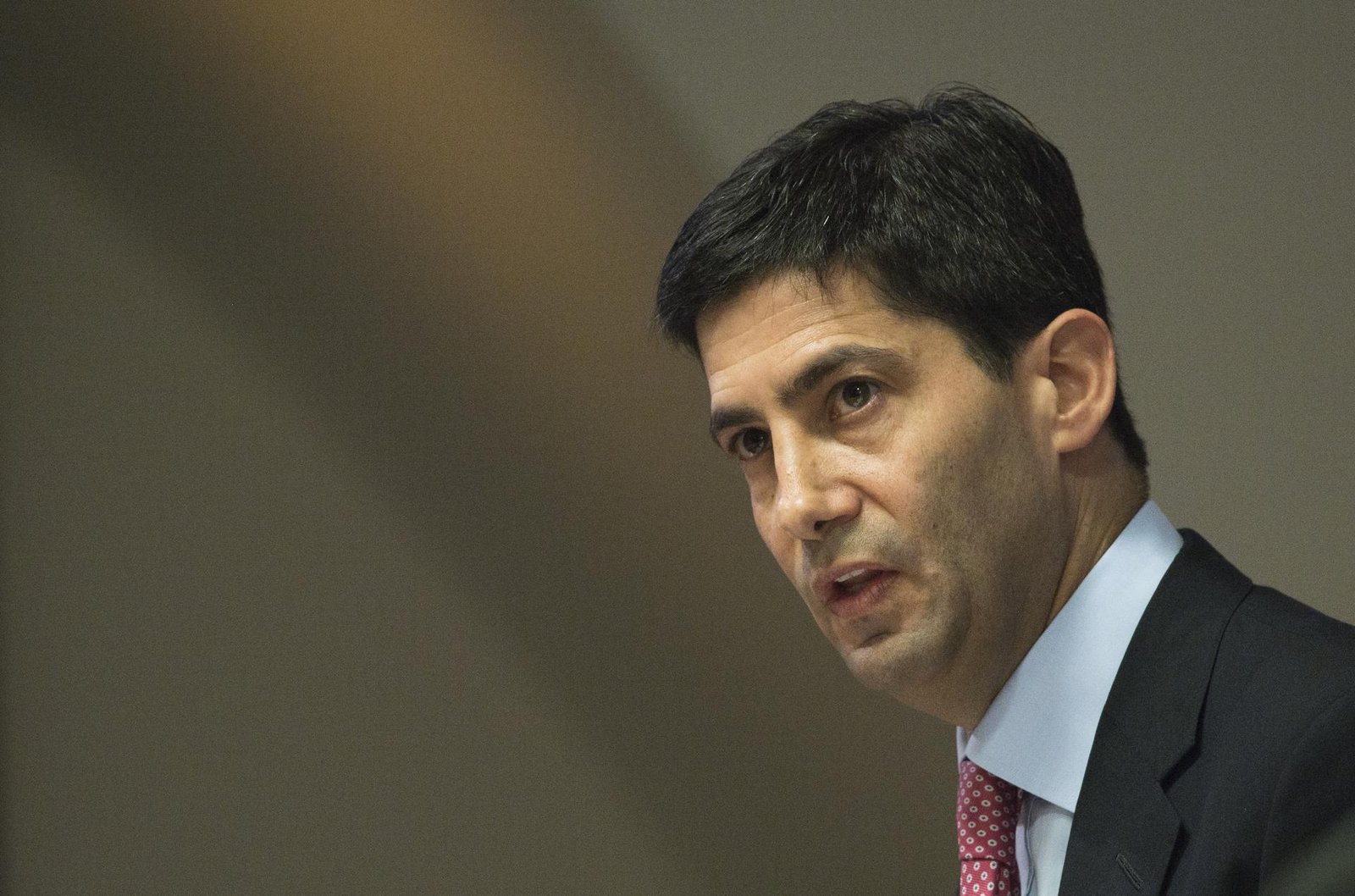
US President Donald Trump chose financier Kevin Warsh to preside over the Federal Reserve (Fed) in the expectation that he will reduce the country’s interest rates, currently in the range of 3.5% to 3.75%. The goal became a priority for the government and led Trump to pressure the current president of the central bank, Jerome Powell.
In this scenario, Warsh, who previously worked at the Fed, will have two main challenges: balancing the institution’s independence with the interests of the White House and maintaining market confidence in the face of doubts about his profile in conducting monetary policy — tasks that, as history shows, do not always end well when politics imposes itself on the central bank.
Warsh is expected to take over the Fed starting in May. His appointment, however, still requires Senate confirmation. The hearing should take place between February and March.
Kevin Warsh’s resume shows that he is not a beginner in managing economic policies. In recent decades, he served as the youngest member of the Fed’s Board of Governors, was an economic advisor to President George W. Bush, a banker on Wall Street and, almost, did not become president of the US central bank in 2017, during Trump’s first administration. At the time, the Republican chose to nominate Powell as he considered him a name of continuity and more aligned with a gradual monetary policy, while there were doubts about Warsh’s willingness to maintain interest rates at lower levels for longer.
Fed Independence at Stake and a Historical Reminder
The main concern among analysts, economists and investors in recent months regarding the Fed was President Trump’s political pressure to reduce interest rates, something that Powell did not comply with and ended up being the target of an investigation by the Department of Justice, related to the increased costs of renovating the central bank’s headquarters.
Warsh’s nomination raises a fundamental issue involving the politicization of the Federal Reserve. The independence of the US central bank has been tested under different administrations throughout American history, which is why decisions about interest rates, inflation control and financial stability have needed to be protected from electoral politics.
One example is that of former president Richard Nixon (1969-1974), who strongly pressured the Fed and its president at the time, Arthur Burns, to ease monetary policy and lower interest rates, aiming for the 1972 elections. As a result, the US suffered long-term consequences with high inflation, which jumped from 5.3% in 1970 to 11.8% in 1974.
In addition to the pressure on interest rates, in August 1971, Nixon suspended the convertibility of the dollar into gold, beginning an era of fiat money, an action that became known as the “Nixon Shock”. With the measure, the government ended the link between the value per ounce of gold and the dollar and began to base the value of the currency solely on trust in the Fed and the government. Foreign countries could also no longer exchange dollars for gold.
Kevin Warsh will find himself in a similar dilemma and will have a major challenge in keeping the bank independent amid political pressure, which could create long-term imbalances for the American economy.
His appointment is seen by some analysts within a critical scenario, in which the White House seeks to exert broad influence over monetary policy. Given Trump’s public speech criticizing Powell in recent months and the pressure for his early departure, the president saw in Warsh someone he could trust who should pursue his agenda of lowering interest rates.
The White House leader has said on multiple occasions that he wants to see mortgage rates lower — they are currently just above 6% — as they have become a sticking point for homebuyers. In an interview with Larry Kudlow, from Fox Businessthe Fed’s presidential nominee suggested that he could “reduce interest rates significantly and thereby make 30-year fixed-rate mortgages viable so that they are affordable and we can revive the housing market.”
The financier’s views on monetary policy, however, have long been considered aggressive. This means that he has a tendency to maintain a more restrictive policy, with higher interest rates to keep inflation under control.
Despite this, in recent statements after his appointment, he demonstrated a certain alignment with Trump’s agenda, arguing that the increase in productivity and the “boom” of Artificial Intelligence (AI) are preparing the ground for accelerated growth that does not threaten a rise in inflation, even with the index above the Fed’s 2% target – the US had an inflation of 2.7% in 2025. It remains to be seen how he will behave in relation to the federal government’s attempts at interference.
For Marcello Marin, master in Corporate Governance and specialist in judicial recovery, the risk of the American central bank losing its independence is unlikely. “The Fed has a mandate, collegiate structure and its own rules, but there could be a reputation crisis if the market perceives political alignment in decisions.”
Adriana Melo, a specialist in Finance and Taxation, also assesses that there is no evidence of a loss of institutional independence by the Fed.
“There is a real risk of institutional friction. Warsh has already publicly defended the Fed’s operational independence, with accountability, and treated this independence as something that needs to be practical. The point of attention is the context: Trump criticized [Jerome] Powell and pushes for lower interest rates. If the market interprets its decisions as politicized, independence suffers from erosion of credibility, not from formal rupture”, he highlighted.
What to expect from Warsh as head of the US central bank
Following Warsh’s appointment, major U.S. stock indexes fell, the dollar strengthened and precious metals plunged, with silver recording its worst daily decline since 1980 and gold having one of its worst days in decades – suggesting market doubts about Warsh’s profile and the direction of monetary policy the Fed will take under his leadership.
In an interview with Bloombergstrategists at New York-based financial services firm Citigroup assessed that Warsh will likely take a gradual approach to reducing the US central bank’s $6.6 trillion portfolio in order to avoid money market tensions. This portfolio is mainly made up of Treasury bonds and securities linked to real estate financing that the Fed has purchased over the years to stimulate the economy. By purchasing these securities, the US central bank injected money into the financial system, helping to keep interest rates lower.
This strategy was used widely after the 2008 financial crisis and during the Covid-19 pandemic. In 2022, the volume of these assets reached around US$9 trillion. Since then, the Fed had been reducing this amount – a process known as quantitative tightening – to the current US$6.6 trillion, but abandoned this practice in December, after rates in the repo market – very short-term operations with securities used by banks and other institutions to obtain liquidity – soared.
In a speech in April 2025, Warsh stated that the Fed’s bloated balance sheet became a “sign of the central bank’s increasing intervention in the economy”. But in analysts’ view, the resumption of balance sheet reduction could reignite pressures on the market.
Regarding lowering mortgage rates, Bill English, a Yale professor and former director of the Fed’s monetary affairs division, explained to The Washington Post that just changing the balance sheet would not be enough for its objective.
“If all he does is reduce the Fed’s balance sheet, it’s hard to see how that would be compatible with lower mortgage rates, and that creates some tension with the president,” he says.
Warsh has already defended that he plans to “change the regime within the Fed”. According to him, this would be linked to a return to what a central bank should do, which is to guarantee price stability.
“The Fed has lost its way. It’s lost its way on supervision, it’s lost its way on monetary policy,” Warsh said in an interview last year. “We need regime change at the Fed, and it’s not just about the president. It’s about a whole range of people, it’s about changing their mindset and their models, and, frankly, it’s about shaking things up because the way they’ve been doing things isn’t working.”
He also clarified that the institution should focus on the currency, not inclusive employment, climate change or other political objectives, which aligns with Trump’s interests.
Specialist Marcello Marin highlighted to the People’s Gazette that Kevin Warsh has a more conservative profile, which can be positive when deciding on the formation of monetary policies.
“If confirmed by the Senate, decisions are expected to be made with a focus on credibility, inflation control and firmer communication, possibly with less tolerance for prolonged stimulus and greater concern with liquidity effects and asset prices”, he pointed out.
