
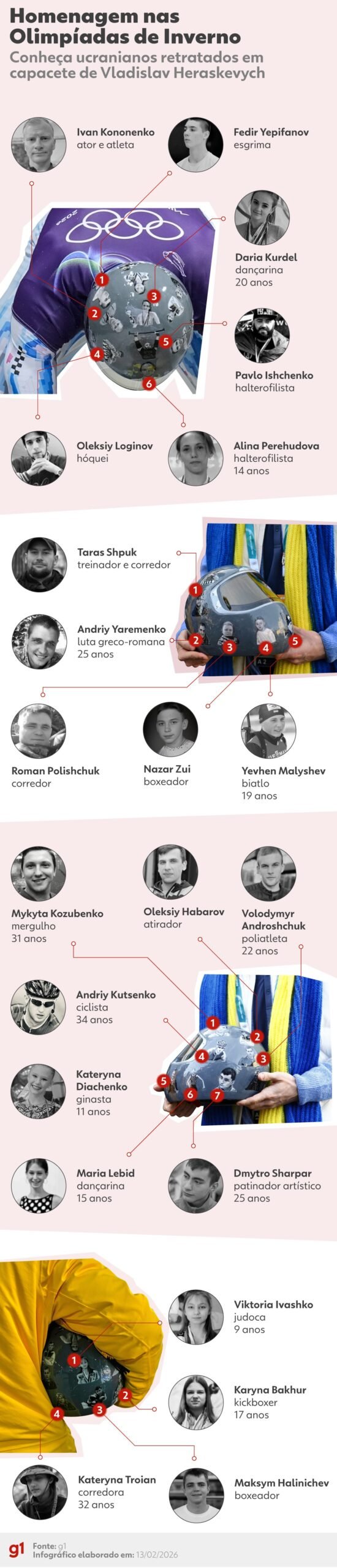
Infographic shows athletes honored in helmets by Ukrainian banned from competing at the 2026 Winter Olympics in Italy. arte/ g1 Among the many notable episodes of the Winter Olympics this week, one even involved an urgent court decision: Ukrainian athlete Vladislav Heraskevych was disqualified from the Games for wanting to compete using a helmet with images of compatriots killed in the war in Ukraine. Heraskevych is a “skeleton” athlete, a discipline in which the competitor descends a circuit face down on a sled and which requires the use of a helmet. ✅ Follow the g1 international news channel on WhatsApp Its was customized with images of other Ukrainian athletes who died during the conflict, but the International Olympic Committee (IOC) banned the accessory on the grounds that political expressions are not allowed in competitions. The episode took on legal consequences — the Ukrainian appealed to the Court of Arbitration for Sport, which denied the appeal — and the tribute ended up being left aside. See below who were the Ukrainian athletes Heraskevych honored on his helmet: Alina Perehudov: Weightlifter. Died at age 14 in a Russian attack in Mariupol in April 2022; Daria Kurdel: Dancer. Died at age 20 in Russian bombing in Kryvyi Rih in July 2022; Fedir Yepifanov: National champion fencer. Died at age 18 in battle in December 2023; Ivan Kononenko: Actor and athlete. Died at age 42 in battle in Kursk in December 2025; Oleksiy Loginov: Hockey. He died at age 23 in combat. Pavlo Ishchenko: World and European champion weightlifter. He died in combat in 2025. He didn’t stop competing even in the middle of the war; Yevhen Malyshev: Biathlete. Died at age 19 in battle in Kharkiv in March 2022; Nazar Zui: Boxer. Killed in March in Mariupol; Taras Shpuk: Coach and runner. Died at age 34 in battle in 2025; Andriy Yaremenko: Greco-Roman wrestler. Died at age 25 in battle in December 2025; Roman Polishchuk: Runner and high jumper. Died in battle at Bakhmut in March 2023; Oleksiy Habarov: Shooter and world record holder for air rifle shooting at 10 meters. Died in action in August 2025 in Donetsk; Dmytro Sharpar: Figure skater. Died at age 25 in Bakhmut; Kateryna Diachenko: Gymnast. He died at age 11 in Russian bombings in Mariupol; Maria Lebid: Dancer. He died at age 15 in a Russian attack on Dnipro. Mykyta Kozubenko: Master in diving and diving. He died at age 31 in combat; Volodymyr Androshchuk: Polyathlete. Died at age 22 in battle in January 2023. Andriy Kutsenko: Cyclist. Died at age 34 after returning from Italy, where he lived, to fight in the war; Kateryna Troian: Runner. Died at age 32 in combat in June 2025; Viktoria Ivashko: Judoka. Killed with her mother at age 9 in a Russian attack in Kiev; Karyna Bakhu: World medalist in kickboxing. Killed at age 17 in November 2025 in a Russian attack on Berestyanka. Understand the case of the athlete disqualified from the Winter Olympics because of his helmet Disqualified due to helmet tributes Heraskevych appeared this Friday at a hotel in Milan where the Court of Arbitration for Sport (CAS) is expected to issue a decision on whether the Ukrainian athlete will be able to compete in the Winter Olympics. The court is the sport’s highest body and can reverse the IOC’s decision. The Ukrainian athlete, who would compete in the “skeleton” category — in which the competitor descends a circuit face down on a sled — told journalists that he received threats from Russians because of his helmet, which was the fault of the IOC’s actions, according to him. Ukrainian athlete Vladislav Heraskevych, disqualified from the Winter Olympics for wanting to compete wearing a helmet commemorating victims of the Ukrainian war, speaks to journalists before the decision of the Court of Arbitration for Sport on February 13, 2026. REUTERS/Alessandro Garofalo The athlete said he was confident of a favorable decision from the CAS, but he said he believed he would be prevented from competing regardless of the outcome of the hearing. Even so, he stated that he has no regrets and that, because of his suspension, the IOC turned the Milan-Cortina Olympic Games into a “Russian propaganda machine”. “I believe that I did not violate any rules, therefore I should not be suspended. I should be participating in the Olympic Games today, being part of the competition, and not an audience. So, we continue fighting for our truth,” said Heraskevych. IOC President Kirsty Coventry said this Friday that she is in favor of freedom of expression at the Olympic Games, but defended the institution’s decision to suspend Heraskevych. Vladyslav Heraskevych wears a helmet with Ukrainian athletes killed in the war during training at the Olympics REUTERS/Athit Perawongmetha In a statement, the international body said the athlete “will not be able to participate” in the Winter Olympics “after refusing to comply with IOC guidelines on athletes’ expression.” On Tuesday (10), the IOC had suggested, as an exceptional measure, that Heraskevych wear a black armband instead of the helmet with images. “This morning, upon his arrival at the competition venues, Heraskevych met with IOC President Kirsty Coventry, who explained the IOC’s position for the last time. As in previous meetings, he refused to change his stance,” the organization said in the statement. See the videos that are trending on g1 As a result, the judges from the International Bobsleigh and Skeleton Federation (IBSF) decided to disqualify, based on the regulations that prohibit equipment outside the approved standard. “The IOC therefore decided, with regret, to withdraw the accreditation for the 2026 Olympic Games. Despite many conversations and face-to-face discussions with Heraskevych (…) he did not want to reach a point of agreement”, added the IOC. On Friday (13), Ukrainian President Volodymyr Zelensky criticized the IOC’s decision to disqualify Heraskevych. “Sport should not mean amnesia, and the Olympic movement should help end wars, not play into the hands of aggressors,” Zelesnsky said. ‘The price of our dignity’ Ukrainian athlete prevented from wearing a helmet honoring war dead In a post on the social network X, Heraskevych defended his point of view. “This is the price of our dignity,” he said. The head of Ukrainian diplomacy also criticized the International Olympic Committee. “The IOC vetoed not just the Ukrainian athlete, but its own reputation. Future generations will cite this as a moment of shame,” Ukrainian Foreign Minister Andrii Sibiga wrote on social media. Heraskevych had participated in training on Monday and Wednesday wearing a “memorial helmet”, as his team called it: a gray model with images of Ukrainian athletes killed in the war. Zelensky praised the initiative. “The helmet bears the faces of our athletes murdered by Russia: figure skater Dmytro Sharpar, killed in combat near Bakhmut; 19-year-old biathlete Yevhen Malyshev, killed near Kharkiv; and other Ukrainian sportsmen whose lives were cut short by the war,” Zelensky wrote on Monday in Telegram. MORE
Source link
Who were the Ukrainian athletes honored with ‘barred’ helmets at the Winter Olympics; see INFOGRAPHIC
36
