
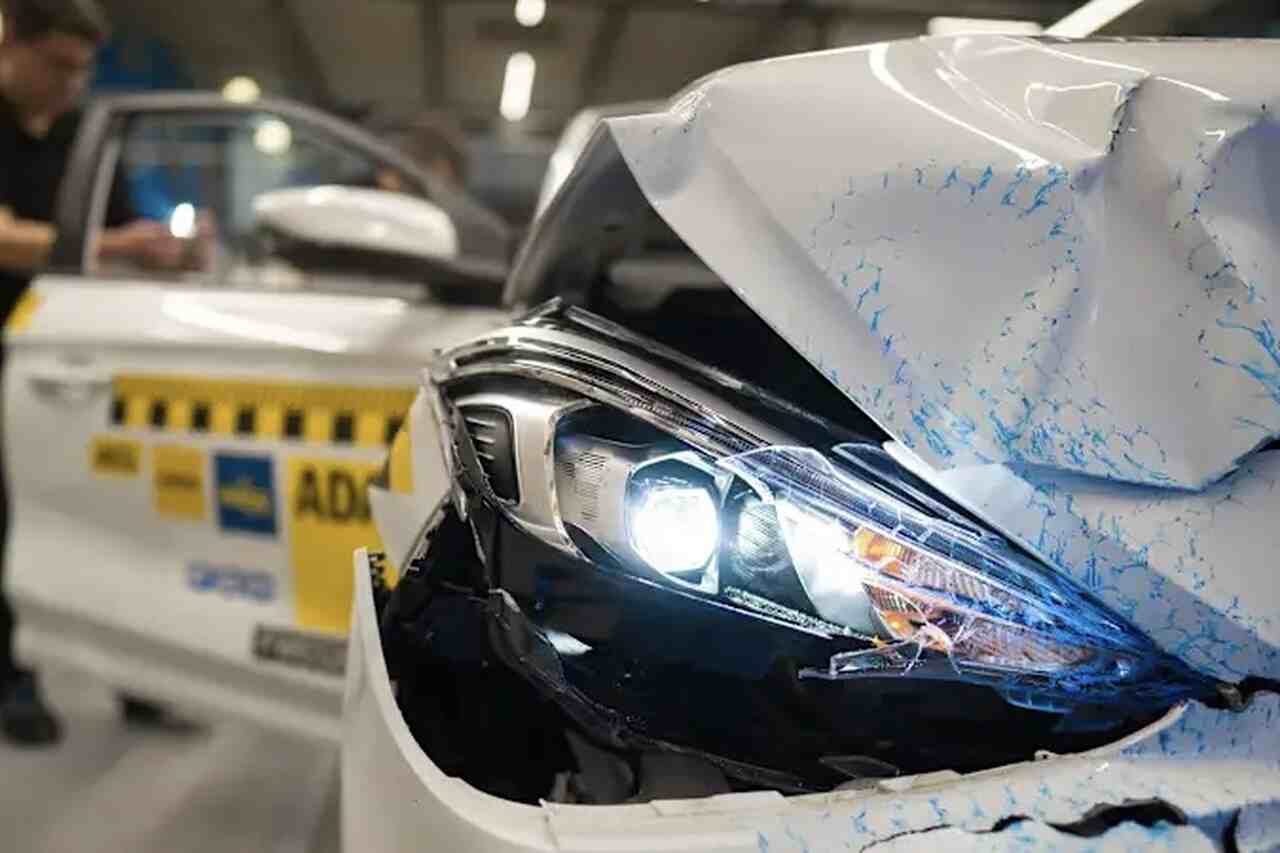
An impact test conducted by the German Automobile Club (ADAC) revealed an interesting finding: collisions at 35 km/h may be more dangerous than at 50 km/h.
Although crash tests are more frequently carried out at 50 km/h, ADAC decided to test an impact at 35 km/h. The chosen test vehicle was a Chinese-built MG3which earned four stars after tests conducted for the 2025 Euro NCAP.
The ADAC tests involved two vehicles, one hybrid and one combustion-powered, and included three occupants instead of two, following the new Euro NCAP guidelines. The MG3 was then crashed into a deformable barrier in order to simulate an accident involving another vehicle.

Even at a lower speed than the standard, the experiment identified some issues. First, the driver suffered greater injuries than would have occurred at 50 km/h. Only the rear passenger benefited from the reduced speed.
In the 50 km/h tests, the rear passenger suffered significant impacts to the chest, neck, and head, while the driver received excellent ratings. In the 35 km/h test, however, this scenario was reversed.

Especially for elderly drivers and passengers, who have less physical resilience, injuries may be more severe at the lower speed due to intense compression in the chest area.
This happens because seat belt pretensioners are designed differently for the rear and front seats. While the belt tensioners give slightly in a 50 km/h impact to relieve the upper body, this system does not operate at 35 km/h.


According to ADAC, this shows that manufacturers focus too heavily on the scenarios required by Euro NCAP and other testing institutes, but fail to assess other collision scenarios.
With this in mind, Euro NCAP has introduced the new crash scenario as an additional standard test. Due to this shortcoming, manufacturers will have to design their safety systems to cover a broader range.
Photos: ADAC. This content was created with the help of AI and reviewed by the editorial team.
