
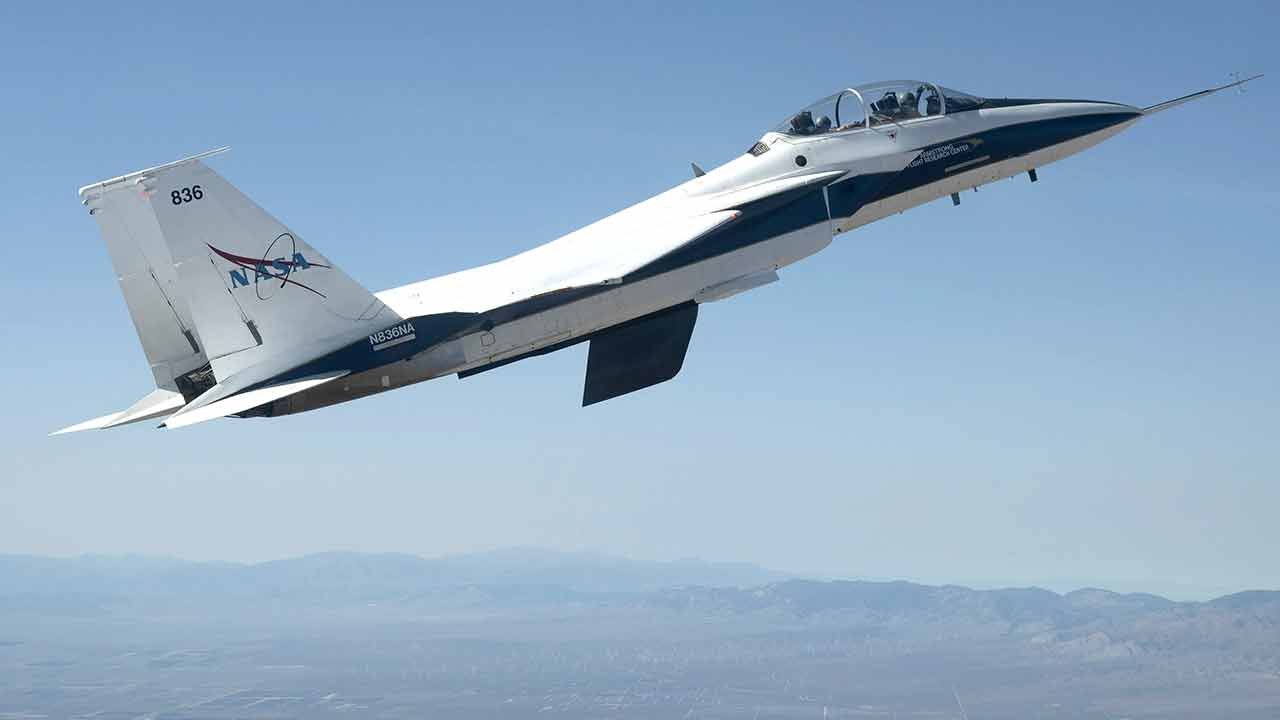
NASA has begun a new phase of flight testing with the experimental concept of laminar flow, known as CATNLF (Compact Advanced Technology Nonplanar Laminar Flow).
The technology was installed on a research aircraft of the type F-15Benabling aerodynamic evaluations under real-world conditions without having to develop an entirely new aircraft.
+ Laser attacks are on the rise in the US – the Air Force launches new protection system for pilots
+ The destroyer USS Mason: Commander deposed by the United States Navy
+ Amanda Holden opens the doors to her mansion as she launches sofa collection
For the tests, engineers mounted a wing mock-up about 40 inches (roughly 1 meter) in a vertical position under the jet’s fuselage. The configuration makes it possible to measure the airflow behavior in the operational environment, reducing costs and speeding up the technical validation process.

The first flight focused on safety and expansion of the flight area
The first flight lasted about 75 minutes. According to the project’s lead researcher Michelle Banchi, the initial goal was to show that F-15B could operate safely and predictably with the prototype installed.
“The first flight focused mainly on expanding the flight area,” explained Banchi. Technically, this involves gradually evaluating different altitudes, speeds and flight modes to verify stability, control and structural integrity before undertaking more demanding profiles.
Future tests will be more demanding
The campaign includes at least 15 additional flights gradually introducing more complex operational regimes. In this phase, the engineers will:
- Change speed ratios and angle of attack
- Monitor transitions between laminar and turbulent flow
- Comparing real data with computational models in fluid dynamics

The monitoring of the air flow takes place with the help of an infrared camera. Since turbulence generates a different surface heating than laminar flow, the temperature variations make it possible to precisely map where the aerodynamic transition occurs on the surface of the experimental wing.
Potential for fuel savings
The concept of laminar flow is considered strategic for both civil and military aviation. By reducing aerodynamic drag, wings designed to maintain laminar flow for longer periods of time can significantly reduce fuel consumption and emissions.
If the tests confirm the expected results, the CATNLF technology could influence the design of future aircraft and contribute to higher energy efficiency, lower operating costs and reduced environmental impact in the aviation sector.
Source and images: NASA. This content was created with the help of AI and reviewed by the editors.
