
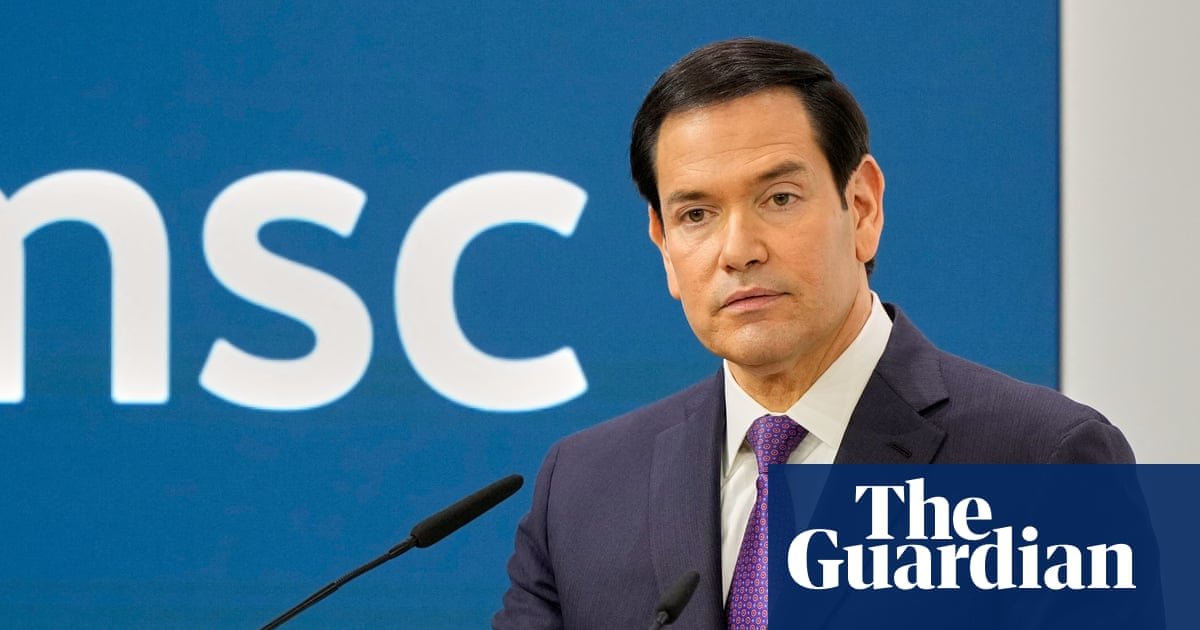
The US secretary of state, Marco Rubio, has described America as “a child of Europe” and made an emotional but highly conditional offer of a new partnership, insisting the two continents belong together.
In a much-anticipated speech at the annual Munich Security Conference, he said the US was intent on building a new world order, adding “while we are prepared, if necessary, to do this alone, it is our preference and it is our hope to do this together with you, our friends here in Europe”. The US and Europe, he said “belong together”.
Admitting the Americans may come across as a little direct and urgent, he said this was only because the US was profoundly concerned by the fate of Europe, and knew their destinies were intertwined.
Overall the tone of the speech was greeted with relief by the delegates in the hall, although many pointed out Rubio was not offering a partnership of equals, but an alliance largely framed in Donald Trump’s terms.
In offering the hand of friendship, in sharp contrast to the tone adopted by the US vice president, JD Vance, at the same conference last year, Rubio made clear the US was not shifting on its fundamental approach.
He said the US under Trump did not want a Europe that was weak or shackled by guilt or shame.
He continued: “We in America have no interest in being polite and orderly caretakers of the west’s managed decline. We do not seek to separate, but to revitalise an old friendship and renew the greatest civilisation in human history. What we want is a reinvigorated alliance that recognises that what has ailed our societies is not just a set of bad policies, but a malaise of hopelessness and complacency.”
He also tried to bind Europe into Trump’s ideology by saying Europe and the US had made the same mistakes together, including bowing down to “a climate cult”, expanding welfare states at the expense of national defence, embracing globalisation and “a world without borders in which everyone would be a citizen of the world”.
Gaining control of national borders was not an expression of xenophobia or hate, he said. “It is a fundamental act of national sovereignty. And the failure to do so is not just an abdication of one of our most basic duties owed to our people, it is an urgent threat to the fabric of our societies and the survival of our civilisation itself.”
He said in rebuilding the global order it would not be necessary to dismantle institutions such as the UN but to reform and rebuild them, arguing it had been Trump, not the UN, that was solving crises in Gaza and Ukraine.
“In a perfect world, all of these problems and more would be solved by diplomats and strongly worded resolutions. But we do not live in a perfect world. And we cannot continue to allow those who blatantly and openly threaten our citizens and endanger our global stability to shield themselves behind abstractions of international law which they themselves routinely violate.
“This is the path that President Trump and the United States has embarked upon. It is the path we ask you here in Europe to join us on.”
Rubio blamed “a foolish but voluntary transformation” of western economies that “left us dependent on others for our needs and dangerously vulnerable to crisis. Mass migration is not, was not, some fringe concern of little consequence. It was and continues to be a crisis which is transforming and destabilising societies all across the west.”
Throughout the speech he showered praise on Europe’s history, but in so doing raised questions whether Europe had the capacity to join the US’s rebuilding of the world.
He said little in his speech about Ukraine, after he skipped a meeting with European leaders on Friday night pointing to scheduling issues. But he said he believed the two sides had narrowed the items of difference, while the remaining issues were the hardest ones.
